Imagine opening a Bible map and seeing the ancient world spread before you. You notice Jerusalem, Galilee, Rome, Greece, and then a large region called Asia. It may look like the modern continent you know today, but the Bible uses the word in a different way.
So, what is the Asia map meaning in the Bible?
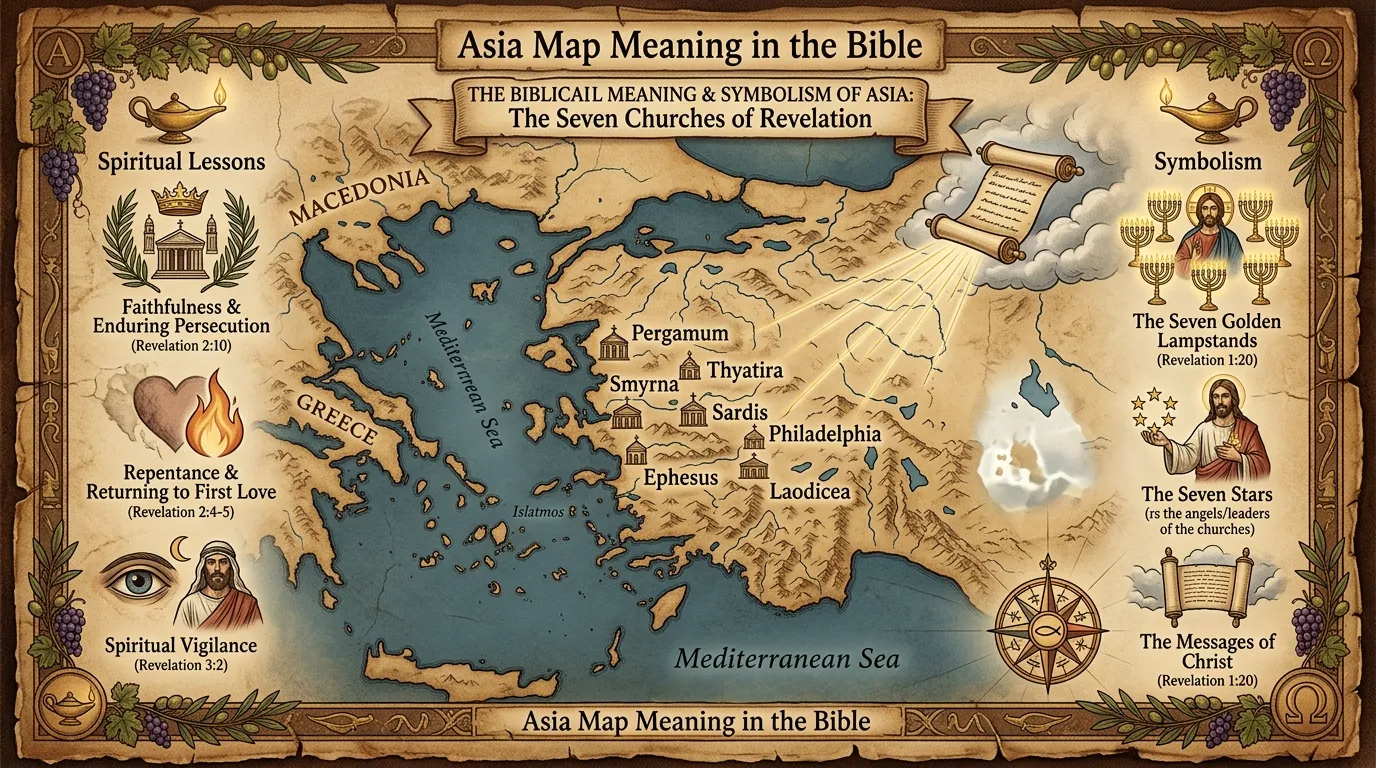
In Scripture, Asia usually refers to a Roman province in western Asia Minor, not the entire modern continent of Asia. This region became very important in the New Testament. Paul traveled through it, churches grew there, and the apostle John received messages for seven churches located there.
The map is more than a picture of places. When we study it with Scripture, it helps us see how the gospel moved from place to place and how God worked through ordinary people.
What Does Asia Mean in the Bible?
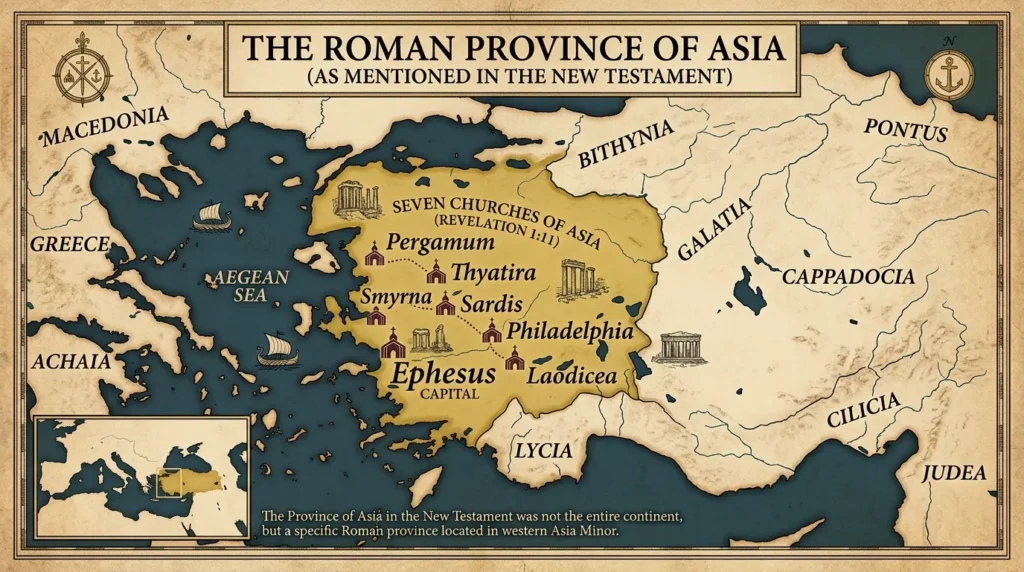
In the New Testament, Asia was a Roman province in the western part of Asia Minor, roughly corresponding to parts of modern-day western Turkey.
The Bible does not use “Asia” in the same broad sense that we use the word today. The modern continent includes countries such as China, India, Japan, Korea, and many others. Biblical “Asia” was a much smaller region.
The book of Acts mentions Asia several times. For example, Paul and his companions traveled through areas connected with the province of Asia during their missionary work.
Acts 19 gives one of the clearest pictures. Paul spent significant time in Ephesus, an important city in the province. His teaching became widely known, and Acts 19:10 says that all the residents of Asia heard the word of the Lord, both Jews and Greeks.
This shows something important: Asia was a major place for the spread of Christianity.
Asia Was a Real Place
The first meaning of Asia in the Bible is geographical.
It was not originally a secret spiritual code. It was a real region with real cities, roads, people, churches, and communities.
Important places connected with biblical Asia include:
- Ephesus
- Smyrna
- Pergamum
- Thyatira
- Sardis
- Philadelphia
- Laodicea
These cities appear especially in the opening chapters of Revelation.
Asia Map Meaning in the Bible Hebrew Meaning
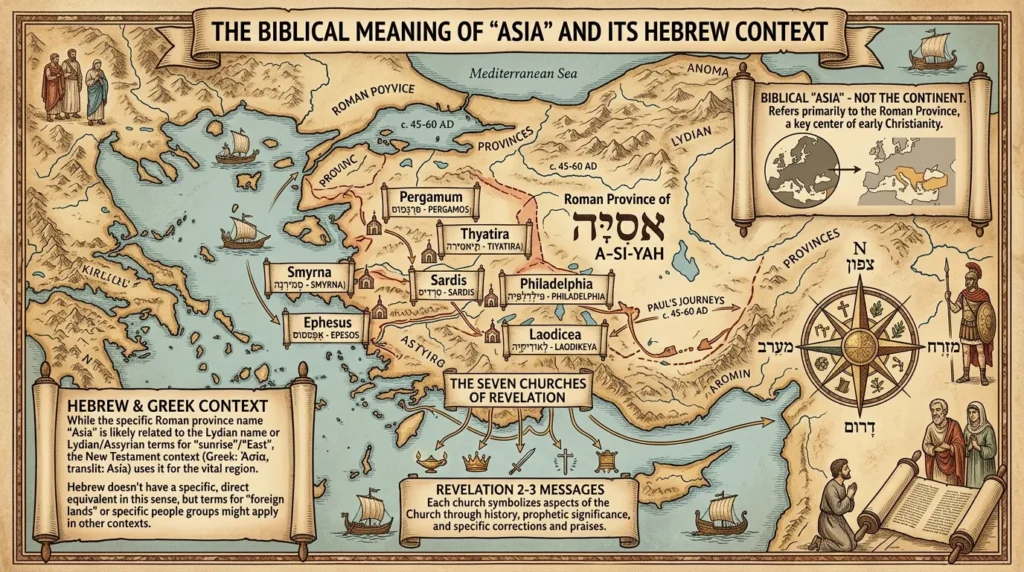
The phrase Asia map meaning in the Bible Hebrew meaning needs a small clarification.
The Old Testament was written mainly in Hebrew, but the New Testament passages about Asia were written in Greek. Therefore, there is no special Hebrew word in the Old Testament that directly means the Roman province of Asia in the New Testament.
The Greek word commonly translated Asia is Asia (Ἀσία).
In the New Testament, its meaning depends on context. It generally refers to the Roman province of Asia in western Asia Minor.
So, if you are looking for the Hebrew meaning of Asia, it is important not to invent a Hebrew spiritual meaning that Scripture does not provide.
The Bible’s strongest meaning comes from its historical and geographical context.
This distinction matters because biblical words should be understood according to how Scripture actually uses them.
Where Was Asia on the Bible Map?
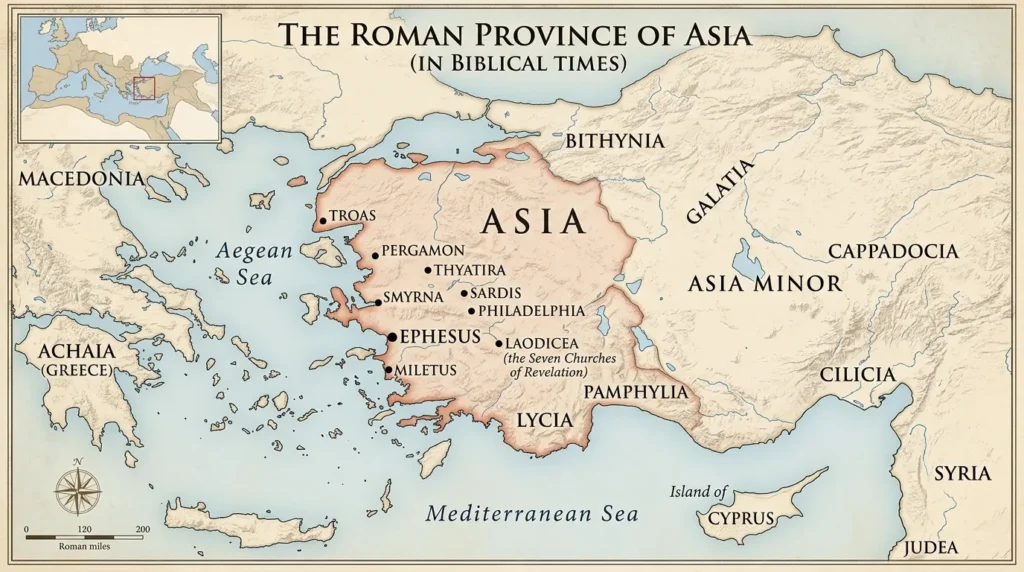
Biblical Asia was located in western Asia Minor, which is largely part of modern Turkey.
Its location placed it between important regions of the ancient Mediterranean world.
A simplified picture looks like this:
Greece → Aegean Sea → Asia Minor → Asia Province
Ephesus was one of the most important cities in this region. It had a strong economy, major trade routes, and a famous temple dedicated to Artemis.
Because of its location, Ephesus became an important center for Christian teaching.
Paul’s ministry there shows how one city could influence a much wider region.
Asia in the Book of Acts
The book of Acts gives us some of the clearest information about Asia.
Paul and the Province of Asia
Paul wanted to preach in certain areas during his missionary journeys. Acts 16:6 tells us that the Holy Spirit prevented Paul and his companions from preaching the word in Asia at that particular time.
This is a powerful lesson.
Paul had a good desire. He wanted people to hear about Jesus. Yet God redirected his plans.
A closed door is not always a rejection of you. Sometimes God is guiding you toward another assignment.
Later, Paul did minister extensively in Asia, especially in Ephesus.
This reminds us that God’s timing can be different from our timing.
The Gospel Spread Through Asia
Acts 19 describes Paul’s long ministry in Ephesus.
Paul taught in the city, and his ministry had a broad influence. Acts 19:10 says the word of the Lord spread throughout Asia.
This was not simply about one preacher standing before a crowd.
The gospel moved through people, homes, relationships, and communities.
A person who heard the message could carry it to someone else.
God can use one faithful witness to influence many lives.
Ephesus and the Biblical Meaning of Asia
Ephesus is especially important when studying an Asia map in the Bible.
Paul spent about two years teaching there according to Acts 19:10. His ministry became so influential that it affected the religious and economic life of the city.
The people of Ephesus had strong devotion to Artemis. When Christianity challenged the worship of false gods, a major disturbance followed.
Acts 19:23–41 records the riot connected with Demetrius, a silversmith whose business was threatened by the spread of Paul’s teaching.
This shows that the gospel can bring real change.
It can challenge old habits, false beliefs, and systems built around things other than God.
At the same time, Christians should respond with wisdom and humility.
Asia and the Seven Churches of Revelation
One of the most important connections between Asia and the Bible is found in Revelation.
Revelation 1:4 addresses seven churches that are in Asia.
These churches were:
- Ephesus
- Smyrna
- Pergamum
- Thyatira
- Sardis
- Philadelphia
- Laodicea
Jesus gave messages to each church in Revelation chapters 2 and 3.
The messages were different because each church had different strengths and weaknesses.
Ephesus: A Church That Needed Renewed Love
Jesus praised the church at Ephesus for its hard work, endurance, and rejection of false teaching.
But He also warned them because they had left their first love (Revelation 2:4).
The lesson is deeply personal.
It is possible to work hard for God while allowing our love for Him to grow cold.
Smyrna: Faith During Suffering
Jesus told the church at Smyrna about coming suffering but encouraged them to remain faithful.
Revelation 2:10 contains the well-known encouragement:
“Be thou faithful unto death, and I will give thee a crown of life.”
The church’s location on the map reminds us that Christian faith existed in real communities facing real pressure.
Pergamum: Holding to Faith
Jesus recognized that the believers in Pergamum remained faithful even in a difficult setting.
Yet He also corrected areas where compromise had entered.
The message is clear:
Faithfulness requires both courage and spiritual discernment.
Thyatira: Love, Faith, and Correction
Jesus praised Thyatira for its love, faith, service, and patience.
Yet the church also tolerated serious wrongdoing.
This teaches Christians that love does not mean ignoring sin.
Biblical love includes truth and correction.
Sardis: A Warning About Spiritual Sleep
The church at Sardis had a reputation for being alive, but Jesus said it was spiritually dead (Revelation 3:1).
This is a serious reminder that outward appearance does not tell the whole story.
God cares about the condition of the heart.
Philadelphia: An Open Door
The church at Philadelphia received encouragement because it had kept Christ’s word and had not denied His name.
Jesus spoke of an open door that no one could shut (Revelation 3:8).
For many Christians, this becomes a beautiful reminder that God can provide opportunities for faithful service.
However, Christians should avoid turning every open door into a guaranteed sign from God. Wisdom, prayer, Scripture, and wise counsel still matter.
Laodicea: A Call to Spiritual Zeal
The church at Laodicea was strongly corrected for being lukewarm.
Jesus called them to repentance and renewed zeal.
The message shows that Jesus cares about genuine devotion, not empty religious appearance.
What Does Asia Symbolize Spiritually?
The Bible does not say that Asia itself has one fixed spiritual symbol.
However, Christians can draw biblical lessons from what happened there.
These lessons should be treated as spiritual applications, not as secret meanings assigned to the geographical name.
Asia can remind us of:
- The spread of the gospel
- God’s guidance
- Faithfulness under pressure
- The need for repentance
- The importance of strong churches
- Cultural and spiritual transformation
- God’s work through ordinary believers
The strongest lesson is perhaps this:
God’s kingdom can grow even in places filled with opposition, false worship, and spiritual confusion.
Asia Map Meaning in a Dream
Some people search for the Asia map meaning in a dream, especially after seeing a map, country, city, or biblical location while sleeping.
The Bible does contain dreams and visions through which God sometimes communicated with people. Joseph, Daniel, and others received significant revelations.
However, Scripture does not teach that every modern dream has a prophetic message.
Therefore, if you dream about an Asia map, it is wise to be careful.
The dream might simply reflect something you recently read, watched, studied, or thought about.
If you believe a dream has spiritual significance, test it against God’s Word.
Ask:
- Does the interpretation agree with Scripture?
- Does it point me toward Christ?
- Does it encourage wisdom, repentance, love, and faith?
- Am I making assumptions that Scripture does not support?
- Could ordinary experiences or emotions explain the dream?
A dream should never become more authoritative than Scripture.
Seeing an Asia Map in Real Life: A Christian Perspective
Perhaps you saw an Asia map while studying the Bible. Maybe you are planning a trip, learning history, or reading about Paul’s missionary journeys.
You do not need to search for a hidden supernatural message.
Instead, allow the map to help you understand the biblical story more clearly.
For example, seeing Ephesus on a map can make Acts 19 feel more real.
You can imagine Paul teaching there, people responding to the gospel, and the Christian message spreading beyond one gathering.
This can strengthen your appreciation for the historical reality of the New Testament.
What Can Christians Learn From Asia?
The biblical story of Asia offers several practical lessons.
God Can Redirect Our Plans
Paul wanted to preach in Asia at one point, but Acts 16:6 says the Holy Spirit prevented him.
Later, God opened opportunities for Paul in the region.
When your plans change, do not immediately assume that everything has gone wrong.
Pray.
Seek wisdom.
Stay faithful.
God may be leading you somewhere you did not expect.
The Gospel Is Meant to Spread
The message reached many people across Asia.
This reminds Christians that faith is not meant to remain hidden.
You can share God’s love through:
- A kind conversation
- Helping someone in need
- Praying for a friend
- Encouraging someone who feels discouraged
- Serving at church
- Living honestly at work
- Showing grace when others expect anger
You do not need a platform to be a faithful witness.
Churches Need Spiritual Health
The seven churches in Revelation were not perfect.
Jesus praised some things and corrected others.
That is important for Christians today.
A healthy church is not simply a busy church. It should be a place where people pursue truth, love, holiness, repentance, service, and faith in Christ.
God Sees What People Cannot See
The churches of Revelation had public reputations.
But Jesus knew their true spiritual condition.
That gives us a personal question:
Am I only looking faithful on the outside, or am I growing closer to Christ on the inside?
This is not meant to create fear.
It is an invitation to honest faith.
Asia in the Bible and God’s Mission
When you look at the Asia map in the Bible, you are looking at a region where the early Christian movement took root and spread.
Paul’s ministry in Ephesus was important, but Paul was not the hero of the story.
God was the One who gave the growth.
This agrees with Paul’s teaching in 1 Corinthians 3:6–7. Paul planted, Apollos watered, but God gave the increase.
That principle still matters today.
A parent may teach a child about Jesus.
A Sunday school teacher may encourage one student.
A pastor may preach a sermon.
A friend may share a simple word of hope.
We may never know how God uses those small acts.
Frequently Asked Questions
What does Asia mean in the Bible?
In the New Testament, Asia generally refers to the Roman province of Asia in western Asia Minor, largely located in what is now Turkey. It does not normally mean the entire modern continent of Asia.
Where was biblical Asia located?
Biblical Asia was in western Asia Minor. Important cities in the region included Ephesus, Smyrna, Pergamum, Thyatira, Sardis, Philadelphia, and Laodicea.
Why is Asia important in the Bible?
Asia was important because the gospel spread throughout the region. Paul had a major ministry in Ephesus, and seven churches in Asia received messages from Jesus in Revelation chapters 2 and 3.
Is Asia a symbol in the Bible?
Scripture does not give Asia one fixed symbolic meaning. Christians may draw spiritual lessons from events in the region, such as gospel growth, faithfulness, repentance, and God’s guidance, but these are applications rather than explicit biblical symbols.
What does an Asia map mean in a dream?
There is no universal biblical interpretation for dreaming about an Asia map. The dream may reflect personal memories, Bible study, travel, or other experiences. If you believe it has spiritual meaning, test the interpretation against Scripture rather than treating the dream as certain revelation.
What is the Hebrew meaning of Asia?
The New Testament term for Asia comes from Greek, not Hebrew. The Greek Asia referred to the Roman province of Asia. Therefore, it is better to understand the biblical term through its historical and New Testament context than to assign it an invented Hebrew spiritual meaning.
What can Asia teach Christians today?
Asia can remind believers that God can spread the gospel through ordinary people, guide us when plans change, strengthen churches during hardship, and call His people back to faithful devotion.
Final Thoughts
The Asia map meaning in the Bible becomes much clearer when we look at Scripture and history together.
Biblical Asia was a real region in western Asia Minor. It was home to important cities where the gospel was preached, churches were established, and believers faced both opportunities and opposition.
Paul’s ministry in Asia shows us that God can use faithful people to reach many others.
The seven churches in Revelation show us that Jesus cares deeply about the spiritual health of His people. He encourages faithfulness, corrects compromise, calls people to repentance, and offers hope.
If you see an Asia map while studying Scripture, let it deepen your understanding of God’s Word rather than searching for a hidden code.
And if an Asia map appears in a dream, pray for wisdom and test every interpretation against Scripture.
Above all, remember the central message: God is faithful, Christ is Lord, and His purposes do not depend on our ability to understand everything.
When your path feels unclear, pray.
When your plans change, trust God.
When your faith feels weak, return to His Word.
And when you wonder where He is leading you next, take the next faithful step with confidence that God’s grace is sufficient and His guidance can be trusted.