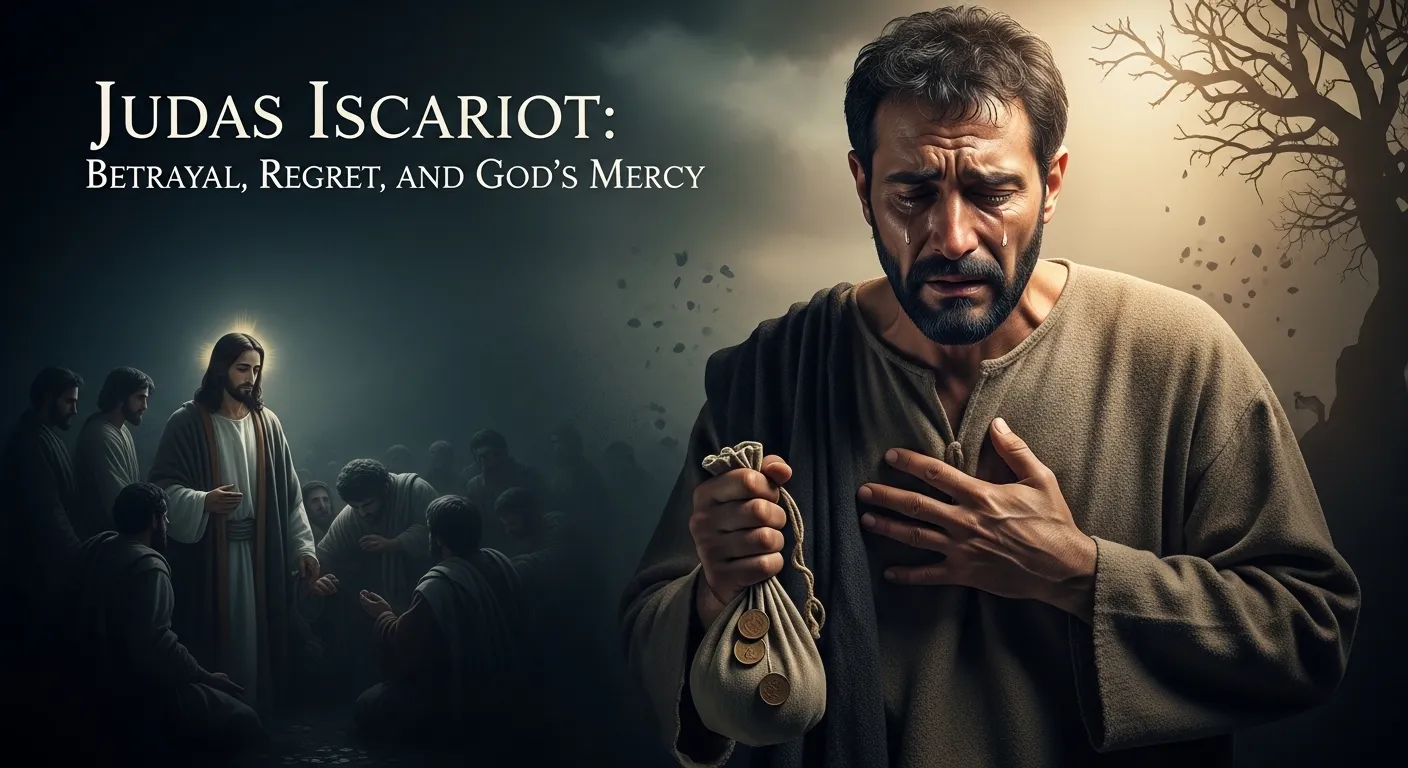
Every tragedy needs a final act that redefines everything before it, and the Gospels give Judas Iscariot one of the most devastating in all literature. A man walks with Jesus for three years. He hears the Sermon on the Mount with his own ears. He watches blind eyes open and dead men walk. He carries the group’s money. And then, in a garden at night, he kisses his teacher — the agreed signal — and hands Him to the soldiers for thirty pieces of silver. The meaning of Judas Iscariot in the Bible is not a riddle to be solved but a tragedy to be understood, because its warning is aimed at every reader who has ever been close to Jesus and felt the slow drift begin.
The Gospels tell his story in what reads like four movements, each one darker than the last. Taken together, they form Scripture’s most thorough anatomy of how a person can be near Christ and still be lost — and its most urgent call to examine the direction of one’s own heart while there is still time.
First Movement: The Trusted Treasurer
Judas begins as an insider, and the Gospels are careful to establish this. He is one of the Twelve — chosen by Jesus after a night of prayer (Luke 6:12–16), sent out with the others to preach and heal (Matthew 10:1–4), present at the feeding of the five thousand and the walking on water. He is not a fringe hanger-on. He is trusted enough to hold the money bag for the whole group.
That detail, dropped almost casually by John, is the first crack of light into his interior life: “he was a thief; as keeper of the money bag, he used to help himself to what was put into it” (John 12:6). The pilfering was small, private, and ongoing — the kind of sin that never makes headlines and slowly hollows out the conscience. When Mary anoints Jesus’ feet with expensive perfume, Judas objects with impeccable-sounding theology — “Why wasn’t this perfume sold and the money given to the poor?” (John 12:5) — and John tells us the piety was camouflage for the theft. This is the first movement’s lesson, and it is aimed squarely at religious people: the most dangerous sins are not the dramatic ones but the small, repeated, well-rationalized ones that teach the heart to live a double life.
It also establishes something theologians have wrestled with for centuries: proximity is not transformation. Judas had the best discipleship program in history — three years of daily, personal instruction from Jesus Himself — and it did not save him. Church attendance, Bible knowledge, ministry involvement: none of these are the same as a surrendered heart. Judas proves it by negative example, which is why his story frightens honest believers in a healthy way.
Second Movement: The Bargain
“Then one of the Twelve — the one called Judas Iscariot — went to the chief priests and asked, ‘What are you willing to give me if I deliver him over to you?'” (Matthew 26:14–15). The cold commercialism of the question is chilling. He names his own price for the Son of God, and the priests count out thirty pieces of silver — the compensation price for a slave gored by an ox (Exodus 21:32), and the exact sum Zechariah had prophesied centuries earlier (Zechariah 11:12–13).
What drove him? The Gospels suggest a convergence rather than a single cause. Greed is named explicitly — Paul’s later warning that “the love of money is a root of all kinds of evil” (1 Timothy 6:10) reads like a commentary on Judas. But there are hints of something else: disillusionment. Judas may have followed a Messiah he expected to overthrow Rome, and watched instead as Jesus talked about dying. Satan’s entry is named too — “Satan entered Judas” (Luke 22:3; John 13:27) — which Scripture presents not as possession overriding his will but as the spiritual reality behind a heart that had already opened the door, coin by coin, disappointment by disappointment.
The Last Supper scene is the tragedy’s unbearable center. Jesus, knowing everything, washes Judas’s feet along with the others (John 13). He offers him the dipped morsel — a gesture of honor and friendship in that culture. He says, “What you are about to do, do quickly” (John 13:27). And John adds the four words that have haunted readers for two thousand years: “And it was night” (John 13:30). Physical night, spiritual night — the darkness Judas had been choosing in small installments had finally become total.
Third Movement: The Remorse That Came Too Late
Here the story takes its most misunderstood turn. When Judas sees that Jesus is condemned, he is “seized with remorse” (Matthew 27:3). He brings the silver back. He confesses — to the wrong audience — “I have sinned, for I have betrayed innocent blood” (Matthew 27:4). The priests shrug: “What is that to us? That’s your responsibility.” So he throws the coins into the temple and goes out and hangs himself (Matthew 27:5).
Readers often miss how much genuine feeling is in this scene — and how much is missing. Judas felt remorse, but remorse is not repentance. The Greek word Matthew uses suggests regret over consequences, not the turning-toward-God that the New Testament calls repentance. Contrast him with Peter, who also betrayed Jesus that same night — three times, with curses. Peter “wept bitterly” (Luke 22:62), but Peter’s tears drove him back toward Christ, and after the resurrection Jesus restored him with three questions and three commissions (John 21:15–19). Judas’s tears drove him away from Christ, toward the priests who could not absolve him, and finally toward the rope.
The difference between the two betrayers is the whole Gospel in miniature. Peter sinned greatly and ran to Jesus. Judas sinned greatly and ran from Him. One found that failure is not final; the other concluded — wrongly, tragically — that his sin was bigger than God’s mercy. Despair, not betrayal, was Judas’s final sin. It is the one sin that cannot be forgiven, not because God refuses, but because the despairing heart stops asking.
The Thirty Pieces and the Field of Blood
Matthew’s account adds a detail that deepens the tragedy into prophecy. When Judas threw the silver into the temple, the priests — scrupulous about blood money but not about blood — used it to buy “the potter’s field as a burial place for foreigners” (Matthew 27:7). Matthew sees Zechariah’s prophecy fulfilled: the thirty pieces, “the handsome price at which they valued me,” thrown “to the potter” in the house of the Lord (Zechariah 11:13). The precise sum Judas bargained for became the precise sum prophecy named, centuries before he was born.
Luke’s account in Acts adds the field’s grim nickname: Akeldama, “Field of Blood” (Acts 1:19). Peter, preaching at Pentecost, treats Judas’s end as Scripture fulfilled — “the Scripture had to be fulfilled… concerning Judas” (Acts 1:16), citing Psalms 69 and 109. The early church did not tiptoe around the story. They preached it as evidence: God’s plan had accounted for the betrayal before the betrayer was born, and the betrayer’s choices were still his own. The field outside Jerusalem remained for generations as a mute monument to the price of selling Christ — and to the terrible precision with which God writes straight with crooked lines.
Fourth Movement: The Warning
Jesus Himself gives the tragedy’s epitaph: “It would be better for him if he had not been born” (Matthew 26:24). And yet — in the same breath — “The Son of Man will go just as it is written about him.” The cross needed no one’s permission. God’s plan was never hostage to Judas’s choice, which is why the betrayal, while fully Judas’s responsibility, could not derail redemption. Divine sovereignty and human responsibility meet at the cross without canceling each other, and Judas stands at the intersection as Scripture’s starkest proof of both.
So what does Judas mean for the reader? Not “don’t be like Judas” as a slogan — but a set of examinations, each one personal. Examine the small compromises. The money bag came before the betrayal. What is your money bag — the private habit, the rationalized sin, the area where your public faith and private life have quietly diverged? Examine your expectations of Jesus. If you are following Christ for what He can do for your plans, disillusionment is already growing. Examine where you run with guilt. Toward Him, like Peter — or away, like Judas? The priests could not help Judas, and no human audience for your confession ever can. Only Christ can, and He is still saying what He said to Peter on the beach: “Follow me” (John 21:19).
There is a final mercy hidden in this darkest of stories, and it belongs to every reader who has failed badly. Peter’s restoration proves that betrayal is not the unforgivable sin — despair is, and despair is a lie. However far the drift has gone, the distance back is one turn. The same Jesus who washed the betrayer’s feet still washes feet today. For the historical and traditional background — the theories about the name Iscariot, the thirty pieces of silver, and how the church has remembered him — the Wikipedia article on Judas Iscariot gathers the scholarship and the centuries of interpretation in one place.