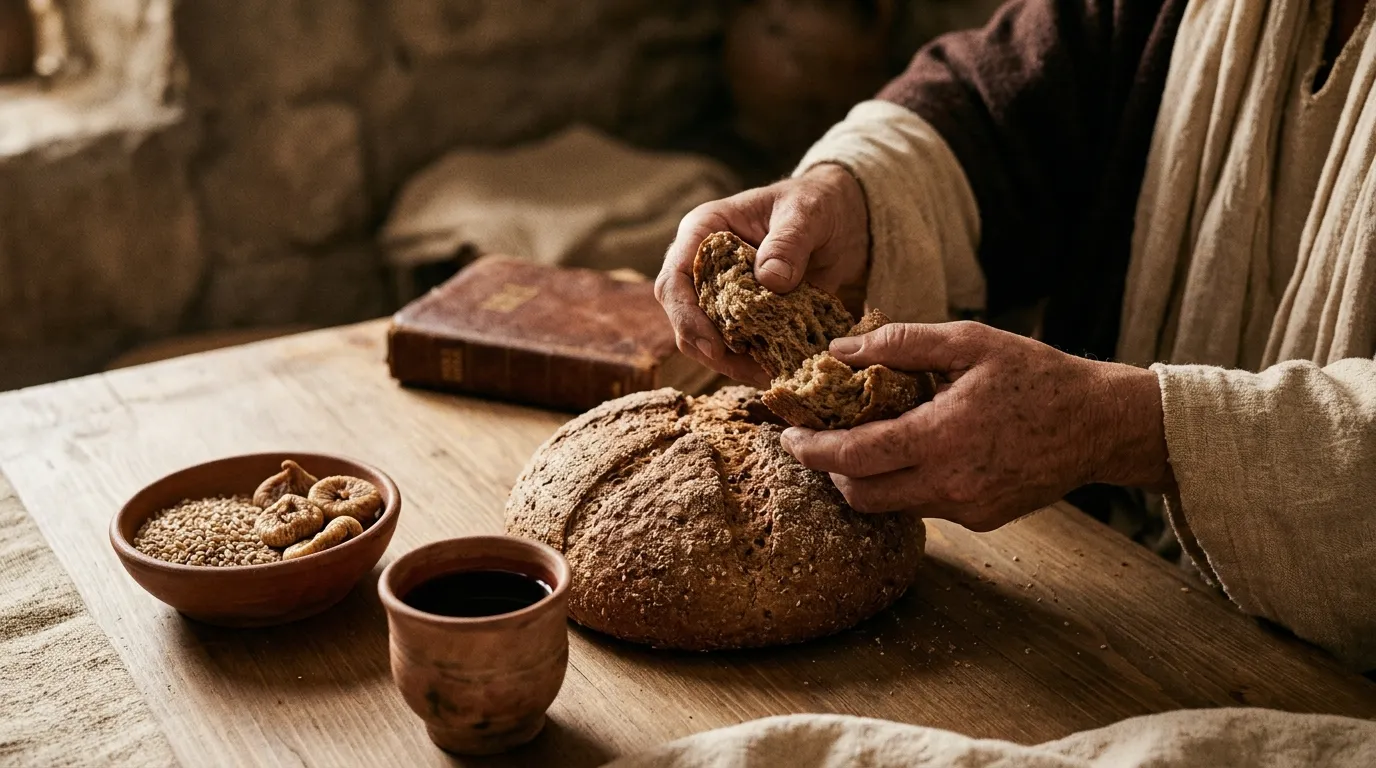
It started with a boy’s lunch. A crowd of thousands had followed Jesus to a remote hillside, the day was fading, and the disciples were doing anxious arithmetic about how to feed everyone. Then Andrew found a boy — unnamed, uncelebrated — carrying five barley loaves and two small fish (John 6:9). That ordinary packed lunch became the raw material of one of the most famous miracles in history. When Scripture talks about bread, it often starts exactly like this: with something small, daily, and easily overlooked — and then shows you that heaven has been paying attention to it all along.
Bread is the Bible’s most ordinary miracle. It appears in the wilderness and in the upper room, in a widow’s jar and on an altar, in a prayer Jesus taught and in a parable He told. It feeds bodies, and then it keeps going — feeding the soul, picturing the Savior, and binding a scattered people into one body. To trace bread through Scripture is to watch God turn the most common thing on the table into one of His deepest lessons.
The Bread That Fell from Nowhere
Israel learned the theology of bread in a desert where no bread could grow. Six weeks out of Egypt, the whole congregation was grumbling about empty stomachs, and God answered with something the world had never seen: “I will rain down bread from heaven for you” (Exodus 16:4). Every morning the ground glittered with manna — fine as frost, tasting, they said, like wafers made with honey (16:31).
The miracle was only half the lesson. The rules were the other half. Gather only what you need for the day. Keep none till morning — it would breed worms (16:19-20). On the sixth day gather double, because the seventh day would bring none. The manna trained a slave people in something they had never practiced: daily dependence. Yesterday’s bread could not be hoarded; tomorrow’s bread could not be secured. Each morning required fresh trust. As Moses would later preach, God fed them manna “that he might make you know that man does not live by bread alone, but man lives by every word that comes from the mouth of the LORD” (Deuteronomy 8:3).
There is a quiet rebuke in the manna for every anxious heart. The Israelites did not manufacture their provision, negotiate it, or deserve it. They gathered it — stooping each morning to receive what grace had left overnight. Much of the Christian life is still just that: waking up, going out with empty hands, and finding that the Father has already been at work before we rose.
The Bread That Multiplied
Centuries later, on that hillside, Jesus took the boy’s five loaves, “gave thanks,” and distributed them — and the fragments filled twelve baskets (John 6:11-13). He did it again for four thousand (Mark 8:1-9). The crowds, predictably, wanted to make Him king by force — a bread-king who would end hunger forever (John 6:15). Jesus withdrew. Then, in the synagogue at Capernaum, He told them what the miracle had actually meant.
“I am the bread of life; whoever comes to me shall not hunger, and whoever believes in me shall never thirst” (John 6:35). The manna had been a picture; He was the reality. The fathers ate manna and died, He said — but this bread gives life to the world (6:49-51). Many disciples found the teaching too hard and walked away (6:66). The miracle that drew the crowd became the sermon that thinned it. Bread that only fills the stomach will always disappoint; the Bread that fills the soul demands everything.
There is tenderness here too, worth noticing. Jesus did not begin with the sermon. He began with the lunch — feeding hungry people because they were hungry, before preaching to them because they were lost. The God of the Bible cares about empty stomachs and empty souls, in that order, on that day. Compassion first, then the call. The church forgets this sequence at its peril.
The Bread on the Table of Presence
Long before the hillside, bread had a permanent address in Israel’s worship. Inside the tabernacle stood the table of showbread — twelve loaves, in two rows, set before the LORD “regularly”, renewed every Sabbath (Leviticus 24:5-8; Exodus 25:30). Week after week, year after year, fresh bread sat in God’s presence, representing the twelve tribes: the whole people, continually before the face of God, sustained by Him and presented to Him.
Those loaves were holy — reserved for the priests. Which is why David’s desperate act is so revealing. Fleeing Saul, starving, he came to the priest at Nob and was given the consecrated bread to eat (1 Samuel 21:1-6). Jesus Himself cited the incident when His disciples were criticized for picking grain on the Sabbath: human need, He argued, was never meant to be crushed by ritual — “the Sabbath was made for man, not man for the Sabbath” (Mark 2:27). The bread of the Presence teaches two truths at once: God wants His people continually before Him, and His mercy bends toward the hungry rather than away from them.
There is another, smaller bread story that belongs here — the widow of Zarephath, down to her last handful of flour and a little oil, gathering sticks to bake a final meal for herself and her son (1 Kings 17:12). Elijah’s outrageous request — feed me first — was met with a miracle: “the jar of flour was not spent, neither did the jug of oil become empty” (17:16). The God of the showbread is also the God of the widow’s jar. Scarcity is never the last word where He is invited to the table.
The Bread That Was Broken
On the night He was betrayed, Jesus took bread — the same ordinary staple — and did what hosts had done for centuries: He “took bread, and when he had given thanks, he broke it” (Luke 22:19). But then He redefined it forever: “This is my body, which is given for you. Do this in remembrance of me.” The bread that had pictured God’s provision, the Bread of Life’s own claim, now became the memorial of His broken body.
Paul would later warn the Corinthians that this meal was no casual snack: “whoever… eats the bread or drinks the cup of the Lord in an unworthy manner will be guilty concerning the body and blood of the Lord” (1 Corinthians 11:27). Yet in the same letter he gives the bread its most beautiful communal meaning: “Because there is one bread, we who are many are one body, for we all partake of the one bread” (1 Corinthians 10:17). One loaf, broken and shared — many people, made one. The table that remembered Christ’s broken body became the place where His scattered body was mended.
And then there is Emmaus. Two disciples, walking home crushed by the crucifixion, unknowingly hosted the risen Jesus — and “he was known to them in the breaking of the bread” (Luke 24:35). Their hearts had burned on the road while He opened the Scriptures (24:32), but recognition came at the table. It still does. Many believers can trace their deepest encounters with Christ not to a sermon or a vision but to an ordinary table where bread was broken and, suddenly, He was there.
The Bread We Pray For
It is no accident that the only food item in the Lord’s Prayer is bread: “Give us this day our daily bread” (Matthew 6:11). Jesus tucked the whole manna theology into six words. Give — it is received, not earned. Us — it is shared, not hoarded. This day — it is daily, not stockpiled. Daily bread — it is enough, not excess. The prayer Jesus taught His followers to pray every day is, at its center, a prayer to relearn the wilderness lesson: trust the Father for today, and let tomorrow belong to Him.
And the Bible’s bread story does not end at our tables. It ends at His. The prophets and the apostles alike look forward to a final feast — “a feast of rich food for all peoples” (Isaiah 25:6), the marriage supper of the Lamb (Revelation 19:9), where the blessed will “eat bread in the kingdom of God” (Luke 14:15). From manna in the desert to the supper of the Lamb: the whole story of redemption can be told as the story of a God who keeps setting a table for His people — in the wilderness, in the upper room, in the breaking of bread house to house (Acts 2:46), and finally in the kingdom that has no end.
So the next time bread appears — in your hands at the table, in a prayer, in a quiet moment of need — remember the boy’s lunch, the widow’s jar, the showbread’s twelve loaves, the broken loaf at Emmaus. It was never just food. It was always a sermon: God provides, Christ satisfies, and the table is bigger than you think. For the long human history of this simplest of foods — how it is made, shared, and revered across cultures — Wikipedia’s article on bread offers a fascinating companion to the biblical portrait traced here.










