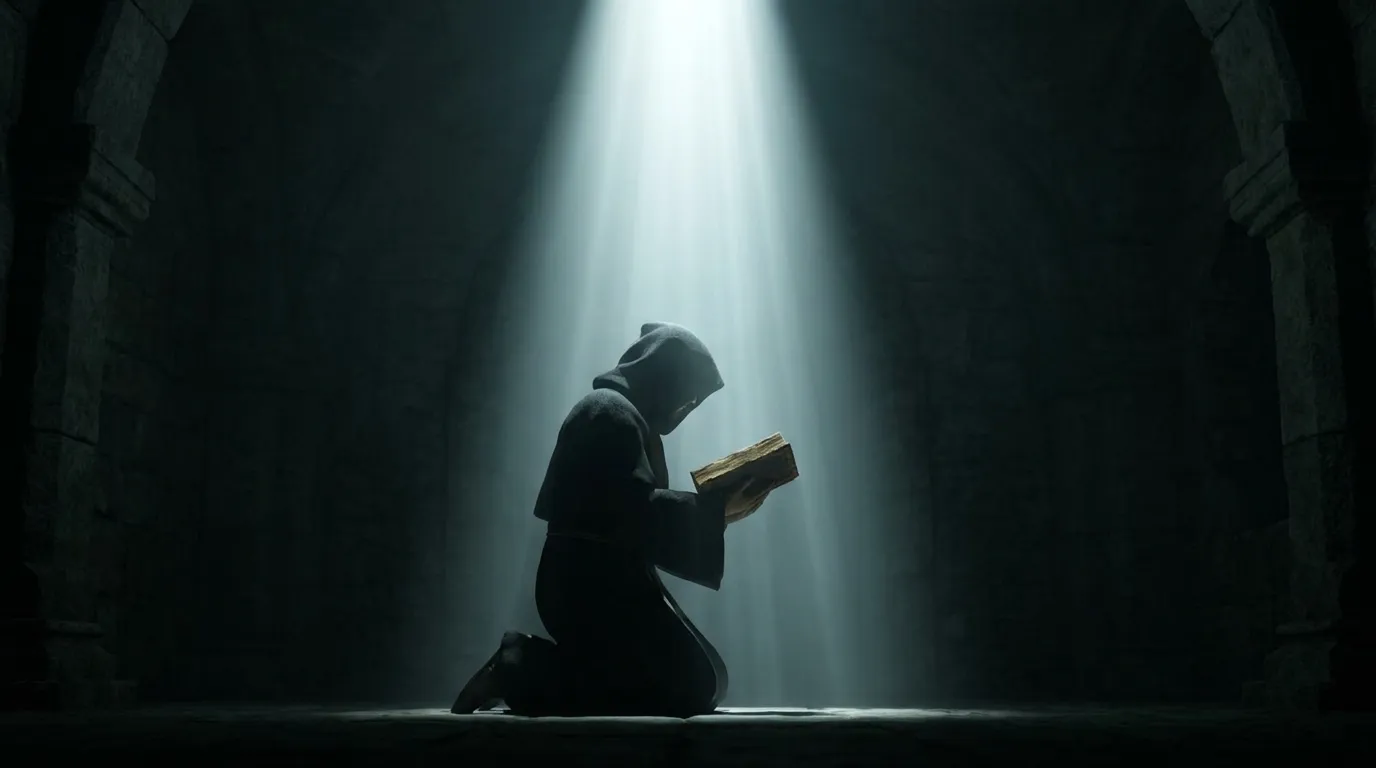
It was past midnight in a Philippian jail, and the jailer was about to kill himself. An earthquake had shaken the prison, the doors stood open, the chains had fallen — and he assumed his prisoners had fled, which under Roman law meant his own execution. Then a voice called out of the dark: “Do not harm yourself, for we are all here” (Acts 16:28). Trembling, the jailer fell before Paul and Silas and asked the most honest question in the entire Bible: “Sirs, what must I do to be saved?” (16:30).
No theological polish. No hedging. A frightened man, a direct question, in the dark. And the answer came back just as direct: “Believe in the Lord Jesus, and you will be saved, you and your household” (16:31). That midnight exchange is the whole doctrine of salvation in miniature — the question every searching heart eventually asks, and the answer Scripture never changes. If you have ever lain awake wondering whether you are truly right with God, you are standing exactly where the jailer stood. Here is what the Bible says to you.
The Question Behind the Question
“What must I do to be saved?” is really several questions wearing one coat. Am I in danger? Yes — the Bible is frank that sin separates people from a holy God (Isaiah 59:2), and that “the wages of sin is death” (Romans 6:23). Can I fix it myself? No — and this is where Christianity parts ways with every religion of self-improvement. “For by grace you have been saved through faith. And this is not your own doing; it is the gift of God, not a result of works, so that no one may boast” (Ephesians 2:8-9). Does God actually want me? That is the question beneath all the others, and the Bible answers it with a shout: “For God so loved the world, that he gave his only Son, that whoever believes in him should not perish but have eternal life” (John 3:16).
Notice what the jailer’s question assumes and what Paul’s answer supplies. The jailer assumed salvation was something he must do. Paul redirected him to Someone he must trust. That redirection — from doing to trusting, from our performance to Christ’s finished work — is the hinge on which the whole Bible turns. Salvation is not a wage to be earned but a rescue to be received.
Believe: The Open Door
The first and foundational answer Scripture gives is believe. Jesus said it to a religious scholar sneaking through the night: “whoever believes in him should not perish but have eternal life” (John 3:16). Paul said it to the jailer (Acts 16:31). John wrote his entire Gospel so that readers “may believe that Jesus is the Christ, the Son of God, and that by believing you may have life in his name” (John 20:31).
But biblical belief is more than mental agreement. The demons believe that God is one — and shudder (James 2:19). Saving faith is trust: the leaning of the whole weight of the soul on Christ, the way a drowning person leans on the rescuer. It believes three things at once — that Jesus is who He claimed to be (the Son of God), that He did what Scripture says He did (died for sins and rose again), and that His work is for me, personally. “To all who did receive him, who believed in his name, he gave the right to become children of God” (John 1:12). Receiving, not merely admiring. Trusting, not merely agreeing.
And belief is never a private transaction that leaves life untouched. The same Paul who told the jailer to believe also wrote that faith “working through love” is what counts (Galatians 5:6). True faith always walks out of the prison — which brings us to the second word.
Repent: The Turned Life
On the day of Pentecost, when the crowd cried out “what shall we do?” — the jailer’s question in different words — Peter answered: “Repent and be baptized every one of you in the name of Jesus Christ for the forgiveness of your sins” (Acts 2:37-38). Repentance is the other side of the coin of faith: faith turns to Christ; repentance turns from sin. You cannot do one without the other, any more than you can turn toward the sunrise without turning your back on the sunset.
Repentance is not merely feeling sorry. Judas felt sorry (Matthew 27:3-5) — and it led him to a field and a rope. Peter repented — and it led him to a beach, a breakfast, and a recommissioning (John 21). The difference is direction: remorse looks at the sin and despairs; repentance looks at Christ and returns. “Repent therefore, and turn back, that your sins may be blotted out” (Acts 3:19). The image is of ink wiped from a ledger — sins not merely forgiven but erased.
This is also where honesty matters most. Repentance names the sin — not “mistakes were made” but “I have sinned.” David’s great repentance psalm begins “Have mercy on me, O God” and then refuses to hide: “my sin is ever before me. Against you, you only, have I sinned” (Psalm 51:1-4). God cannot forgive what we will not confess. But “if we confess our sins, he is faithful and just to forgive us our sins and to cleanse us from all unrighteousness” (1 John 1:9) — faithful, just, and all. No exceptions, no fine print.
Confess: The Spoken Allegiance
“If you confess with your mouth that Jesus is Lord and believe in your heart that God raised him from the dead, you will be saved” (Romans 10:9). In the Roman world, “Jesus is Lord” was a treasonous sentence — Caesar claimed that title. Confession was the public break with every other allegiance. It still is. Saving faith refuses to stay silent; it declares its King.
This is why baptism follows belief throughout the book of Acts — not as the price of salvation but as its uniform. The Ethiopian eunuch, reading Isaiah in his chariot, understood the gospel Philip preached and immediately asked: “See, here is water! What prevents me from being baptized?” (Acts 8:36). Philip’s condition was simple: “If you believe with all your heart, you may” (8:37). The jailer was baptized “the same hour of the night” (16:33). Three thousand on Pentecost were baptized the same day (2:41). In every case the order is identical: hear, believe, repent, confess — and the water is the wedding ring, not the wedding.
The Thief’s Short Road
Someone will object: what about the person with no time for all this — no baptism, no church attendance, no life of good works ahead? Scripture has already answered, from a cross. The criminal dying beside Jesus had exactly one conversation with the Savior: “Jesus, remember me when you come into your kingdom.” And Jesus answered: “Truly, I say to you, today you will be with me in paradise” (Luke 23:42-43).
No baptism. No communion. No restitution, no reform, no religious résumé. Just a condemned man, a confession of Christ’s kingship, and a plea for remembrance — and it was enough. The thief is the Bible’s standing rebuke to every version of salvation-by-achievement. He proves that the door is as wide as faith and as narrow as Christ: wide enough for a dying criminal with minutes to live, narrow enough that no one enters except through Jesus, who said “I am the way, and the truth, and the life. No one comes to the Father except through me” (John 14:6).
What Salvation Is Not
Because the stakes are eternal, Scripture is careful to say what salvation is not:
It is not inherited. “To all who did receive him… he gave the right to become children of God, who were born, not of blood nor of the will of the flesh nor of the will of man, but of God” (John 1:12-13). God has children; He has no grandchildren. A Christian home is a blessing, not a birthright.
It is not postponed. “Behold, now is the favorable time; behold, now is the day of salvation” (2 Corinthians 6:2). And the warning alongside the invitation: “Today, if you hear his voice, do not harden your hearts” (Hebrews 3:15). The jailer did not schedule a follow-up; he believed that night.
It is not uncertain. John wrote his first letter so that believers “may know that you have eternal life” (1 John 5:13) — know, not guess. Assurance rests not on the perfection of our faith but on the perfection of Christ’s work. The question is never “did I believe hard enough?” but “is Christ trustworthy enough?” — and He is.
The Life After the Rescue
Salvation is a moment — the jailer’s midnight — and then it is a direction. “Therefore, if anyone is in Christ, he is a new creation. The old has passed away; behold, the new has come” (2 Corinthians 5:17). The rescued life looks different: the jailer washed the apostles’ wounds and fed them (Acts 16:33-34) — the first fruits of a changed heart were kindness. Zacchaeus repaid what he had stolen (Luke 19:8). The Ephesian converts burned their magic books (Acts 19:19).
None of this earns the rescue. It proves it — the way a healed leg proves the surgery worked, by walking. “We are his workmanship, created in Christ Jesus for good works, which God prepared beforehand, that we should walk in them” (Ephesians 2:10). Grace first, works after; rescue first, then the rescued life. Get the order wrong and you get either pride or despair. Get it right and you get gratitude — the engine of every genuine Christian life.
So here is the Bible’s answer, midnight-simple: you are in danger, you cannot save yourself, Christ has done everything, and the door stands open. Believe in the Lord Jesus. Turn from your sin. Confess Him openly. The jailer asked in the dark and walked out into the light rejoicing — “he rejoiced along with his entire household that he had believed in God” (Acts 16:34). That joy is still on offer, tonight, to everyone who asks his question with his honesty. For the broader history of how Christians have understood this rescue across the centuries, Wikipedia’s article on salvation in Christianity surveys the major traditions — a useful map of the territory this article has walked through Scripture.










