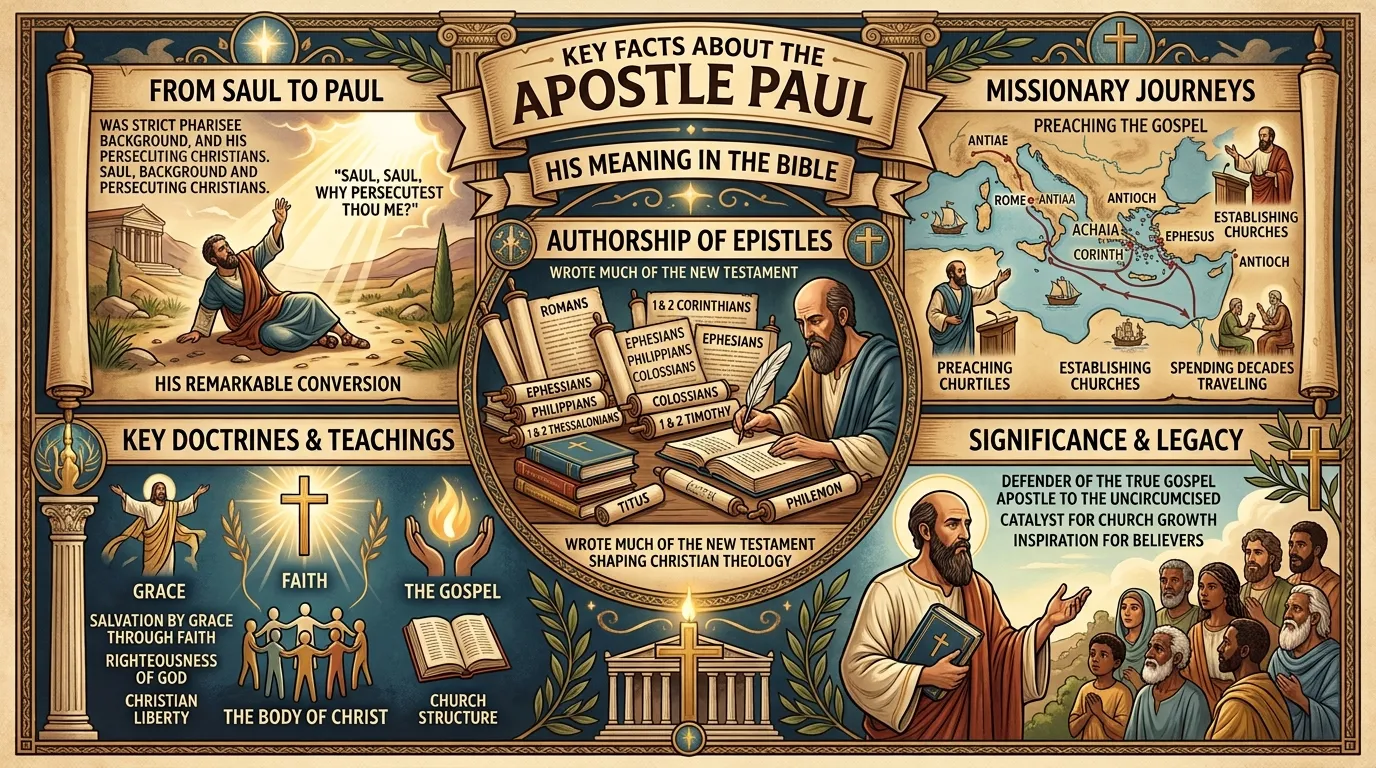
Paul is one of the most studied figures in history, and for good reason: he wrote a large share of the New Testament, planted churches across the Roman world, and shaped Christian theology more than any writer besides Jesus Himself. Yet the facts about Paul are often flattened into a single dramatic moment — the blinding light on the Damascus road — as if his life were one scene. The real story is longer, harder, and richer. It is a life of turning points, each one reshaping what came before.
This article walks through those turning points in order. Rather than a list of trivia, it follows the arc of a man who was changed, then spent the rest of his life carrying that change to others — at great personal cost.
Turning Point 1: A Pharisee Trained to the Highest Standard
Paul was born in Tarsus, a respected city in Cilicia, and raised as a Jew of the tribe of Benjamin. He introduces himself in Philippians 3:5 as “circumcised on the eighth day, of the people of Israel, of the tribe of Benjamin, a Hebrew of Hebrews; in regard to the law, a Pharisee.” He studied in Jerusalem under Gamaliel, one of the most honored teachers of his day (Acts 22:3). He was a Roman citizen by birth — a rare privilege that would later shape his ministry and protect his life.
Paul’s training mattered because it explains both his zeal and his later theology. He knew the Scriptures deeply. He understood the law from the inside. When he later wrote that righteousness does not come through the law but through faith in Christ, he was not dismissing something he had never tried. He was describing something he had pursued with everything he had — and found wanting. His background also gave him tools: fluency in Greek, familiarity with Jewish debate, and the ability to argue Scripture with rabbis and philosophers alike.
Turning Point 2: The Persecutor
Before Paul was a missionary, he was a persecutor. He first appears in Acts at the stoning of Stephen, where he is called Saul and is described as guarding the coats of those who threw the stones (Acts 7:58). Acts 8:3 says he “began to destroy the church. Going from house to house, he dragged off both men and women and put them in prison.” This was not casual hostility. It was organized, energetic opposition driven by sincere conviction: he believed the Jesus movement was a dangerous distortion of God’s covenant.
Paul never hid this part of his past. In his letters he calls himself the least of the apostles, “because I persecuted the church of God” (1 Corinthians 15:9), and says he was “a blasphemer and a persecutor and a violent man” before grace found him (1 Timothy 1:13). That honesty is one of the most important facts about Paul. He did not rewrite his biography. He let his worst chapter stand as evidence that grace is real — if God could change him, God could change anyone.
Turning Point 3: The Damascus Road
The turning point of Paul’s life came on the road to Damascus, where he was traveling with authority to arrest Christians. A light from heaven flashed around him, he fell to the ground, and he heard a voice: “Saul, Saul, why do you persecute me?” (Acts 9:4). When he asked who was speaking, the answer came: “I am Jesus, whom you are persecuting.” The risen Jesus did not merely stop Paul. He claimed him. The persecutor became the persecuted one’s ambassador in a single encounter.
Paul was blinded for three days. He did not eat or drink. Then a believer named Ananias — who had every reason to fear Paul — came to him, laid hands on him, and welcomed him as a brother. Paul’s sight was restored, he was baptized, and he began at once to preach in Damascus that Jesus is the Son of God. The people who heard him were astonished. The man who had come to arrest Christians was now proclaiming Christ.
Two details deserve attention. First, Paul’s conversion was not a private spiritual experience that stayed private; it immediately produced a public mission. Second, the story is told three times in Acts (chapters 9, 22, and 26), each time with a slightly different emphasis — a sign of how central it was to the early church’s understanding of who Paul was and why he could be trusted.
Turning Point 4: Years in Obscurity
What happened next is often overlooked. After his conversion, Paul did not immediately launch a famous ministry. Galatians 1 describes a period in Arabia and then a return to Damascus, followed by three years before he went up to Jerusalem. Then he spent years in Syria and Cilicia — his home region — largely out of the spotlight. By some estimates, a decade passed between his conversion and the beginning of his great missionary journeys.
Those hidden years matter. They remind us that God’s preparation often happens out of sight. Paul was not idle; he was learning, growing, and probably sharing the gospel in quieter settings. But he was not yet the figure we picture. When Barnabas finally went to Tarsus to find him and bring him to Antioch (Acts 11:25–26), Paul had been formed by obscurity as much as by revelation. The church at Antioch became his sending base, and it was there that followers of Jesus were first called Christians.
Turning Point 5: Three Missionary Journeys
From Antioch, Paul embarked on the journeys recorded in Acts 13–21. He traveled through Cyprus, Galatia, Macedonia, Greece, and Asia Minor, preaching in synagogues and marketplaces, debating philosophers in Athens, making tents to support himself in Corinth, and planting churches that would outlive him. His strategy was consistent: go to the cities, preach the gospel, gather believers, appoint leaders, and move on — then write letters to the churches he left behind.
The journeys were marked by hardship. Paul was beaten, stoned, imprisoned, shipwrecked, and opposed by both Jewish and Gentile audiences. He lists many of these sufferings in 2 Corinthians 11: beatings with rods, lashings, stonings, dangers from rivers, robbers, and false believers, sleepless nights, hunger, and cold. Yet he kept going. His perseverance is one of the most remarkable facts about him: the man who once persecuted the church now endured persecution for it without turning back.
Turning Point 6: The Writer
Paul’s letters — Romans, 1 and 2 Corinthians, Galatians, Ephesians, Philippians, Colossians, 1 and 2 Thessalonians, 1 and 2 Timothy, Titus, and Philemon — form the theological backbone of the New Testament. He wrote them to real churches facing real problems: division in Corinth, legalism in Galatia, confusion in Thessalonica, conflict in Philippi. His answers became enduring teaching on grace, faith, the cross, the church, and Christian living.
Romans is his most systematic letter, setting out the gospel of justification by faith. Galatians defends that gospel fiercely. Philippians radiates joy from prison. Philemon shows grace applied to a broken relationship. Together, the letters reveal a mind that could argue like a rabbi, reason like a philosopher, and love like a pastor. Seven of the letters are accepted by nearly all scholars as authentically Paul’s; the others are debated but have been received by the church as his.
Turning Point 7: The Prisoner Who Kept Preaching
Paul’s ministry ended the way it had run: in chains. Arrested in Jerusalem, he appealed to Caesar as a Roman citizen and was sent to Rome, surviving a shipwreck on the way. Acts closes with Paul under house arrest in Rome, “proclaiming the kingdom of God and teaching about the Lord Jesus Christ — with all boldness and without hindrance” (Acts 28:31). Tradition holds that he was later executed in Rome under Nero, probably in the mid-60s AD.
Even in prison, Paul wrote letters, received visitors, and saw his confinement as an opportunity: his chains, he wrote, had “become clear throughout the whole palace guard and to everyone else” that he was in chains for Christ (Philippians 1:13). His final letters urge Timothy to keep the faith and guard the gospel. The last word of his story is not defeat but faithfulness.
What Paul’s Life Teaches Us
The facts about Paul add up to more than a biography. They form a picture of grace: a man who opposed God was met by God, changed by God, and sent by God to people he once would have despised. His life shows that no past disqualifies a person from God’s purposes, that suffering is not a sign of God’s absence, and that faithfulness over decades — in obscurity as much as in fame — is what builds a legacy.
Paul himself summarized it best near the end of his life: “I have fought the good fight, I have finished the race, I have kept the faith” (2 Timothy 4:7). The race was long. The fight was real. But the faith held — not because Paul was extraordinary, but because the grace that found him on the Damascus road never let him go. For a concise historical survey of his life and letters, see the Wikipedia entry on Paul the Apostle.










