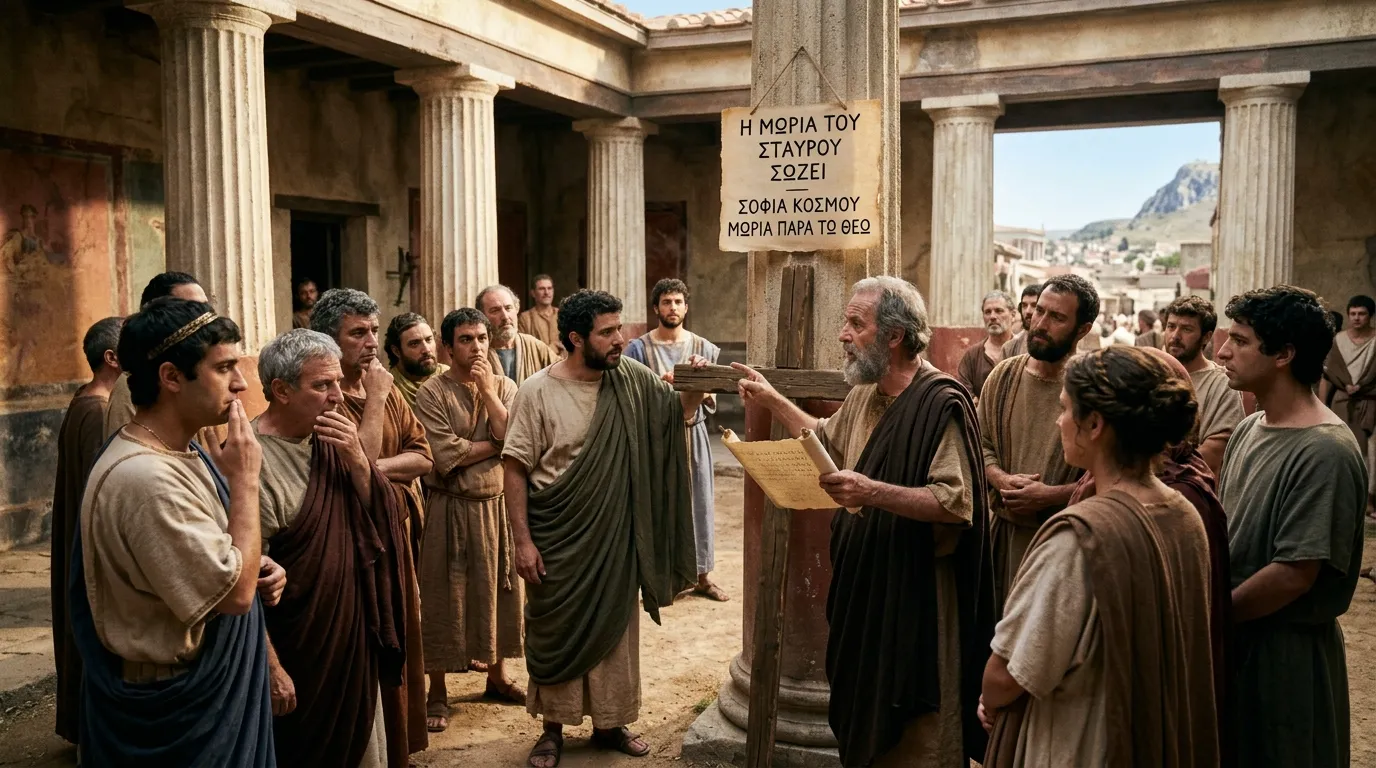
“We are fools for Christ’s sake, but you are wise in Christ.” When Paul wrote those words to the church in Corinth, he was not confessing a lack of intelligence. He was holding up a mirror. The Corinthians prided themselves on wisdom, strength, and status. Paul and his fellow workers looked, by those standards, like failures: hungry, thirsty, poorly clothed, beaten, homeless. The phrase “fools of Corinth” is Paul’s ironic label for a truth that runs through all his letters: God’s wisdom looks like foolishness to a world that measures by power, polish, and prestige.
Corinth: The City That Worshiped Success
Corinth was a city built for ambition. It sat on the narrow isthmus connecting mainland Greece with the Peloponnese, and its two harbors made it one of the great commercial centers of the Mediterranean. It was wealthy, cosmopolitan, and notorious for moral license. Its people valued rhetoric, philosophy, status, and display. In such a city, a teacher was judged the way a modern audience judges a speaker: by polish, confidence, and following.
The church in Corinth absorbed the city’s values. Believers divided into factions behind their favorite teachers: “I follow Paul,” “I follow Apollos,” “I follow Cephas” (1 Corinthians 1:12). They prized impressive speech and spiritual gifts that looked spectacular. They tolerated a man living in open immorality. They sued one another in public courts. They turned the Lord’s Supper into a feast where the rich ate well and the poor went hungry. The Corinthian church had the gospel, but it was reading the gospel through the lens of Corinthian success.
The Cross as God’s Foolishness
Paul’s answer to Corinth begins at the cross. “The word of the cross is folly to those who are perishing, but to us who are being saved it is the power of God” (1 Corinthians 1:18). A crucified Messiah was a scandal to Jews, who expected a victorious king, and foolishness to Greeks, who expected a philosophy of wisdom. Paul insists that the scandal is the point. God chose what is foolish in the world to shame the wise, and what is weak in the world to shame the strong (1 Corinthians 1:27). The cross is not a problem to be explained away. It is the center of God’s wisdom.
This is the theological foundation for everything Paul says about being a fool for Christ. If God’s own saving act looked like foolishness, then His servants should expect to look foolish too. The Christian life is not a climb toward worldly impressiveness. It is a participation in a crucified Lord. The fools of Corinth are those who have accepted that bargain.
The Irony of 1 Corinthians 4
The sharpest passage comes in 1 Corinthians 4. Paul addresses the Corinthians’ pride with biting irony. “Already you have all you want! Already you have become rich! Without us you have become kings! And would that you did reign, so that we might share the rule with you!” (1 Corinthians 4:8). The praise is not praise. It is a mirror held up to a church that thought it had already arrived.
Then Paul contrasts their self-image with the apostles’ reality: “For I think that God has exhibited us apostles as last of all, like men sentenced to death, because we have become a spectacle to the world, to angels, and to men. We are fools for Christ’s sake, but you are wise in Christ. We are weak, but you are strong. You are held in honor, but we in disrepute” (1 Corinthians 4:9-10). The word “spectacle” in Greek is theatron, the word for a theater. Paul pictures the apostles as condemned prisoners paraded in the arena for the crowd’s entertainment. The Corinthians sat in the stands, applauding themselves. The apostles were in the ring.
Paul goes on to describe the apostles’ life: hungry, thirsty, poorly clothed, buffeted, homeless, laboring with their own hands, reviled and persecuted, treated as “the scum of the world, the refuse of all things” (1 Corinthians 4:11-13). This is not a complaint. It is a credential. The apostles’ suffering was evidence that they belonged to a crucified Lord.
What “Fools for Christ” Does Not Mean
Paul is not praising ignorance. He was one of the most educated men of his day, trained in the law, fluent in Greek, and capable of reasoning with philosophers in Athens. He is not praising carelessness or deliberate oddity. The foolishness he describes is not a performance. It is the inevitable appearance of a life shaped by the cross in a world shaped by pride.
Being a fool for Christ means being willing to choose faithfulness over impressiveness: to forgive when revenge would look strong, to serve when status would look better, to speak the truth when silence would be safer, to give when accumulation would be smarter. It means accepting that the world may misunderstand, mock, or dismiss you, and trusting that God’s judgment matters more than the crowd’s.
The Wisdom That Lasts
Paul’s letter does not end with irony. It ends with a call to imitate him: “I urge you, then, be imitators of me” (1 Corinthians 4:16). The Corinthians were to measure themselves not by Corinthian standards but by the cross. The wisdom of God, Paul argues, is not the wisdom of the age or of its rulers, who are passing away. It is the wisdom God decreed before the ages for our glory (1 Corinthians 2:6-7), revealed by the Spirit, and centered on Christ.
The Divisions Behind the Foolishness
The Corinthian pride Paul confronted was not abstract. It had produced concrete divisions. Believers were sorting themselves into factions behind their favorite teachers, treating the church like a school of philosophy where students boasted about their master. Some claimed Paul, others Apollos, others Cephas, others Christ. Paul’s response was blunt: “Is Christ divided? Was Paul crucified for you? Or were you baptized in the name of Paul?” (1 Corinthians 1:13). The factions were a symptom of the deeper disease: a church measuring itself by the standards of Corinthian success rather than by the cross.
The same pride showed up in the church’s handling of spiritual gifts. The Corinthians prized the gifts that looked spectacular, especially tongues, and they used them to rank one another. Paul’s response, in 1 Corinthians 12-14, was to reframe the gifts around love. The greatest gift is not the most impressive one. It is the one that builds up the body. And love, he wrote, is patient, kind, and not boastful. The “fools for Christ” passage and the love chapter belong together. Both are attacks on the same pride: the pride that turns faith into a performance.
The Lord’s Supper and the Reversal of Status
Perhaps the most concrete example of Corinthian pride was the Lord’s Supper. When the church gathered, the wealthy ate their own food and got drunk while the poor went hungry (1 Corinthians 11:20-22). The meal that was supposed to proclaim the Lord’s death had become a display of social rank. Paul’s rebuke was fierce: those who eat and drink without discerning the body bring judgment on themselves. The Supper was meant to be the great equalizer, the table where slave and free, rich and poor, ate the same bread and drank the same cup. The Corinthians had turned it into a mirror of Corinthian society.
This is why the “fools of Corinth” passage matters beyond its irony. It is not only about how the apostles looked. It is about how the church lived. A community that measures itself by the cross will eat together differently, give differently, and resolve disputes differently. The foolishness of the cross is not a theory. It is a way of life, and the Corinthians were failing at it.
The Apostles as Spectacle
Paul’s image of the apostles as a “spectacle” deserves a closer look. In the Roman world, a spectacle was public entertainment: gladiators in the arena, criminals paraded before execution, prisoners displayed for the crowd’s amusement. Paul says God has exhibited the apostles “as last of all, like men sentenced to death,” a spectacle to the world, to angels, and to men. The image is deliberately humiliating. The apostles were not the heroes of the arena. They were the condemned, displayed for the crowd. And the Corinthians, sitting in the stands of their own self-regard, were the audience. Paul’s irony turns the seating chart upside down: the people who thought they were the stars were the spectators, and the people they dismissed were the ones on display before heaven.
The image also explains why Paul’s argument is so powerful. He is not asking the Corinthians to admire the apostles’ suffering. He is asking them to see that the suffering is the credential. The apostles look like fools because they follow a crucified Lord, and a crucified Lord’s servants will look crucified. The Corinthians’ mistake was to expect the Christian life to look like Corinthian success. Paul’s correction was to show them that it looks like the cross.
The church in Corinth eventually heard the rebuke, at least in part. Paul’s second letter to the Corinthians shows a community that had begun to repent. But the temptation Paul diagnosed has never gone away. Every generation of Christians faces the Corinthian choice: to measure faith by the standards of the culture, or to accept that following a crucified Lord will sometimes look like foolishness. The fools of Corinth are a warning and a badge of honor at once: a warning against pride, and an honor for those who bear the cross without embarrassment. For the context of Paul’s letter to this church, see the Wikipedia article on the First Epistle to the Corinthians.










