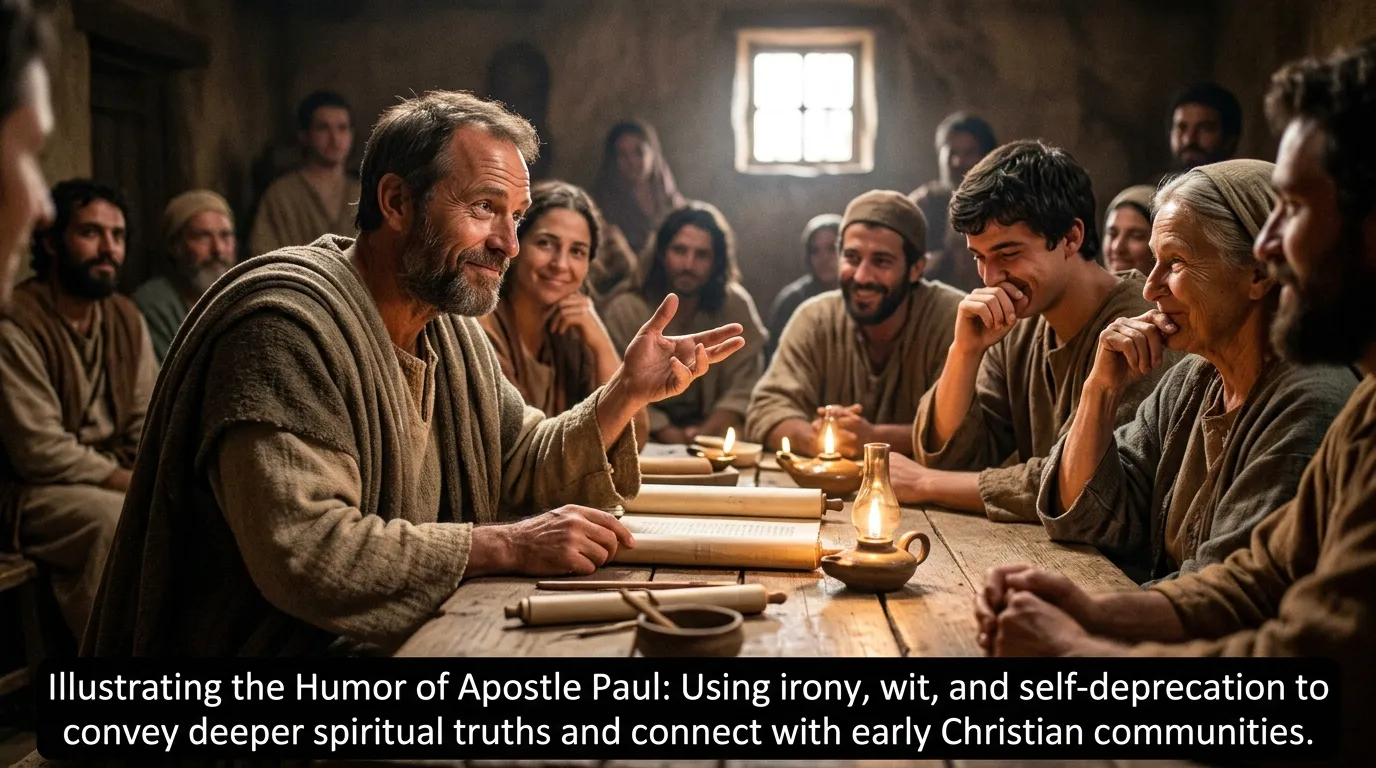
Paul is not usually the first name that comes to mind when Christians think about humor. He is remembered as the theologian of grace, the apostle of the Gentiles, the man who wrote Romans and endured beatings and shipwrecks. Yet anyone who reads his letters closely will find moments of sharp irony, exaggeration, wordplay, and even sarcasm. Paul’s humor is not entertainment. It is a pastoral tool, a way of making truth memorable, exposing pride, and showing that faith has room for wit as well as tears.
Why a Serious Apostle Used Irony
Paul wrote to real churches with real problems: division, immorality, false teaching, pride, and confusion. He could have written in a flat, formal style, and sometimes he did. But he was also a man of great rhetorical skill, trained in the traditions of Jewish argument and Greek persuasion. Irony allowed him to do something plain statement could not: to let his readers hear how absurd their position sounded. When people are proud, a direct accusation makes them defensive. An ironic mirror makes them laugh, and then makes them think.
It is also worth remembering that Paul’s letters were read aloud to congregations. They were heard, not silently studied. A sharp ironic line would have landed in a room the way a good sermon illustration lands today: with a ripple of recognition. Paul knew his audiences, and he wrote to be heard.
The Corinthian Irony
The clearest example of Paul’s irony is in 1 Corinthians 4. The Corinthians were proud of their wisdom, their gifts, and their favorite teachers. Paul answered with praise that was not praise: “Already you have all you want! Already you have become rich! Without us you have become kings!” (1 Corinthians 4:8). The congregation would have heard the applause in the words, and then felt the sting. They had not become kings. They were acting like it. Paul’s irony exposed the gap between their self-image and their reality.
The same technique appears in 2 Corinthians, where Paul engages in what scholars call the “fool’s speech” (2 Corinthians 11:16-12:10). His opponents had been boasting about their credentials, their visions, and their suffering. Paul decided to “boast” too, and his boasting was a catalog of humiliations: beatings, stonings, shipwrecks, sleepless nights, and anxiety for the churches. The irony is devastating. If boasting is the game, Paul wins by listing his weaknesses. The passage ends with the famous declaration: “For when I am weak, then I am strong” (2 Corinthians 12:10). The joke, if it is one, is on the whole idea that strength is the measure of an apostle.
The Galatian Exaggeration
Paul’s letter to the Galatians contains his sharpest language, and his sharpest humor is there too. The Galatians were being told that Gentile converts had to be circumcised and keep the law of Moses. Paul saw this as a denial of the gospel itself, and he responded with a ferocity that surprises modern readers. “I wish those who unsettle you would emasculate themselves!” he wrote (Galatians 5:12). The line is deliberately shocking. Paul takes the agitators’ obsession with circumcision and pushes it to its logical extreme. If cutting is the way to God, why stop where they stopped? The exaggeration is meant to make the reader recoil and realize how absurd the demand was.
Paul also used wordplay in Galatians. He notes that the agitators want to make a good showing in the flesh (Galatians 6:12), and he contrasts their desire for circumcision with the cross of Christ, in which he boasts. The letter’s tone is urgent and angry, but the anger is the anger of a pastor watching his children be led astray. The humor is a weapon, not a joke.
Philemon: The Gentle Wordplay
Not all of Paul’s humor is sharp. His letter to Philemon is a masterpiece of gentle persuasion. Philemon’s runaway slave, Onesimus, had become a Christian and was returning to his master. Paul asked Philemon to receive him “no longer as a bondservant but more than a bondservant, as a beloved brother” (Philemon 1:16). The letter turns on a pun: the name Onesimus means “useful.” Paul writes that Onesimus was once “useless” to Philemon, but now he is “useful” to both of them (Philemon 1:11). The wordplay is deliberate and tender. Paul is asking Philemon to see the man differently, and he uses the man’s own name to make the point.
The letter is also full of tactful pressure. Paul says he could command Philemon but prefers to appeal in love. He notes that he is writing with his own hand, that Philemon owes Paul his very self, and that he has confidence Philemon will do even more than he asks. The whole letter is a diplomatic dance, and the humor is part of the diplomacy: a way of making a hard request without breaking the relationship.
Humor in the Service of Truth
Paul’s humor always serves a serious purpose. It exposes pride, as in Corinth. It unmasks error, as in Galatia. It softens a hard request, as in Philemon. It never mocks the vulnerable, never makes light of sin, and never treats the gospel as a joke. The humor is the servant of the message, not a distraction from it.
There is a broader lesson here for Christians. Faith is serious, but seriousness is not the same as solemnity. The Bible itself contains wit, irony, and wordplay, from Elijah mocking the prophets of Baal on Mount Carmel (1 Kings 18:27) to Jesus’ image of a camel going through the eye of a needle (Matthew 19:24). A faith that cannot laugh at human pride has lost one of Scripture’s own tools. Paul’s letters show that truth can be both weighty and witty, and that a well-placed ironic line can do the work of a whole chapter of argument.
Irony in 2 Corinthians: The Thorn and the Boast
Paul’s most personal use of irony comes in 2 Corinthians 12, where he describes his “thorn in the flesh.” He had prayed three times for it to be removed, and the Lord’s answer was, “My grace is sufficient for you, for my power is made perfect in weakness” (2 Corinthians 12:9). Paul’s response is a reversal of everything the Corinthians valued: “Therefore I will boast all the more gladly of my weaknesses, so that the power of Christ may rest upon me.” The man who had every reason to boast about visions, revelations, and apostolic credentials chose to boast about a thorn. The irony is not a joke. It is a confession that God’s strength works through human limitation, not around it.
Sarcasm and the False Apostles
Paul’s sharpest humor was reserved for the false apostles who had infiltrated Corinth. He called them “super-apostles” (2 Corinthians 11:5), a title dripping with sarcasm. He noted that they preached a different Jesus, a different spirit, and a different gospel, and that the Corinthians put up with it “readily enough” (2 Corinthians 11:4). The sarcasm is withering, but it serves a pastoral purpose: to wake a church that had been charmed by impressive impostors. Paul’s irony was a diagnostic tool, a way of showing the Corinthians how foolish they looked for preferring polish to truth.
Notice the pattern. Paul’s humor is never aimed at the weak or the suffering. It is aimed at the proud, the false, and the self-satisfied. It is the humor of a shepherd protecting the flock, not the humor of a comedian entertaining a crowd. The target is always the same: the pride that makes people prefer the appearance of strength to the reality of grace.
The Humor of the Resurrection Hope
There is one more strain of Paul’s humor that is easy to miss: the humor of resurrection hope. In 1 Corinthians 15, Paul takes up the claim that there is no resurrection of the dead and follows it to its absurd conclusion. If there is no resurrection, he argues, then Christ has not been raised, the preaching is in vain, the faith is in vain, the apostles are misrepresenting God, and Christians are of all people most to be pitied. The argument is a reductio ad absurdum, a way of showing that the denial of the resurrection collapses the whole faith. And then comes the turn: “But in fact Christ has been raised from the dead, the firstfruits of those who have fallen asleep” (1 Corinthians 15:20). The logic is rigorous, but the tone has a kind of grim comedy to it: the opponents’ position is so self-defeating that Paul can dismantle it by simply following it to the end.
Paul then closes the chapter with a taunt aimed at death itself: “O death, where is your victory? O death, where is your sting?” (1 Corinthians 15:55). The words are a quotation from Hosea, but in Paul’s hands they become a victory shout. Death, the enemy that had seemed so final, is mocked. The humor here is not a joke. It is the laughter of victory, the sound of a people who know that the worst thing that can happen to them has already been defeated.
At the same time, Paul’s humor reminds us that the goal is never the laugh. The goal is the person. Paul’s irony was aimed at pride and error, never at the people he was trying to win. He wept over the churches he corrected. His humor was the humor of a shepherd who loved the sheep enough to startle them awake. For the background of Paul’s most lighthearted letter, the one built on a pun about usefulness, see the Wikipedia article on the Epistle to Philemon.