Picture a house church in Ephesus, late in the first century. The believers have gathered — merchants, slaves, widows, a few former priests of Artemis — and someone stands to read a letter that has just arrived from the aged apostle John, exiled on Patmos. “Blessed is the one who reads aloud the words of this prophecy, and blessed are those who hear” (Revelation 1:3). They listen. They hear about lampstands and stars, a slaughtered Lamb on a throne, trumpets and bowls, a bride and a city. Some of it puzzles them. All of it steadies them. Because this strange, glorious book was not written to confuse them — it was written to keep them faithful.
That original scene is the key most readers lose. The book of Revelation is, before anything else, a pastoral letter to pressured churches — and only secondarily the apocalyptic puzzle modern readers make of it. Its visions of dragons and judgments serve its letters to seven congregations, not the other way around. Read it as John’s readers did — as a word from their pastor about their crisis — and the book’s famous obscurity begins to clear. Its message, in one sentence: the Lamb has won, the churches must endure, and the ending is a wedding.
A Letter, Not a Codebook
The book announces its own genre in the opening verses: “John to the seven churches that are in Asia: Grace to you and peace” (Revelation 1:4). That is how letters begin. It ends the way letters end: “The grace of the Lord Jesus be with all. Amen” (Revelation 22:21). Between those bookends, the visions unfold — but the letter-frame never disappears. Seven times in chapters 2-3, the risen Christ dictates “to the angel of the church in…” — personal correspondence to real congregations in real cities, each with a real situation John knew intimately.
Those situations were serious. The churches of Asia Minor lived under the long shadow of imperial Rome, where loyalty to Caesar was becoming a religious test. Christians faced social exclusion (cut off from trade guilds, which meant cut off from livelihoods), public slander, imprisonment, and — increasingly — execution. Antipas had already been killed in Pergamum (Revelation 2:13). John himself was exiled “on account of the word of God and the testimony of Jesus” (Revelation 1:9). This is not the setting for abstract speculation. It is the setting for survival literature — a pastor writing to his suffering people: hold on; I have seen the throne; I know how this ends.
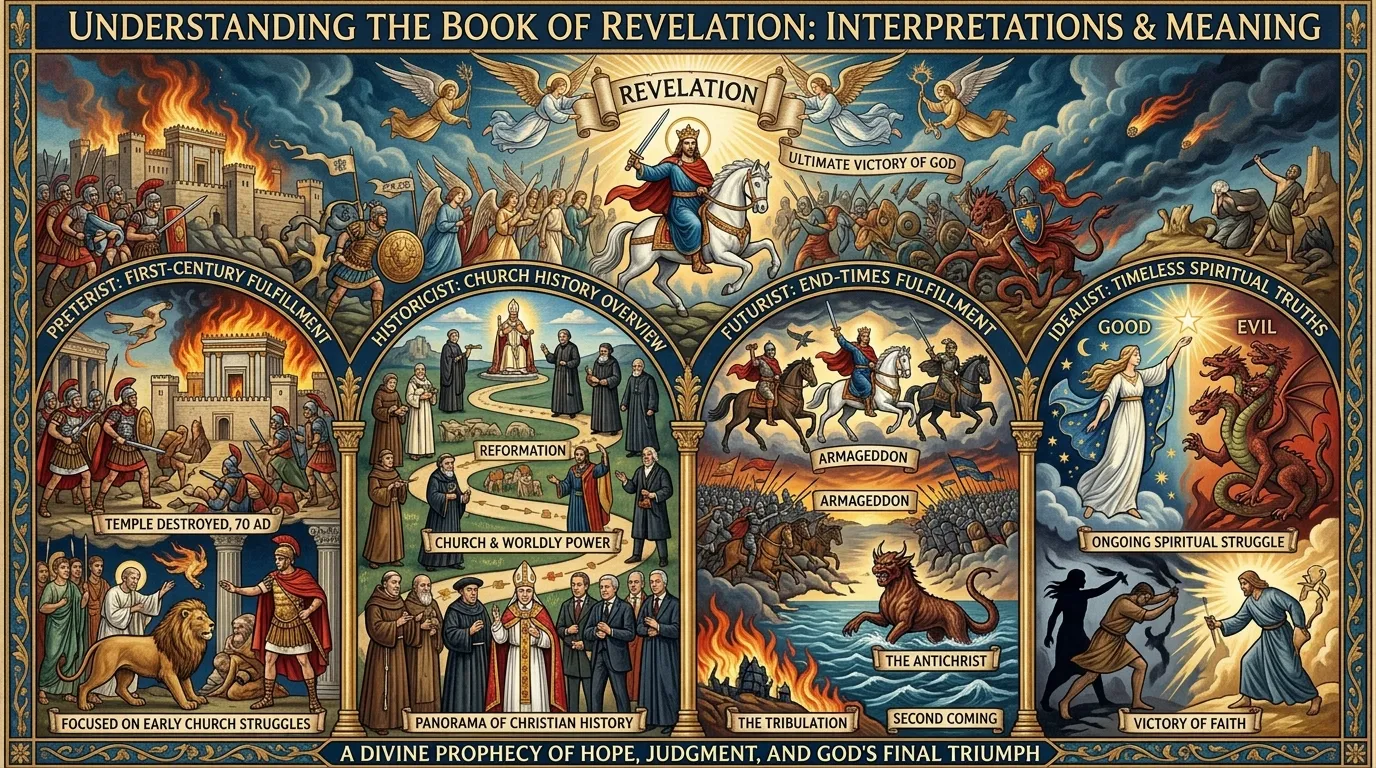
That pastoral purpose reframes every debate about the book’s timeline. Whatever else the visions depict, they were first meant to be heard by people choosing, that week, whether to burn incense to Caesar or lose their shops — whether to confess Christ or save their lives. Any interpretation that would have been useless to them is probably a misreading. The book’s first question is not “when will these things happen?” but “will you be faithful when they do?”
The Seven Churches: Seven Mirrors
Before a single seal is opened, Christ walks among the lampstands (Revelation 1:12-13, 20) and dictates seven assessments — and each one follows the same searching pattern: I know your situation, here is my commendation and my rebuke, here is my counsel, and to the one who conquers, here is my promise. The seven churches are seven mirrors, and every church since has seen its face in at least one.
Ephesus (2:1-7): orthodox, hardworking, discerning — and loveless. “You have abandoned the love you had at first.” The church that does everything right and loves nothing is told to repent, or its lampstand goes. Smyrna (2:8-11): poor, slandered, about to suffer prison and death — and receives no rebuke at all, only the crown of life: “Be faithful unto death.” Pergamum (2:12-17): faithful where Satan dwells, yet tolerating compromise — the teaching that blesses idolatry and immorality must go. Thyatira (2:18-29): loving, serving, growing — but tolerating “Jezebel,” the voice that normalizes sin. Love without truth is not love.
Sardis (3:1-6): the church with a reputation for being alive — “you are dead.” The most frightening sentence in the letters, aimed at respectable religiosity with no pulse. Philadelphia (3:7-13): small, weak, faithful — and given an open door no one can shut. Laodicea (3:14-22): rich, comfortable, self-sufficient — and lukewarm, making Christ want to spit them out. Yet even Laodicea gets the tenderest invitation in the book: “Behold, I stand at the door and knock” (3:20).
Read the seven together and the pattern is unmistakable: Christ knows — the word opens nearly every letter (“I know your works,” “I know your tribulation”). He is not a distant judge but a present inspector, walking among the lampstands, seeing the church as it truly is beneath its reputation. And every letter ends the same way: “To the one who conquers…” — the tree of life, the crown, the white stone, the morning star, the open door, the seat with Christ on His throne. The whole book, in embryo, is right here: see truly, repent deeply, endure faithfully, and inherit gloriously.
The Throne at the Center
After the letters, John is summoned upward — “Come up here” (Revelation 4:1) — and what he sees reframes everything the churches are suffering. A throne. Someone seated on it. Lightning, thunder, a sea of glass. Twenty-four elders and four living creatures crying “Holy, holy, holy, is the Lord God Almighty, who was and is and is to come!” (Revelation 4:8). Before a single judgment falls, the book establishes the politics of heaven: whatever Caesar claims, whatever the empire’s propaganda declares, this throne is the real seat of power, and it is occupied.
Then the crisis of the vision: a scroll sealed with seven seals, and no one worthy to open it — and John weeps (Revelation 5:1-4). The scroll is God’s plan for history, and its sealed state means history looks meaningless: the wicked prosper, the saints suffer, Rome wins. Who can make sense of it? The answer is the book’s theological center: “Weep no more; behold, the Lion of the tribe of Judah… has conquered” — and John looks, and sees “a Lamb standing, as though it had been slain” (Revelation 5:5-6). The Lion is the Lamb. Conquest comes through sacrifice. The throne’s power belongs to the slaughtered One.
Heaven’s response is worship on a cosmic scale — and note what the worship declares: “Worthy are you to take the scroll and to open its seals, for you were slain, and by your blood you ransomed people for God from every tribe and language and people and nation” (Revelation 5:9). The cross is the hermeneutical key to history: because the Lamb was slain and ransomed a people, the sealed scroll — the meaning of history — can be opened. Every judgment that follows in the book flows from this throne-room logic: God is just, the Lamb is worthy, and history is heading somewhere.
Conquering by the Blood of the Lamb
The book’s most subversive sentence may be Revelation 12:11: “They have conquered him by the blood of the Lamb and by the word of their testimony, for they loved not their lives even unto death.” In Rome’s vocabulary, conquering meant legions, crucifixions, and triumphs. In Revelation’s vocabulary, conquering means martyrdom — holding the testimony when it costs everything. The saints do not conquer the beast by becoming a bigger beast. They conquer by refusing to worship it, even unto death — because the Lamb already conquered by refusing to come down from the cross.
This is why the book’s heroes are not warriors but witnesses — the Greek word is martys, the root of “martyr.” The souls under the altar cry “how long?” (Revelation 6:10), and they are given white robes and told to rest a little longer. The great multitude no one can number stands before the throne in white, “these are the ones coming out of the great tribulation” (Revelation 7:14). The book does not promise the churches escape from suffering. It promises them meaning in suffering — and a throne on the other side of it (“The one who conquers, I will grant him to sit with me on my throne,” 3:21).
For the original readers, this was not theory. It was the difference between apostasy and endurance when the knock came at the door. And it remains the book’s pastoral function today wherever the church is pressured: your suffering is seen, your enemy is judged, your King is coming, and your white robe is already prepared.
The Ending That Is a Wedding
After the judgments, the falls of Babylon, and the final defeat of the dragon, the book does not end with a battlefield. It ends with a wedding and a city. “Blessed are those who are invited to the marriage supper of the Lamb!” (Revelation 19:9). Then the new heaven and new earth, the holy city descending “prepared as a bride adorned for her husband” (Revelation 21:2) — and the most tender promise in Scripture: “He will wipe away every tear from their eyes, and death shall be no more, neither shall there be mourning, nor crying, nor pain anymore” (Revelation 21:4).
The city’s description is pointed: no temple, “for its temple is the Lord God the Almighty and the Lamb” (21:22); no sun or moon, “for the glory of God gives it light, and its lamp is the Lamb” (21:23); no night, no closed gates, no curse (21:25; 22:3). Every loss the churches suffered — exclusion from the city’s life, darkness of persecution, the curse of living under the beast — is reversed. And the river of life flows with the tree of life, “and the leaves of the tree were for the healing of the nations” (22:2). The story that began in a garden ends in a garden-city, with the nations healed.
The book’s last words are a prayer, and they are the right response to everything in it: “Surely I am coming soon.” Amen. Come, Lord Jesus! (Revelation 22:20). Not a chart. Not a code. A cry of longing from a pressured church to its coming King. That is what the book of Revelation is: a letter of endurance, a vision of the throne, a promise of the wedding — written to keep seven struggling churches faithful, and still doing its work in every church that reads it as they did: aloud, together, listening for the blessing.
For the book’s historical background, authorship debates, and interpretive traditions, Wikipedia’s article on the Book of Revelation gathers the key facts and scholarly discussion in one place.










