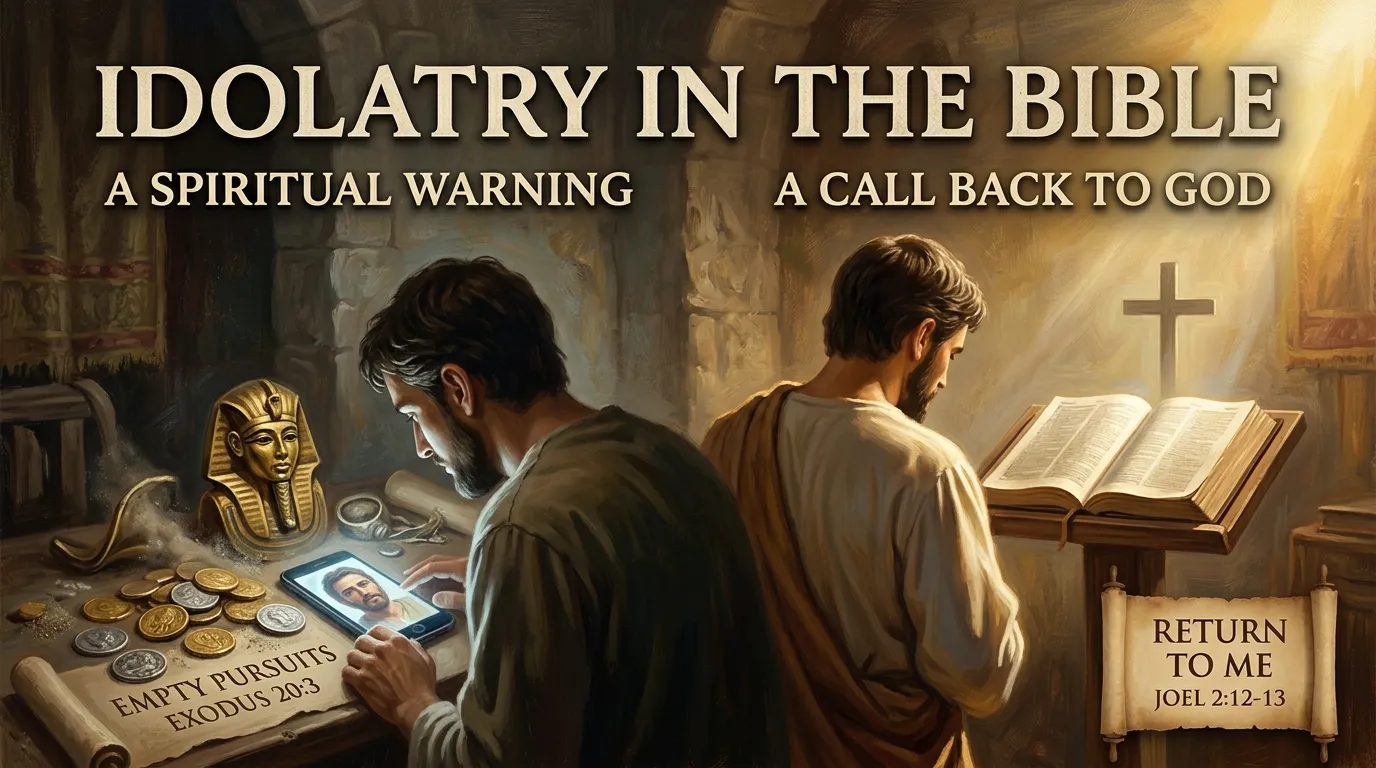
Picture a man who receives a priceless gift from someone he loves — a watch from his father, say, worn every day because it reminds him of the giver. Slowly, imperceptibly, the watch becomes the point. He polishes it obsessively, insures it, talks about it constantly, plans his day around it — and one day realizes he has not called his father in months. The gift did not change. His heart did. What once pointed him toward love now stands in love’s place.
That is idolatry — not only, and not mainly, bowing to statues. Idolatry is what happens when a good gift takes God’s place. The Bible’s teaching on it is far more searching, and far more personal, than most people expect. It is not really about ancient pagans and their carved images. It is about the human heart’s factory-like production of replacements for God — and about the God who refuses to share His throne, not from pettiness but from love.
The Golden Calf: Idolatry’s Case Study
The Bible’s defining idolatry story is Exodus 32, and its details are uncomfortably revealing. Moses is on Mount Sinai receiving the law — delayed, from the people’s perspective. The Israelites, anxious and impatient, demand of Aaron: “Come, make us gods who will go before us.” Aaron collects their gold earrings, fashions a calf, and the people declare, “These are your gods, Israel, who brought you up out of Egypt.”
Notice what is not happening. The people are not converting to a foreign religion. They are not rejecting Yahweh outright. They are trying to worship Yahweh on their own terms — with a visible, controllable, immediate god instead of the invisible, sovereign, sometimes-slow one. Aaron even “built an altar in front of the calf” and announced “a festival to the Lord” (Exodus 32:5) — using the covenant name of God. This is not paganism invading Israel; it is Israel domesticating God.
That is always how idolatry works. It rarely announces itself as rebellion. It presents as improvement: a god we can see, a god who acts on our schedule, a god whose demands fit our preferences. The calf was golden — valuable, beautiful, impressive. Idols usually are. That is what makes them tempting.
The First Two Commandments: Why God Takes This So Personally
“You shall have no other gods before me. You shall not make for yourself an image” (Exodus 20:3-4). These are not suggestions; they are the first words of the covenant, the foundation everything else stands on. And the reason God gives is startling in its intimacy: “for I, the Lord your God, am a jealous God” (Exodus 20:5).
We need to rescue that word jealous from its modern baggage. Human jealousy is usually possessive and insecure — the fear of losing what we clutch. God’s jealousy is the fierce protectiveness of a husband for his wife, a parent for a child. It is love refusing to watch the beloved destroy herself. When Israel chased idols, the prophets did not describe it as a legal infraction; they described it as adultery — the book of Hosea, the imagery of Ezekiel 16, the weeping of Jeremiah. Idolatry breaks God’s heart before it breaks God’s law.
Why? Because idols always fail, and God knows it. “Those who make them will be like them, and so will all who trust in them” (Psalm 115:8). Worship shapes the worshiper: bow to what is deaf and you become deaf to God; trust what is powerless and you become powerless in crisis. Idolatry is not just disloyal; it is self-diminishing. We become like what we worship — which is glorious news if we worship the living God, and terrible news if we do not.
The Idols You Cannot See
The New Testament moves idolatry decisively inward. Paul writes, “Put to death, therefore, whatever belongs to your earthly nature… and greed, which is idolatry” (Colossians 3:5). Greed — idolatry. No statue required. No temple. Just a heart that has made an ultimate out of an appetite.
This is the Bible’s mature doctrine, and it is devastating in its scope. An idol is anything you look to for what only God can give: ultimate security, ultimate identity, ultimate satisfaction, ultimate control. By that definition, the modern idol shelf is crowded:
- Money — “You cannot serve both God and money” (Matthew 6:24). Mammon promises security and delivers anxiety.
- Success and status — the idol of being impressive, which demands ever-increasing sacrifices of time, family, and integrity.
- Romance and family — good gifts that become crushing idols when a spouse or child is expected to provide the unconditional love and total fulfillment only God can give.
- Comfort and control — the idol of a pain-free, predictable life, which shatters the moment reality intrudes.
- Self — the final idol, the one behind all the others: the demand that reality conform to my desires, my timeline, my wisdom.
Ezekiel confronted this directly: “These men have set up idols in their hearts” (Ezekiel 14:3). Not in their shrines — in their hearts. The most dangerous idols are the ones no one else can see, because no one else can challenge them. Ask the diagnostic questions: What do you daydream about? What can you not stop worrying about? What would devastate you beyond recovery if you lost it? What do you sacrifice your integrity, your family, or your peace to protect? Follow the trail of your anxieties and you will find your altars.
Why Idols Always Disappoint
Scripture is unsparing about the economics of idolatry: it always costs more than it promises and delivers less than it advertises. Isaiah mocks the idol-maker with devastating logic: he plants a tree, uses half of it for firewood to bake bread, and “from the rest he makes a god, his idol; he bows down to it and worships” (Isaiah 44:15-17). Same wood — half for breakfast, half for worship. The prophet’s point: idols are absurd, and deep down, every idolater knows it.
Jeremiah adds the image of “broken cisterns that cannot hold water” (Jeremiah 2:13). Israel had forsaken “the spring of living water” for cisterns — and not even good cisterns, but broken ones. That is the universal idol experience: the promotion that was supposed to satisfy leaves you emptier; the relationship that was supposed to complete you leaves you lonelier; the wealth that was supposed to secure you leaves you more afraid. Idols leak. Only the spring flows.
And there is a final, terrible cost: idols demand what they cannot repay. The worshipers of Baal on Mount Carmel “shouted louder and slashed themselves with swords and spears, as was their custom, until their blood flowed” — and “there was no response, no one answered, no one paid attention” (1 Kings 18:28-29). Four hundred and fifty prophets, bleeding for a god who was not there. Every idol eventually asks for blood — your time, your health, your family, your soul — and gives silence in return.
The Way Back: Dethroning Idols
The Bible never leaves idolaters without a road home, and the road has three markers.
First, name it. Idols survive on vagueness. “I just really value my career” is vagueness; “my career has become the source of my identity and worth, and I have been sacrificing my family and my integrity to it” is naming. Confession begins with precision: “Search me, God, and know my heart… See if there is any offensive way in me” (Psalm 139:23-24). Pray that prayer honestly and brace yourself — He answers it.
Second, dethrone it — don’t just manage it. Israel’s reforming kings did not put warning labels on idols; they smashed them (2 Kings 23). Josiah ground the altars to dust. The New Testament equivalent is “put to death” (Colossians 3:5) — violent language for a violent necessity. Half-measures with idols do not work, because idols are patient. They will wait out your good intentions. What needs to happen is a transfer of trust: deliberately, prayerfully moving your weight off the idol and onto God — changing where you turn first in anxiety, where you look first for approval, what you consult first in decisions.
Third, replace it with the real thing. An empty throne does not stay empty. The man in Jesus’ parable who swept his house clean but left it unoccupied ended up worse than before (Matthew 12:43-45). Idolatry is not cured by subtraction but by supersession — by seeing Christ so clearly, wanting God so deeply, that the idol simply loses its shine. “We all, who with unveiled faces contemplate the Lord’s glory, are being transformed into his image” (2 Corinthians 3:18). You become like what you behold. Behold the living God long enough, and the golden calf starts looking like what it is: a cow made of earrings.
The God Who Will Not Share You
Behind the Bible’s fierce anti-idolatry stands the most tender truth of all: God refuses to share you because He loves you. His jealousy is the jealousy of the cross — the God who would rather die than lose you will not politely split your heart with a calf, a career, or a comfort. “Love the Lord your God with all your heart and with all your soul and with all your mind” (Matthew 22:37) is not a demand for perfection; it is an invitation to wholeness. A divided heart is a miserable heart. A whole heart, given to a worthy God, is the only happy heart there is.
So examine the altars. Name the idols — the visible ones and the ones in the heart. Smash them, not with willpower alone but with worship: fixing your eyes on the God who needs no image because He gave you His Son, “the image of the invisible God” (Colossians 1:15). For a broader look at how idol worship has appeared across human religions and history, the Wikipedia article on idolatry offers helpful background — but the question that matters is not historical but personal, and it is asked by a jealous, loving God: is there anything you love, trust, or serve more than Me? Answer honestly, and let Him have the throne back. He never wanted a share. He wants all of you — because He gave all of Himself.