Listen to a great choir sing a psalm, and you will notice something the printed page hides: the music breathes. Between phrases, the singers pause. The instruments rest. For a beat or two, there is only silence — and the silence is part of the song. Anyone who has ever been moved by worship knows those pauses carry as much weight as the notes. The Bible has a word for that sacred rest, printed right in the text of the Psalms seventy-one times. The word is Selah.
Most readers skip over it. It sits there between verses, untranslated, unexplained — and most of us hurry past, eager for the next line. But what if Selah is not an interruption of the worship? What if it is worship — the congregation’s collective breath, the musicians’ lifted hands, the holy hush after a truth too large to rush past? This is the Selah meaning the Bible’s worshipers would have understood in their bones: the liturgical pause, the sacred rest inside the song.
Selah Where It Was Sung
To understand Selah, stand where it was first heard: in the temple courts, with the Levitical choirs. The Psalms were not private devotional poems; they were the hymnbook of Israel’s public worship, sung by trained musicians at the morning and evening sacrifices, at festivals, at the dedication of the temple. When the text says “Selah,” it is addressing them — the choir director, the instrumentalists, the congregation.
Consider Psalm 46, the great anthem of God’s protection: “God is our refuge and strength, an ever-present help in trouble… Selah.” Imagine that sung by hundreds of voices, strings and cymbals swelling — and then, at the Selah, everything stops. A thousand people standing in sudden silence, letting the truth settle: God is our refuge. Not rushing to verse 2. Just… standing in it.
Or take Psalm 3, David’s cry when fleeing Absalom: “I lie down and sleep; I wake again, because the Lord sustains me… Selah.” Between the terror of verse 5 and the defiance of verse 6, the pause. In a liturgy sung by people who knew real enemies and real fear, that silence was pastoral care set to music — space for every worshiper to lay their own Absalom before God before the song moved on.
What the Musicians Probably Did
Scholars debate Selah’s precise meaning — and we will be honest that no one knows with certainty — but the leading theories all point to the same practice: something musical happened in the pause. The most widely held view is that Selah marked an instrumental interlude: the voices rested while the instruments played, or the volume lifted, or the pitch rose. The Septuagint, the ancient Greek translation of the Old Testament, renders Selah with a word suggesting a musical interlude (diapsalma), which tells us the earliest translators understood it as a performance direction.
Another strong theory connects Selah to the Hebrew root meaning “to lift up” — a signal to lift the voices, lift the instruments, or lift the hands in praise. Either way, the picture is the same: Selah was choreography for worship. It told the congregation what to do with their bodies and their attention at the moment when words ran out.
Think about what this implies. Israel’s worship leaders believed that not singing could be an act of worship. The pause was not empty time between the real content; it was content. The rest was not the absence of music; it was music’s deepest note. Our modern worship — with its relentless forward motion, its fear of “dead air,” its three-songs-and-a-sermon efficiency — has largely forgotten what the Levites knew: hurried worship is shallow worship.
The Sacred Rest: Selah in Your Own Prayer
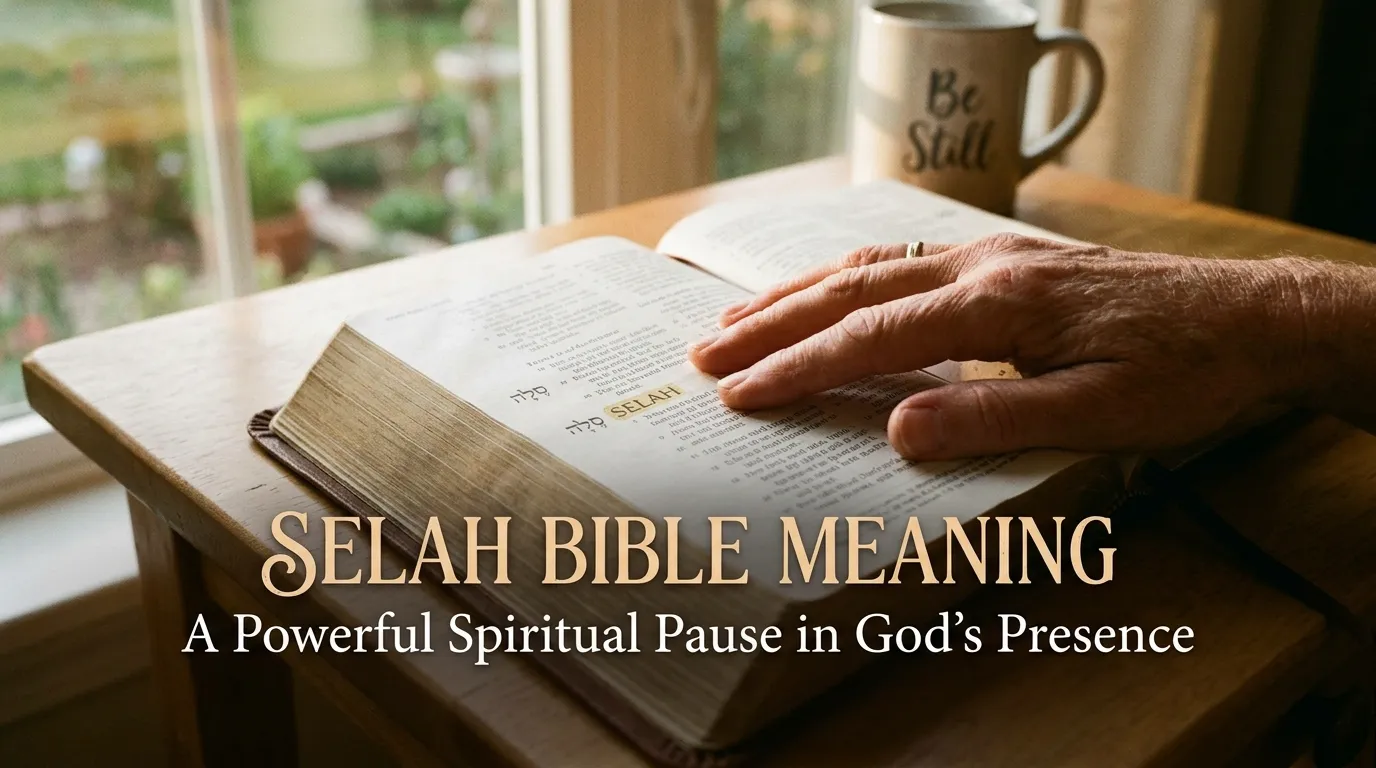
Here is where the liturgical pause becomes personal. You do not need a choir or a temple court to practice Selah. You need only a Bible, a few minutes, and the willingness to stop.
Try it with a single verse. Read Psalm 23:1 slowly: “The Lord is my shepherd, I lack nothing.” Then — Selah. Put the Bible down. Sit in the silence for sixty seconds. Let the shepherd image do its work: His rod, His staff, His presence in the valley. Do not analyze it. Do not move to verse 2. Just rest in verse 1 until it rests in you.
This is the ancient practice the church has called lectio divina — sacred reading — and Selah is its biblical seed. The pattern is simple: read, pause, reflect, respond. Most of our Bible reading fails at step two. We consume chapters the way we scroll feeds, and then wonder why nothing transforms. Selah is the Bible’s built-in speed bump, placed by the Spirit precisely where we are most tempted to rush: right after the truths that matter most.
Notice where Selah tends to appear: after declarations of God’s character (“The Lord of hosts is with us; the God of Jacob is our fortress. Selah,” Psalm 46:11), after cries for help, after confessions of trust. The pauses cluster around the weight-bearing walls of faith. That is not accidental. Selah marks the places where truth needs time.
Selah Moments in the Life of Jesus
Jesus practiced Selah constantly, though He never used the word. Before choosing the Twelve, “he went out to a mountainside to pray, and spent the night praying to God” (Luke 6:12) — a Selah before the decision. After feeding the five thousand, “he went up on a mountainside by himself to pray” while the crowds still clamored (Matthew 14:23) — a Selah after the miracle. In Gethsemane, between His anguished prayers, He returned three times to find the disciples sleeping (Matthew 26:40-44) — Selahs of surrender between waves of sorrow.
The most striking Selah of His ministry may be the shortest verse in the Bible: “Jesus wept” (John 11:35). At Lazarus’s tomb, the Son of God — who knew He was about to raise the dead — paused to weep first. He did not rush to the miracle. He stood in the grief. He let the sorrow have its moment. That is Selah: the holy refusal to hurry past what matters.
And on the cross itself, between “My God, my God, why have you forsaken me?” and “It is finished,” there were three hours of darkness (Matthew 27:45) — the longest Selah in history, the silence in which the world’s redemption was accomplished. God does His deepest work in pauses.
Selah and the Sabbath: The Weekly Pause
Selah has a big sibling in Scripture: the Sabbath. Just as Selah interrupts the song, the Sabbath interrupts the week — a commanded pause in the liturgy of labor. “Remember the Sabbath day by keeping it holy. Six days you shall labor… but the seventh day is a sabbath to the Lord your God” (Exodus 20:8-10). The logic is identical: rest is not the absence of work; it is the crown of it.
God Himself modeled this. After six days of creation’s magnificent activity, “he rested on the seventh day from all his work” (Genesis 2:2) — not from exhaustion but from completion, pausing to behold that “it was very good” (Genesis 1:31). Every Sabbath is a week-long Selah: stop producing, stop striving, and let the truth settle — God is God, I am not, and that is good news. The Christian who practices Selah in the psalms and Sabbath in the week is learning one lesson in two tempos: hurry is not holiness, and the pause is where God does some of His finest work.
Recovering the Pause in Corporate Worship
What would it look like for churches to recover Selah? It would look like silence after the Scripture reading — not rushing to the next element, but letting the Word echo. It would look like a pause after the confession of sin, space for each heart to name its own. It would look like instrumental interludes treated as prayer, not filler. It would look like worship leaders comfortable with stillness, trusting that the Spirit can speak in the quiet as surely as in the song.
The Quakers built an entire tradition on this instinct — gathered silence, waiting on God together. The liturgical churches kept it in the pauses of the liturgy. The psalms kept it in a single word, printed seventy-one times, waiting for hurried readers to finally notice. Selah is God’s reminder that worship is not a performance to complete but a presence to inhabit.
Some truths cannot be sung quickly. Some prayers cannot be prayed at speed. Some encounters with God require what the psalmists scheduled into the service itself: a stop, a breath, a holy hush. The next time you meet Selah in your reading, do not skip it. Obey it. Put down the Bible, close your eyes, and let the silence preach. In the pause, you may hear what the singing was trying to tell you all along.
For those interested in the musical and historical background — how scholars reconstruct ancient Israelite temple music and where Selah fits in it — the Wikipedia article on Selah surveys the main theories fairly; but the practice itself needs no theory, only a quiet room, an open psalm, and the willingness to stop singing long enough to listen.