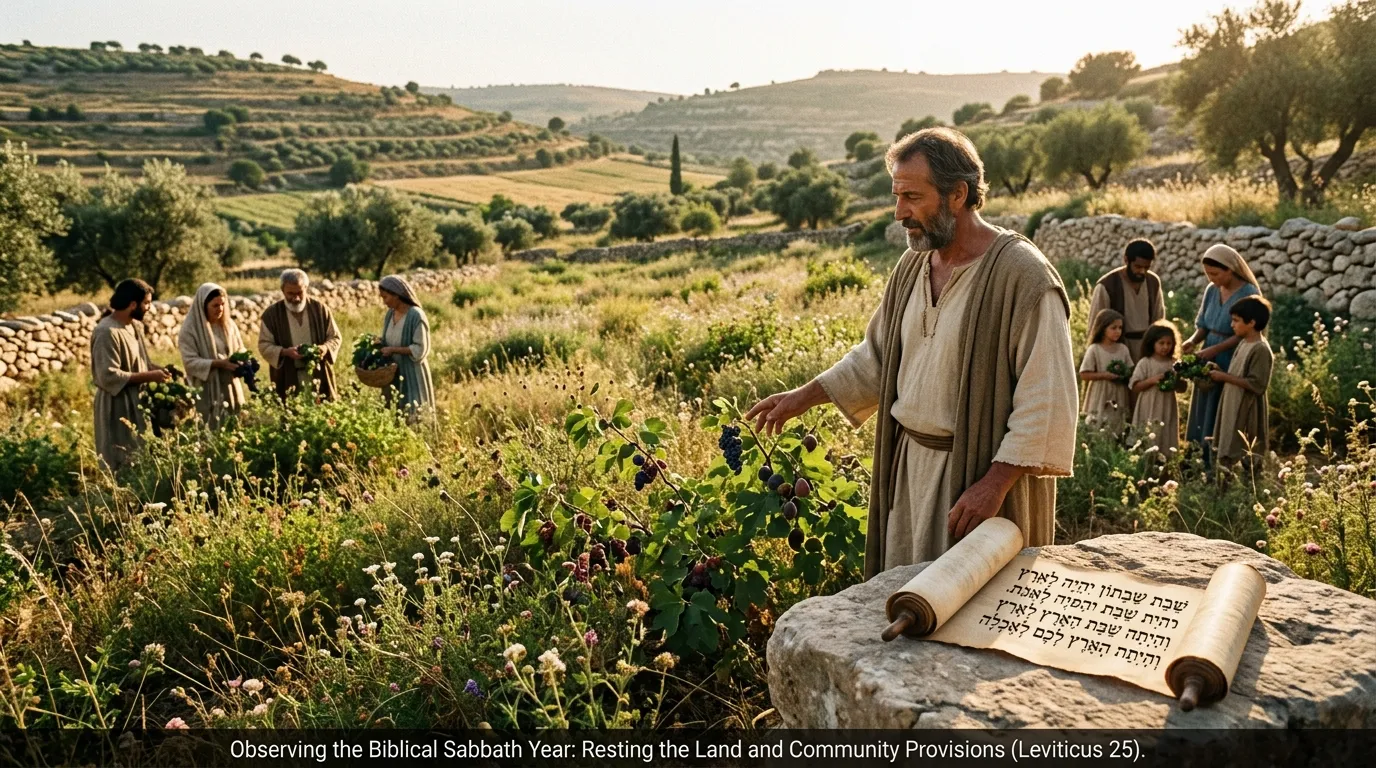
Stand at the edge of a wheat field in late summer. For six years this soil has been plowed, sown, and harvested. The farmer knows every furrow, and his hands know the weight of every season. Now imagine a voice — not a consultant’s, not a market analyst’s, but God’s — saying: this year, plant nothing. Let the land rest. I will feed you anyway. Every instinct in the farmer screams that this is ruin. Every promise of God says it is worship. That collision — between economic terror and divine command — is the beating heart of the biblical sabbatical.
Our modern word “sabbatical” usually means a professor’s paid semester off or a burned-out employee’s career break. Those are fine things, but they are puddles next to the ocean. In Scripture, the sabbatical is not a vacation policy. It is a theology: a God-ordered, regularly scheduled confrontation with the question of who actually provides for you.
The Seventh Year God Commanded
The institution is laid out with stunning clarity in Leviticus 25: “For six years sow your fields, and for six years prune your vineyards and gather their crops. But in the seventh year the land is to have a year of sabbath rest, a sabbath to the LORD. Do not sow your fields or prune your vineyards” (Leviticus 25:3-4). Every seventh year, the entire agricultural economy of Israel was to stop. No sowing. No pruning. No systematic harvest — though whatever grew on its own could be gathered freely by anyone, including the poor, the hired worker, and even the wild animals (Leviticus 25:6-7).
Notice the phrasing: “a sabbath to the LORD.” The rest was not ultimately for the soil, though the soil benefited. It was for God — an acted-out confession that the land was His, not theirs. “The land is mine and you reside in my land as foreigners and strangers,” God says a few verses later (Leviticus 25:23). Israel did not own the farm; they were tenants of a generous Landlord. The sabbatical year was the annual — well, septennial — rent receipt, paid not in grain but in trust. The Hebrew root underneath it all is shabbat, “to cease, to stop.” The sabbatical is the Sabbath principle scaled up from a day to a year: stop striving, and remember who you belong to.
Why Rest Requires More Faith Than Work
Here is what makes the command so radical: obedience looked exactly like irresponsibility. A farmer who plants nothing for a year is, by every human metric, gambling his family’s survival. God anticipated the objection and answered it head-on: “You may ask, ‘What will we eat in the seventh year if we do not plant or harvest our crops?’ I will send you such a blessing in the sixth year that the land will yield enough for three years” (Leviticus 25:20-21).
Do not rush past that. God does not command blind leaps; He underwrites the obedience He requires. The sixth-year harvest would be supernaturally abundant — enough for year six, year seven, and into year eight until the new crop came in. The sabbatical was therefore a laboratory of trust. For six years the farmer could tell himself his bread came from his plow. In year seven, the theology became unavoidable: God feeds me. My hands are not my savior.
This is why the sabbatical still convicts. Most of us do not farm, but we all have our “fields” — the income stream, the career momentum, the productivity identity we clutch like a plow handle. The sabbatical principle asks the same question in every century: can you stop, and believe you are still held? Modern exhaustion is rarely just physical; it is theological. We rest badly because we believe, functionally, that everything depends on us. The seventh year was God’s annual demolition of that lie.
Debts Released, Slaves Freed: The Economy of Mercy
The sabbatical year carried a second, social dimension that is easy to miss if we spiritualize it too quickly. Deuteronomy 15 commands that every seventh year, debts among Israelites were to be canceled outright: “At the end of every seven years you must cancel debts” (Deuteronomy 15:1). And Hebrew servants were to go free in the seventh year — not empty-handed, but loaded with provision from the flock, the threshing floor, and the winepress (Deuteronomy 15:12-14).
Think about what this did to Israel’s economy. It made permanent underclasses structurally impossible. No family could spiral into irreversible debt bondage, because the calendar itself kept hitting reset. Wealth could not compound across generations into dynastic oppression; every seven years, the slate was wiped clean. This was not charity — it was design. God’s economy had a built-in circuit breaker against the concentration of power.
The spiritual symbolism is unmistakable, and Jesus Himself would later pick up the thread: the gospel is a perpetual sabbatical for debtors. “Forgive us our debts,” we pray (Matthew 6:12), because we are the beneficiaries of the greatest debt cancellation in history — the cross, where Paul says God “canceled the charge of our legal indebtedness” (Colossians 2:14). Every seventh year, Israel rehearsed in economics what God would one day accomplish in salvation: you cannot pay, so I will cancel.
From Sabbath Year to Jubilee: The Pattern Grows
Leviticus 25 does not stop at seven. After seven sabbatical cycles — forty-nine years — came the Year of Jubilee, the fiftieth year, when the trumpet sounded and liberty was proclaimed throughout the land (Leviticus 25:9-10). Ancestral land returned to its original families. It was the sabbatical principle taken to its fullest: not just rest, but restoration; not just pause, but homecoming.
Centuries later, Jesus stood in a Nazareth synagogue, unrolled the scroll of Isaiah, and read: “The Spirit of the Lord is on me, because he has anointed me to proclaim good news to the poor… to proclaim the year of the Lord’s favor” (Luke 4:18-19; Isaiah 61:1-2). Then He sat down and said, “Today this scripture is fulfilled in your hearing.” Scholars widely recognize “the year of the Lord’s favor” as Jubilee language. Jesus was announcing that the entire sabbatical-Jubilee architecture — rest, release, restoration — had been pointing to Him all along. He is the sabbatical. He is the Jubilee.
Jesus, Lord of the Rest
This reframes the most famous rest-invitation in Scripture: “Come to me, all you who are weary and burdened, and I will give you rest” (Matthew 11:28). Jesus is not offering a spa day. He is offering what the sabbatical year offered — cessation from the crushing labor of self-salvation. The book of Hebrews makes the connection explicit, arguing that the Sabbath rest of God remains open and that believers “enter that rest” by ceasing from their own works (Hebrews 4:9-10).
Notice the deep logic: under the old covenant, Israel rested one year in seven to declare that God provided. Under the new covenant, believers rest perpetually from the work of earning God’s favor — because the work is finished (John 19:30). The sabbatical year was a shadow; Christ is the substance. Every exhausted Christian trying to earn what has already been given is like a farmer plowing in the seventh year — working against the very rest God commanded.
Practicing Sabbatical in a Nonstop World
So what does a sabbatical look like for someone with a mortgage, a smartphone, and no farmland? The principle translates better than you might think.
Practice weekly Sabbath as a mini-sabbatical. One day in seven, stop producing. The command in Exodus 20 was given before the sabbatical year ever was; the day trains you for the year. If you cannot rest for a day, you have already answered the trust question.
Build financial margin that makes trust possible. The Israelites could rest in year seven partly because God multiplied year six — but also because the command forced a community to plan, save, and share rather than consume everything immediately. Margin is the practical soil in which trust grows.
Take real seasons of withdrawal. Elijah collapsed and was fed and rested by God before his next assignment (1 Kings 19:5-8). Jesus regularly withdrew to lonely places (Luke 5:16). Periodic retreats — a weekend, a week, a genuine sabbatical from work when possible — are not laziness. They are obedience to the rhythm God built into creation.
Cancel debts — at least the emotional ones. You may not hold anyone’s financial note, but you almost certainly hold grudges, the relational equivalent of unpayable debt. The sabbatical command to release debts (Deuteronomy 15:1-2) has a direct New Testament echo: “Forgive as the Lord forgave you” (Colossians 3:13). Some sabbaticals are internal.
The land that never rests becomes barren; so does the soul. God’s command was never really about agriculture. It was about forming a people who know, in their bones, that they are provided for — people who can stop striving because they have finally learned who is holding the field. For background on how the sabbatical concept developed in later Jewish and Christian practice, the overview at Sabbatical is a useful starting point — but the richest account remains Leviticus 25 itself, where rest is revealed not as the absence of work, but as the presence of trust.










