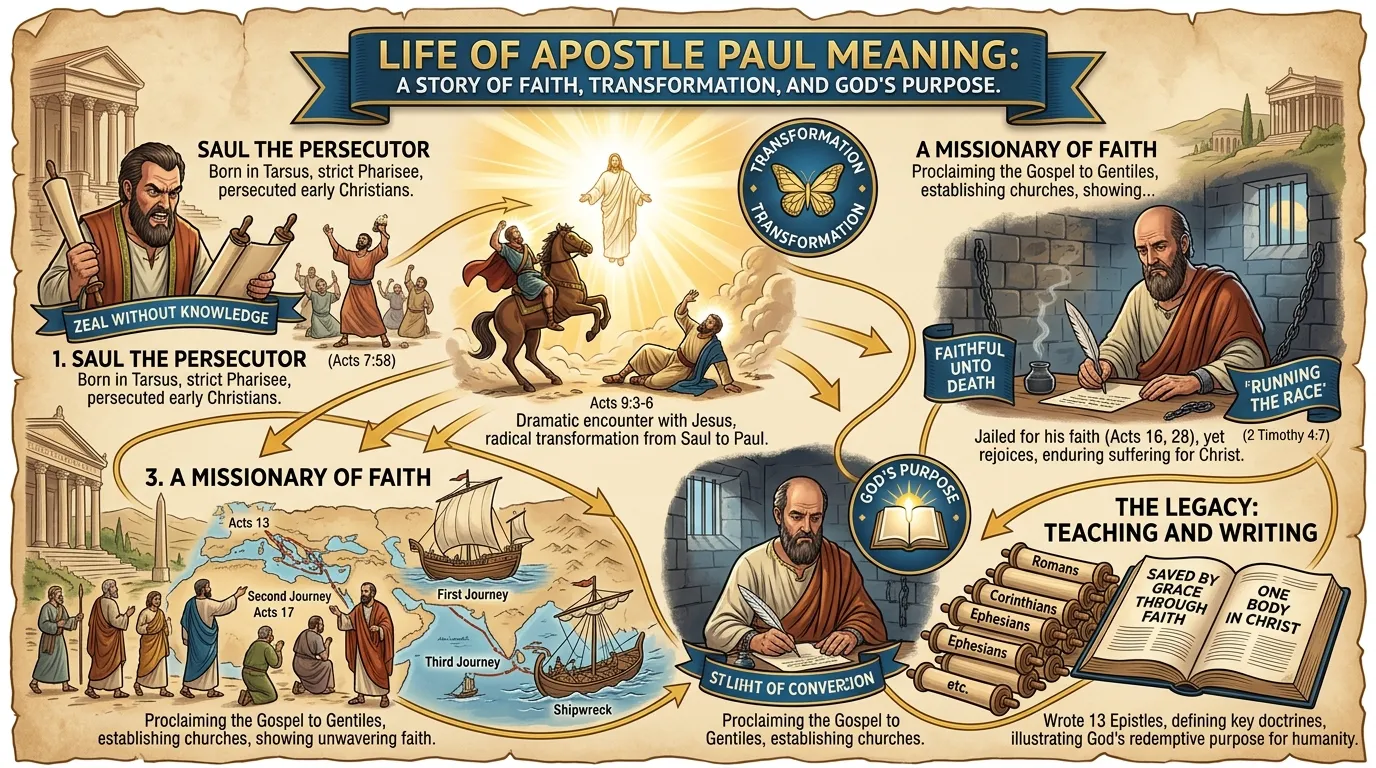
Thirteen letters in your New Testament bear one man’s name. Romans, Corinthians, Galatians, Ephesians, Philippians, Colossians, Thessalonians, Timothy, Titus, Philemon — nearly half the books of the New Testament flowed from a single pen. And the man who wrote them was, by his own repeated confession, the last person anyone would have chosen. “I am the least of the apostles,” he wrote, “because I persecuted the church of God” (1 Corinthians 15:9). The life of the apostle Paul is the Bible’s loudest answer to the question of whether anyone is too far gone, too late, or too wrong for God to use.
His story stretches across the entire book of Acts and most of the epistles — roughly thirty years of travel, preaching, suffering, writing, and dying. It is a whole-life arc: a strict Pharisee becomes a blinding-light convert, then the most traveled missionary of the ancient world, then a prisoner whose chains produced some of the deepest theology ever written. To trace that arc is to watch grace do its complete work on one human life.
The Pharisee From Tarsus
Paul was born Saul in Tarsus, a respected city in Cilicia, to a family of the tribe of Benjamin. He held Roman citizenship from birth — a rare and valuable status for a Jewish family — and he was raised with the twin inheritances of Hebrew Scripture and Greco-Roman culture. He could quote the poets of his day and the prophets of his fathers. His education was finished in Jerusalem under Gamaliel, the most honored rabbi of the age, and Paul excelled: “I was advancing in Judaism beyond many of my own age among my people,” he later wrote, “so extremely zealous was I for the traditions of my fathers” (Galatians 1:14).
That zeal made him, for a time, the church’s enemy — a chapter this article will touch only briefly, since it deserves its own telling. What matters for the whole arc is the kind of man Saul was: brilliant, disciplined, utterly sincere, and utterly wrong. He was not a casual sinner drifting from God; he was a devout man sprinting in the wrong direction. God does not only save the indifferent. He saves the convinced — and Saul of Tarsus proves it.
Knocked Down at Noon
The turning point came on an ordinary stretch of road to Damascus, where Saul was traveling with warrants to arrest Christians. Around noon, a light from heaven — brighter than the sun, Luke stresses — blinded him, and a voice spoke: “Saul, Saul, why are you persecuting me?” The persecutor had attacked the church; Jesus took it personally. “I am Jesus, whom you are persecuting.” In that sentence the whole of Christian theology stands: to strike the body is to strike the Head.
Led by the hand into Damascus, blind for three days, Saul waited — and the church he had come to destroy sent him its mercy in the form of a man named Ananias, who laid hands on him, restored his sight, and baptized him. The hunter became the hunted man’s brother in a single afternoon. Within days, Saul was in the synagogues proclaiming that Jesus is the Son of God, and the believers who heard him were, Luke says, astonished. Grace does not ask for a résumé. It rewrites one.
Three Journeys That Drew the Map
What followed was the most consequential travel career in church history. Over roughly a decade, Paul undertook three great missionary journeys, planting churches across the Roman world and effectively carrying the gospel from Jerusalem to the doorstep of Rome.
The first journey (Acts 13–14) took Paul and Barnabas from Antioch to Cyprus and into the highlands of Galatia — Pisidian Antioch, Iconium, Lystra, Derbe. At Lystra, after healing a lame man, the crowds tried to worship Paul as a god; at the same city, shortly after, a mob stoned him and dragged him out of town, supposing him dead. He got up and walked back in. That is the missionary pattern in miniature: miracles, misunderstanding, violence, perseverance.
The second journey (Acts 15–18) broke into Europe. At Philippi, Paul and Silas were beaten and jailed — and sang hymns at midnight until an earthquake opened the prison; the jailer and his household were baptized before dawn. At Thessalonica the mission sparked a riot; at Berea the hearers checked the Scriptures daily; at Athens Paul debated the philosophers on the Areopagus, quoting their own poets to preach the unknown God; at Corinth he stayed eighteen months, and a church was born that would receive two of his greatest letters.
The third journey (Acts 18–21) centered on Ephesus, where Paul taught daily for over two years and “all the residents of Asia heard the word of the Lord.” The gospel hit the local economy — silversmiths who made shrines of Artemis rioted — which is what the gospel does when it actually arrives. Everywhere Paul went, two things followed: converts and controversy. He considered both of them normal.
Running beneath all three journeys was the Jerusalem Council of Acts 15, where Paul helped settle the question that would define Christianity: Gentiles do not have to become Jews to follow Jesus. The gospel is not a tribal religion with admission requirements. It is grace, open to all — a doctrine Paul did not merely teach but embodied, since he himself was living proof.
The Pen of a Prisoner
Paul’s journeys ended in chains, but his influence was only beginning. Arrested in Jerusalem, tried before governors and a king, shipwrecked on the way to Rome, he finally reached the imperial capital as a prisoner — and from custody he wrote the letters we call the Prison Epistles: Ephesians, Philippians, Colossians, Philemon. Consider the irony: the man with the least freedom in the empire wrote the church’s greatest meditations on freedom, joy, and the cosmic Christ. “Rejoice in the Lord always,” he wrote from prison (Philippians 4:4) — not as theory, but as testimony.
His letters are where Christian doctrine found its clearest voice. Romans lays out justification by faith with the precision of a legal brief and the passion of a sermon. Galatians defends grace against those who would add conditions to it. Ephesians lifts the church into the heavenlies. First Corinthians applies the gospel to a messy, divided congregation. The pastoral letters — Timothy and Titus — hand the mission to the next generation. Paul wrote theology the way a field surgeon works: under pressure, for people who were bleeding.
And he suffered for every word of it. His own summary reads like a casualty report: “Five times I received at the hands of the Jews the forty lashes less one. Three times I was beaten with rods. Once I was stoned. Three times I was shipwrecked” (2 Corinthians 11:24–25) — and the list goes on. He called these his credentials. In Paul’s arithmetic, scars were the signature of authenticity.
The Finish Line
Tradition holds that Paul was released from his first Roman imprisonment, traveled again, was arrested once more under Nero, and was finally executed in Rome around AD 64–67 — beheaded, as befitted a Roman citizen, outside the city walls. His last letter, 2 Timothy, was written from a cold cell with winter coming: “I have fought the good fight, I have finished the race, I have kept the faith. Henceforth there is laid up for me the crown of righteousness” (2 Timothy 4:7–8). No bitterness, no regret, no plea for rescue. Only a runner checking the distance already covered and finding it complete.
Luke closes the book of Acts not with Paul’s death but with Paul preaching in Rome “with all boldness and without hindrance” — the gospel unchained even when the apostle was chained. It is the perfect final image: the mission outlives the missionary. The man dies; the message does not.
What His Life Keeps Asking Us
Paul’s whole-life arc leaves every reader with the same uncomfortable, wonderful question: if God could do that with him — the blasphemer, the persecutor, the violent man, as he called himself in 1 Timothy 1:13 — then what is He able to do with you? His life answers in three movements. Your past is not your prison: the worst chapter can become the prologue. Your suffering is not wasted: beatings became letters, prisons became pulpits. And your calling is bigger than your comfort: the man who could have retired to Tarsus chose the road, the sea, the cell, and the sword — and called it gain.
For readers who want the wider historical frame around this remarkable life, the Wikipedia article on Paul the Apostle gathers the major events, journeys, and scholarly discussion of his letters in one place — a helpful companion to reading his story straight through Acts and the epistles.










