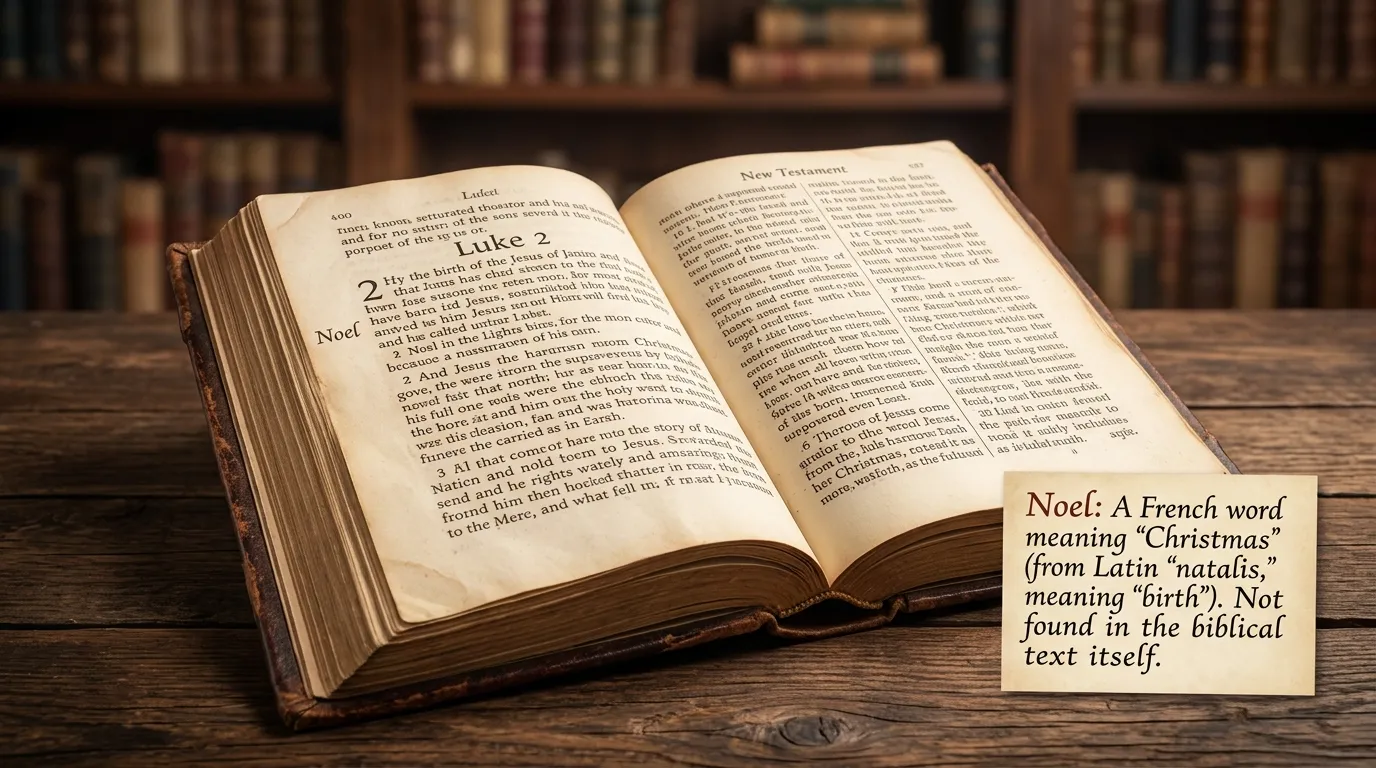
It appears in carols, on cards, and in the names of children born in December — Noel. Most people who sing “The First Noel” have never asked what the word means, or whether it is even in the Bible. The answer is a small journey through Latin, French, and English, ending at a Bethlehem manger. Noel is not a Hebrew or Greek word of Scripture, but the reality it names — birth, good news, the arrival — is the heartbeat of the Christmas story.
From Latin to Carol: Where the Word Comes From
Noel comes to English through Old French noel (modern French Noël), which derives from Latin natalis — meaning “of birth” or “birthday.” The full Latin phrase was natalis dies Domini: “the birthday of the Lord.” Over centuries, the word for the day became the word for the season and then for the joy of the season — so that in French, “Joyeux Noël” is simply “Merry Christmas,” and a noël is a Christmas carol.
The English carol “The First Noel” (first published in 1833, though the words are older) uses the word in its original sense: “The first Noel the angel did say / Was to certain poor shepherds in fields as they lay.” The “first Noel” is the first announcement of the birth — the angel’s “I bring you good news of great joy” (Luke 2:10). The carol is essentially Luke 2 set to music, walking verse by verse through the shepherds, the star, and the wise men. To sing it thoughtfully is to sing Scripture.
As a given name, Noel (and Noelle for girls) became popular precisely because of these associations — parents naming December-born children, or any children, after the joy of Christ’s birth. The name carries no Hebrew meaning, but it carries a Christian history: birth, gladness, the good news announced.
The Announcement: What the First Noel Declared
If Noel means “birth announcement,” then the Bible’s first Noel is Luke 2:10-11: “Fear not, for behold, I bring you good news of great joy that will be for all the people. For unto you is born this day in the city of David a Savior, who is Christ the Lord.” Every word is weighted. “Good news” (euangelion — gospel) was the word used for imperial proclamations of a Caesar’s birth or victory; Luke deliberately applies the emperor’s word to a peasant baby. “Great joy” — not mild pleasantness but overwhelming gladness. “For all the people” — the announcement is universal, though first delivered to shepherds, society’s overlooked. “A Savior, who is Christ the Lord” — three titles in one breath: Savior (He rescues), Christ (the Anointed King), Lord (God Himself).
Matthew’s account gives the same announcement from another angle: the angel tells Joseph to name Him Jesus, “for he will save his people from their sins” (Matthew 1:21). The name Jesus (Yeshua — “the LORD saves”) is the Noel in miniature: the birth’s meaning compressed into two syllables. Every “Noel” ever sung is commentary on that name.
The Prophecies Behind the Birth
The birth announced at the first Noel did not arrive unannounced in history. Isaiah, seven centuries earlier: “For to us a child is born, to us a son is given… and his name shall be called Wonderful Counselor, Mighty God, Everlasting Father, Prince of Peace” (Isaiah 9:6). Micah named the town: “O Bethlehem… from you shall come forth for me one who is to be ruler in Israel” (Micah 5:2). Isaiah again: “Behold, the virgin shall conceive and bear a son, and shall call his name Immanuel” (Isaiah 7:14) — God with us (Matthew 1:23).
This is why the New Testament treats the birth as news rather than merely an event: it is the arrival of what was promised, the keeping of an ancient word. “When the fullness of time had come, God sent forth his Son” (Galatians 4:4). Noel means the waiting is over. The prophets’ “one day” became the shepherds’ “this day.”
Paul’s phrase “the fullness of time” hints at why then: the Roman Empire had built roads to every corner of the known world, a common trade language (Greek) carried ideas across borders, and the Jewish dispersion had planted synagogues — and the Scriptures — in city after city. The stage was set for news to travel: Pax Romana, the Jewish diaspora, and the Greek tongue became the unwitting ushers of the gospel. God timed the Noel not only theologically but strategically — the birth arrived when the world could hear it. And the same God times His workings in your life with the same precision: what feels like delay is often preparation, the roads being built for the news to run on.
The Carols That Carried Noel Through the Centuries
Noel might have remained a scholar’s Latin footnote if singers hadn’t carried it. In medieval France, the noël became a whole genre: popular songs sung door to door at Christmas, mixing the sacred story with local color. These weren’t cathedral compositions but people’s music — farmers and townsfolk singing the nativity in their own tongue. The tradition crossed the Channel, and by the 1700s English singers knew “The First Noel” as a Cornish folk carol, passed along orally before it was ever printed.
That oral history matters theologically. “The First Noel” teaches doctrine the way the best hymns do — by narrating: “Born is the King of Israel” (theology in a chorus), the wise men following the star “night and day,” the call to “praise” with “one accord.” Generations learned Luke 2 and Matthew 2 not from commentaries but from singing. When the church worries about biblical literacy, it should remember: the Noel carols were catechism set to melody, and they worked.
The French tradition gave us more than the word. “O Holy Night” (Cantique de Noël) proclaims “the thrill of hope, the weary world rejoices” — Noel as hope for the weary. “Angels We Have Heard on High” with its soaring Gloria is the shepherds’ hillside in song. Each carol is a facet of the same diamond: the birth announced, the joy commanded, the King adored. To sing them is to join a centuries-long choir — and to teach the next generation the announcement without a single sermon.
There’s a lesson here for how truth travels. The angel’s Noel reached shepherds by proclamation; it reached us by song. God seems pleased to let His greatest news ride on melodies. So sing the Noels — loudly, accurately, and often. Every “Noel, Noel, born is the King of Israel” is evangelism in 4/4 time.
What Noel Means for the One Who Hears It
The angel’s announcement demands a response, and Scripture shows the range. The shepherds went “with haste” to see, then “made known the saying” and returned “glorifying and praising God” (Luke 2:16-20) — haste, witness, worship. Mary “treasured up all these things, pondering them in her heart” (Luke 2:19) — contemplation, the quiet counterpart to the shepherds’ proclamation. The Magi traveled far and “fell down and worshiped him,” offering treasures (Matthew 2:11) — costly worship from unexpected people. Herod was “troubled” and schemed murder (Matthew 2:3) — the announcement as threat to those who will not bend the knee.
Every hearer of the Noel still falls somewhere on that spectrum: hurrying to Christ, pondering Christ, worshiping Christ at cost — or troubled by Him. There is no neutral reception of good news this great. The question Noel asks each December is the question the angel asked the shepherds in effect: now that you have heard, what will you do?
And the promise attached to the announcement is for “all the people” — which includes the anxious, the guilty, the far-off. “The peace of God, which surpasses all understanding, will guard your hearts and your minds in Christ Jesus” (Philippians 4:7) is the Noel’s ongoing fruit: the birth announced once becomes peace experienced daily. “May the God of hope fill you with all joy and peace in believing” (Romans 15:13) — joy and peace in believing, which is simply Noel received.
Is Noel a biblical word?
Not in the original languages — you won’t find it in Hebrew or Greek concordances. It is a Latin-derived word that became the French and English shorthand for “the birth (of Christ)” and the joy surrounding it. The reality it names — the announced birth of the Savior — is thoroughly biblical, centered in Luke 2 and Matthew 1.
Why do we say “Noel” at Christmas instead of just “birth”?
Language keeps what the heart treasures. “Noel” survived because it gathered centuries of gladness into a single syllable — birth, carol, greeting, and good news all at once. It is tradition’s poetry for Scripture’s prose: Luke’s announcement distilled to a word you can sing.
Noel is the sound of heaven’s announcement in human language: a Child is born, a Savior is given, and great joy is for all people. Sing it, say it, name a child by it — but above all, believe it, for “unto you is born this day… Christ the Lord.” For the history of the feast the word celebrates, see Christmas.










