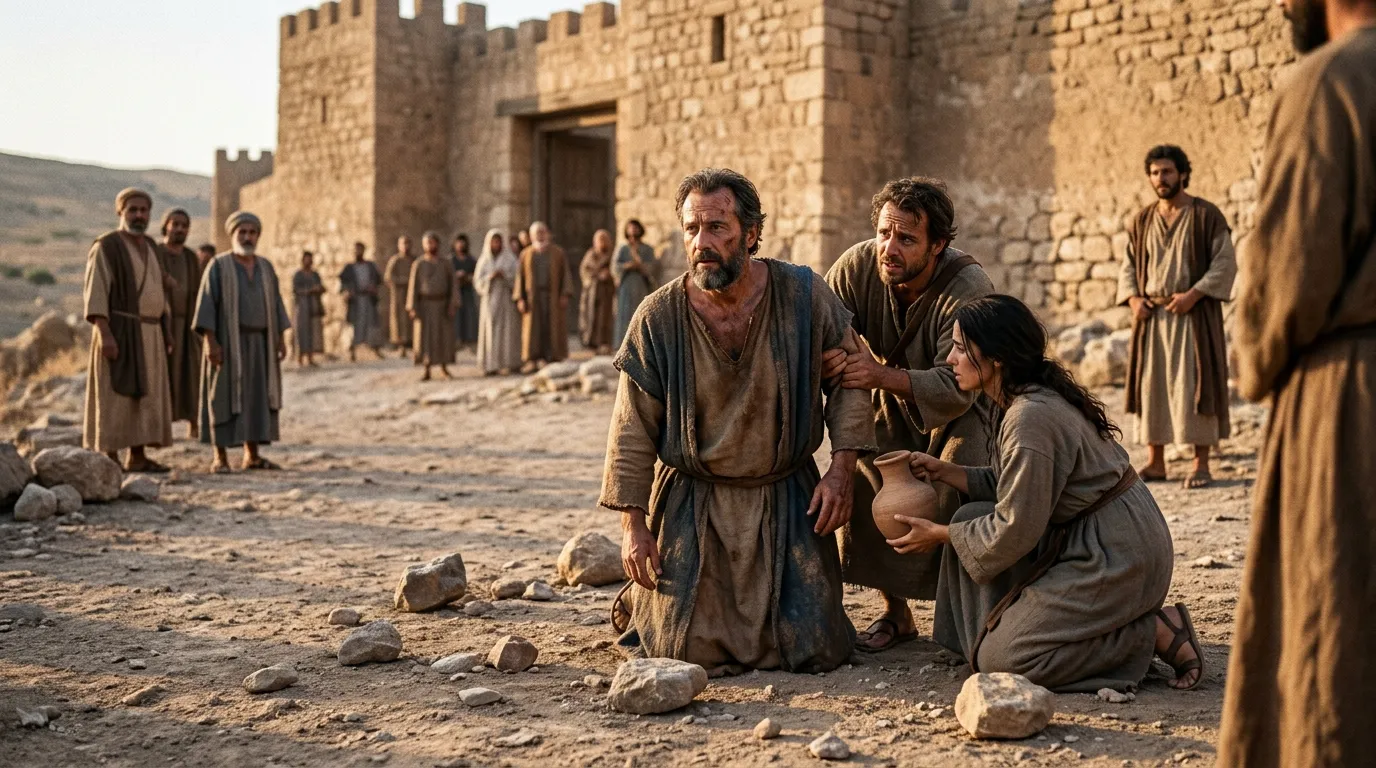
Lystra was supposed to be a triumph. Days earlier the crowds there had tried to worship Paul and Barnabas as gods. Then opponents arrived from Antioch and Iconium, turned the crowd, and dragged Paul outside the city and stoned him. Acts 14:19–20 tells the story in two stark sentences: they stoned Paul and dragged him out of the city, thinking he was dead. But he got up and went back into the city. The next day he left for Derbe. No long recovery scene. No complaint. Just a man who was left for dead standing up and walking back into the very place that had tried to kill him.
This is one of the most astonishing episodes in the book of Acts, and it raises questions that still matter: Why did God allow it? What did Paul learn from it? And what does it mean for believers who suffer for doing good? The stoning at Lystra is not a story about God shielding His servants from every harm. It is a story about God sustaining His servants through harm that should have ended them.
From Worship to Murder in a Single Week
The speed of the reversal is part of the shock. In Acts 14:8–18, Paul healed a man who had been lame from birth. The crowd, steeped in the local legend of gods visiting in human form, shouted that Hermes and Zeus had come down. The priest of Zeus brought bulls and wreaths to offer sacrifices. Paul and Barnabas tore their clothes in horror and rushed out to stop the worship, insisting they were only human beings bringing good news. The crowd was barely restrained.
Then Jews from Antioch and Iconium arrived — men who had already opposed Paul in their own cities — and persuaded the crowd. The same people who had wanted to offer sacrifices now picked up stones. Crowds are volatile, and Luke shows that volatility without exaggeration. Popularity is a poor measure of faithfulness. A crowd that worships you on Tuesday can stone you on Friday. Paul learned that lesson in his body, not just in his theology.
What Stoning Meant
Stoning was not a symbolic punishment. It was a brutal method of execution: a hail of rocks aimed at the head and body until the victim collapsed. The attackers at Lystra were not performing a ritual; they were trying to kill Paul, and they believed they had succeeded. The text says they dragged him out of the city, “thinking he was dead.” The Greek suggests they supposed or assumed it — they saw a broken, bloodied, motionless man and concluded the job was done.
Whether Paul was actually dead and revived, or unconscious and recovered, Luke does not say. Some readers have connected the event to 2 Corinthians 12, where Paul speaks of being caught up to the third heaven, but Paul never dates that experience to Lystra, and the connection is speculation. What the text does say is that the disciples gathered around him, he got up, and he went back into the city. The image of the disciples standing around his body, and then Paul rising, is one of the most cinematic moments in Acts — and Luke reports it with remarkable restraint.
“We Must Go Through Many Hardships”
The stoning cannot be separated from what Paul preached immediately afterwards. After reaching Derbe and preaching there, Paul and Barnabas retraced their steps — back through Lystra, Iconium, and Antioch — “strengthening the disciples and encouraging them to remain true to the faith.” And then this sentence: “We must go through many hardships to enter the kingdom of God” (Acts 14:22).
Paul was not theorizing. He was speaking with fresh wounds. Hardship was not an obstacle to the kingdom; it was the road into it. That is a hard word for a culture that often treats suffering as evidence that something went wrong. For Paul, suffering was evidence that something was going right — that the gospel was advancing into hostile territory and the enemy was resisting. The stoning became a credential, not a contradiction, of his apostleship.
Why God Did Not Stop the Stones
The question every reader asks is why God allowed it. The text does not give a direct answer, and honest interpretation should not invent one. But several truths emerge from the wider story. First, God’s protection of His servants is not the same as immunity from harm. Paul was delivered from many dangers, but not from all of them. Second, suffering became Paul’s pulpit. The believers in Lystra — including a young man named Timothy, who likely witnessed these events — saw a gospel worth bleeding for. Third, Paul’s endurance authenticated his message. A man who returns to the city that stoned him is not peddling a comfortable philosophy. He is testifying to something he believes is worth dying for.
It is also worth noting that Paul later listed stoning among his sufferings — “once I was pelted with stones” (2 Corinthians 11:25) — alongside beatings, shipwrecks, and imprisonments. He did not present it as a badge of superiority but as part of the cost of the calling. The stoning at Lystra was one entry in a long ledger of suffering, and Paul treated the whole ledger as evidence of Christ’s power in weakness rather than of his own toughness.
Timothy, Lystra, and the Long Shadow
Lystra matters beyond Paul’s own story because it became the home of Timothy. When Paul returned to Lystra on his second journey, he found Timothy there, “well spoken of by the believers at Lystra and Iconium” (Acts 16:2). Timothy’s mother Eunice and grandmother Lois had taught him the Scriptures from childhood (2 Timothy 1:5; 3:15). It is very likely that Timothy saw or heard about Paul’s stoning. Imagine the effect on a young man: the preacher who had been left for dead came back, kept preaching, and later came looking for a young partner. Timothy said yes. The stones at Lystra may have planted a seed that grew into one of the most important pastorates of the early church.
Suffering has a way of producing witnesses. The disciples who gathered around Paul’s body did not scatter. The church in Lystra did not dissolve. It produced Timothy. What looked like the end of Paul’s mission in that city became the beginning of a new generation of leadership.
What the Stoning Means for Believers Today
Few believers today will face literal stones, but the pattern holds. Doing good does not guarantee safety. Crowds turn. Reputations reverse. Faithful people get hurt in the very places they tried to help. The stoning at Lystra teaches that God’s presence is not measured by the absence of pain but by the strength to rise and re-enter the city. Some wounds require withdrawal for a season — Paul did leave for Derbe the next day — but withdrawal is not surrender. He came back to Lystra again, and he kept preaching.
The passage also warns against reading suffering as God’s disapproval. The opponents at Lystra surely thought the stones proved God had rejected Paul. The resurrection of Paul’s ministry proved the opposite. When believers suffer for righteousness, the stones are not the final word. The God who raised Paul from the dust outside Lystra is the same God who raises His people from every place they have been left for dead.
Paul’s Scars and His Later Ministry
Paul carried the marks of Lystra for the rest of his life. Years later he wrote to the Galatians — churches in the very region where he had been stoned — “I bear on my body the marks of Jesus” (Galatians 6:17). The Greek word is stigmata, the brand-marks of a slave. Paul was saying that his scars were his credentials. They proved whose he was. The stones of Lystra, the rods of Philippi, the chains of Rome — all of them were marks of ownership. He belonged to Christ, and his body told the story.
The scars also shaped his pastoral counsel. When Paul wrote to young churches about suffering, he was not quoting a theory. He was reporting from experience. He could tell the Thessalonians that they were “destined” for trials (1 Thessalonians 3:3) because he had lived it. He could tell the Corinthians that God comforts us in all our troubles so that we can comfort others (2 Corinthians 1:3–4) because he had been comforted in the dust outside Lystra. Suffering that is surrendered to God becomes a pastoral resource. The wounds that were meant to silence Paul became the very things that gave his words weight.
Believers who carry their own scars — physical, emotional, or relational — can take heart from Paul’s example. Scars are not proof that God abandoned you. They can become proof that God sustained you. The stones did not get the last word at Lystra, and they do not get the last word in your story either.
For the historical background of stoning as a punishment in the ancient world, see the Wikipedia overview of stoning.










