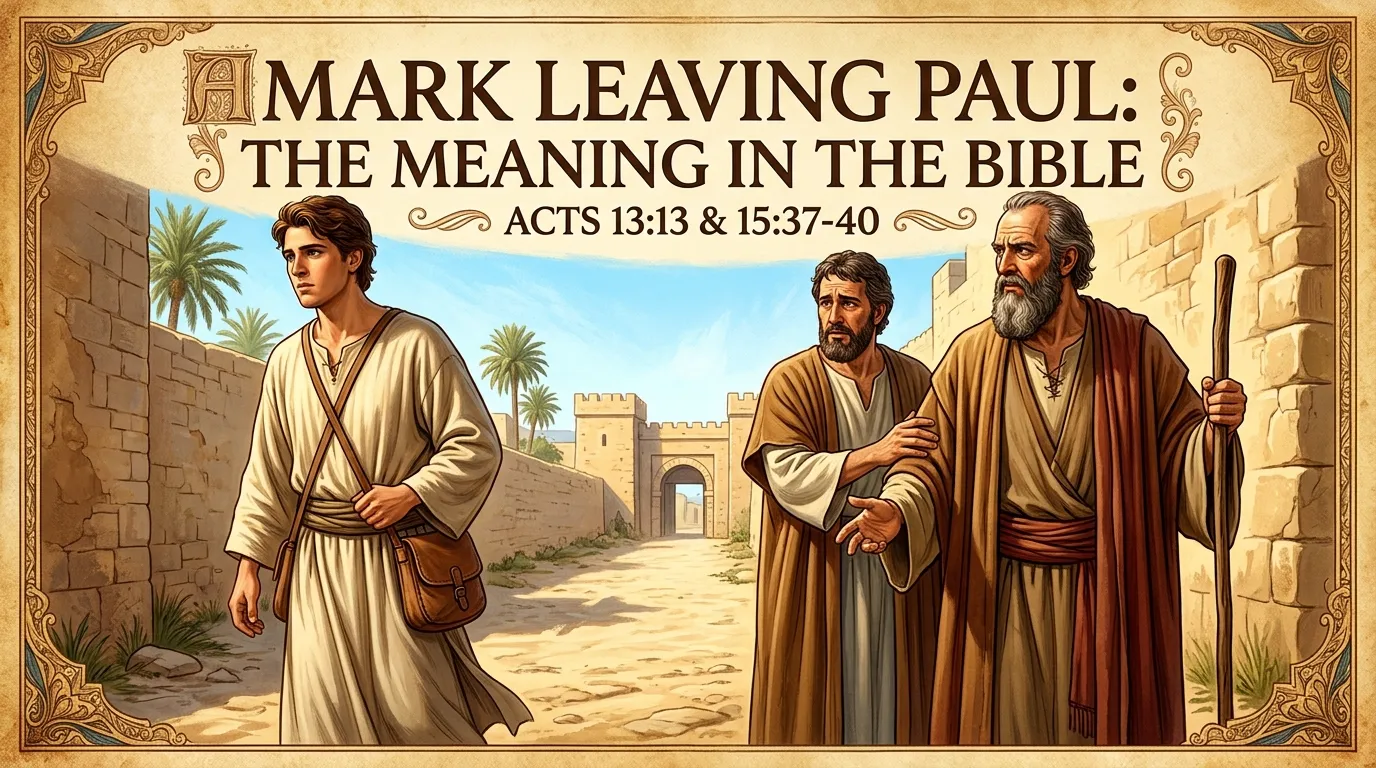
Every leader has a moment when someone on the team walks away, and every young person has a moment when an early failure seems to define them. John Mark had both moments in the same journey. On Paul’s first missionary trip, Mark left the team at Perga in Pamphylia and returned to Jerusalem (Acts 13:13). Luke records the departure in a single clause and offers no explanation. That silence has echoed for two thousand years, because the departure became the fault line in one of the most consequential disagreements of the early church — and because Mark’s story did not end at Perga.
This is not merely a story about quitting. It is a story about how the early church handled failure, how a young man recovered from it, and how two apostles weighed mercy against mission. Mark’s departure touches anyone who has ever left too soon, been left behind, or wondered whether an early failure is permanent.
What Actually Happened at Perga
The facts are sparse. Paul, Barnabas, and John Mark sailed from Cyprus to Perga in Pamphylia. Then, Luke writes, “John left them and returned to Jerusalem.” That is all. No argument is recorded. No rebuke. No stated reason. The team continued into the interior of Asia Minor — through Pisidian Antioch, Iconium, Lystra, and Derbe — without him.
The guesses about why Mark left are many: the malaria-ridden lowlands of Pamphylia; the daunting Taurus mountains ahead; homesickness for Jerusalem, where his mother Mary’s house was a gathering place for believers (Acts 12:12); discomfort with Paul’s growing leadership as the mission shifted toward Gentiles; fear after the confrontation with Elymas on Cyprus. Any of these is plausible, and none can be proved. What can be said is that Mark’s departure was voluntary, it happened at a hard moment, and Paul remembered it.
Why Paul Refused to Take Him Again
When Paul proposed revisiting the churches, Barnabas wanted to bring Mark along. Paul refused, because Mark “had deserted them in Pamphylia and had not continued with them in the work” (Acts 15:38). Paul’s verb is strong — Mark had withdrawn, abandoned the work. From Paul’s perspective, the second journey would be harder than the first: they would be revisiting cities where they had been opposed, beaten, and stoned. A team member who had left once might leave again at a worse moment.
Paul’s judgment was not cruelty. It was stewardship under pressure. Leaders who carry responsibility for others feel the weight of reliability differently. Paul was not deciding whether Mark was saved or whether Mark was a good person. He was deciding whether Mark was ready for this particular assignment. Those are different questions, and confusing them is one of the most common mistakes in Christian conflict. A person can be loved, forgiven, and still not yet ready for a given role.
Why Barnabas Insisted on a Second Chance
Barnabas saw the same facts and reached a different conclusion. His name meant “son of encouragement,” and he lived up to it. He had once vouched for Paul when everyone else was afraid of the former persecutor. Now he wanted to vouch for Mark. Barnabas understood something Paul’s focus on the mission could miss: people grow in the gap between failure and restoration, but only if someone stays close enough to walk with them through it.
Barnabas took Mark and sailed to Cyprus — Mark’s home territory. The choice was strategic as well as pastoral. Cyprus was where the first journey had begun, and it was a gentler assignment than the mainland cities. Barnabas was not throwing Mark back into the deepest water. He was giving him a place to rebuild trust, prove faithfulness, and regain confidence. Good restoration is not just forgiveness; it is a wisely chosen next assignment.
The Long Road Back
Mark’s rehabilitation did not happen overnight. Years pass in the narrative before he reappears. When he does, the references accumulate like a quiet restoration. Paul mentions Mark in Colossians 4:10 as a comfort and instructs the church to welcome him — a notable detail, suggesting Paul himself had to help the church receive Mark. In Philemon 24, Mark is among Paul’s fellow workers in Rome. And in 2 Timothy 4:11, written near the end of Paul’s life, the apostle says, “Get Mark and bring him with you, because he is helpful to me in my ministry.” The man once deemed unreliable had become useful — the Greek word is euchrēstos, the same word Paul uses for a vessel “useful to the Master” in 2 Timothy 2:21.
Church tradition adds that Mark later became Peter’s interpreter and the author of the Gospel of Mark, drawing on Peter’s eyewitness testimony. Peter calls him “my son Mark” (1 Peter 5:13). Whether or not every detail of the tradition is certain, the trajectory is clear: the young man who left at Perga became a Gospel writer. Early failure did not write his ending.
Three Lessons from Mark’s Departure
First, early failure is data, not destiny. Mark’s departure revealed something real about his readiness at that moment. It did not reveal his permanent character. People change, and the church must leave room for that change.
Second, restoration requires both grace and structure. Barnabas did not simply declare Mark restored; he took him on a real mission with real responsibilities. Forgiveness without a next step leaves a person in limbo. Barnabas gave Mark work to do.
Third, disagreement about a person is not the same as rejection of the person. Paul’s refusal was painful, but it was not final. He kept the door open, and decades later he walked through it himself by asking for Mark. If you have been on either side of such a decision — the leader who said “not yet” or the person who heard it — Mark’s story says the story is not over.
For Those Who Left Too Soon
Many readers identify with Mark more than with Paul or Barnabas. They left a ministry, a marriage, a calling, a city — too soon, for reasons that seemed overwhelming at the time. Mark’s story offers no quick fix and no denial of consequences. His departure really did cost him a place on the second journey, and the disagreement it caused was real. But the story also insists that leaving is not the last chapter. The same Lord who used Paul’s steadfastness also used Barnabas’s patience and Mark’s repentance. If you left too soon, the path back is the one Mark walked: accept the consequence, take the smaller assignment, prove faithful in it, and let time and fruitfulness rebuild trust.
Mark and Peter: A Second Mentor
Barnabas was not Mark’s only mentor. Church tradition, supported by Peter’s own words, says that Mark later became closely associated with Peter. Peter calls him “my son Mark” (1 Peter 5:13), using the language of spiritual fatherhood. The early church historian Papias records that Mark became Peter’s interpreter, writing down Peter’s preaching as the basis for the Gospel of Mark. If that tradition is correct, then Mark’s restoration involved not one mentor but two: Barnabas, who gave him a second chance, and Peter, who gave him a story to tell.
Peter was a fitting mentor for Mark. Peter knew what it meant to fail publicly. He had denied Jesus three times, in the courtyard, on the night of the crucifixion. He knew what it meant to be restored — three questions on a beach, three commissions. A mentor who has failed and been restored can speak to a younger failure with a credibility that the never-fallen cannot match. Peter could tell Mark: I know what it is to walk away. I also know what it is to come back. And the One who restored me will restore you.
The pairing of Mark with Peter also shows how God weaves restoration through community. No single person carries the whole work. Barnabas started it. Peter continued it. Paul completed it by welcoming Mark back. Restoration is a team project, and the church is the team.
The Discipline of Waiting
One of the hardest parts of Mark’s story is the waiting. Between his departure at Perga and his reappearance as a trusted coworker, years passed — years in which he had to prove himself on Cyprus with Barnabas, away from the spotlight, doing faithful work that no one recorded. Restoration is rarely instant. It is a slow accumulation of small faithfulnesses: showing up, finishing the task, staying when it gets hard. Mark’s story dignifies the waiting. The years on Cyprus were not wasted years. They were the years that made him trustworthy. If you are in a season of proving yourself after a failure, take heart: the waiting is the work.
For more on the figure at the center of this story, the Wikipedia article on Mark the Evangelist surveys the biblical and traditional evidence.










