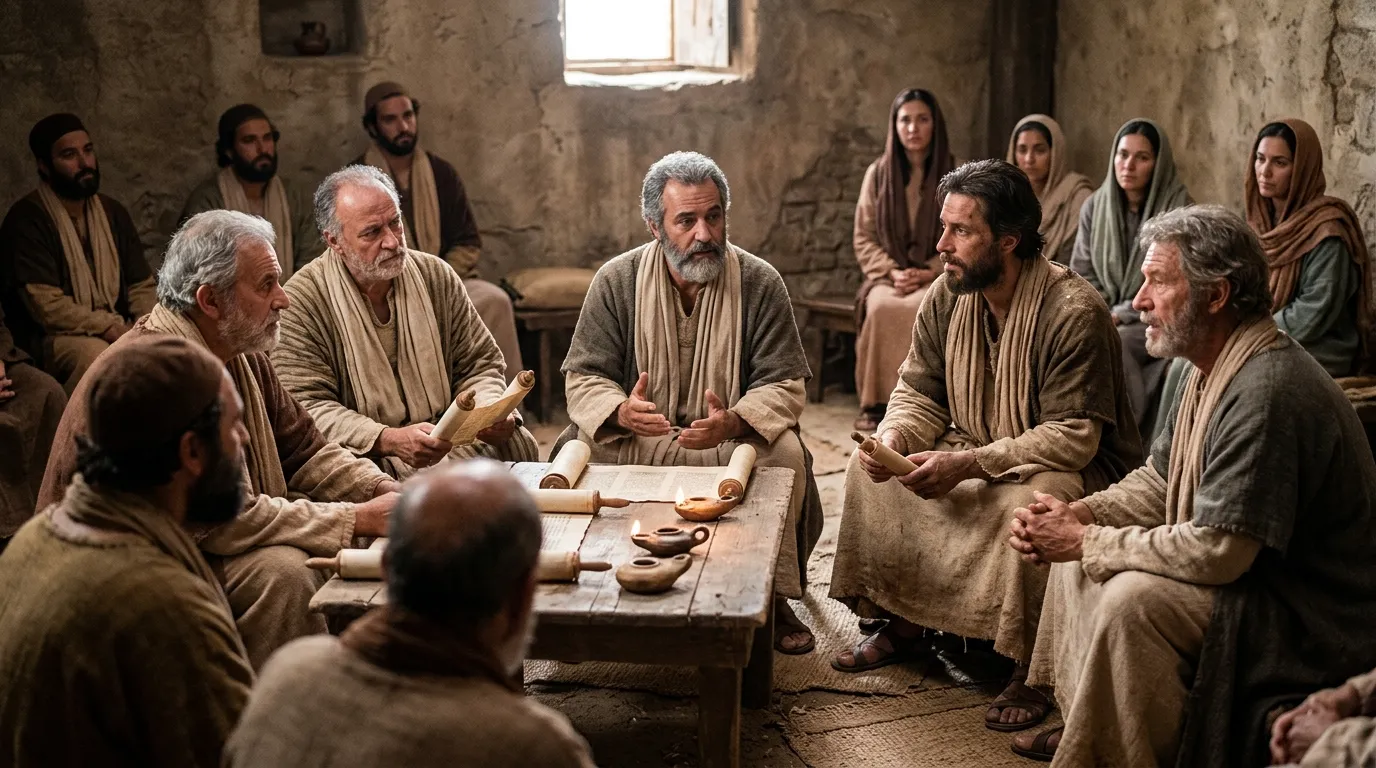
The early church did not grow in a straight line. It grew through arguments — sharp, consequential, sometimes public arguments about what the gospel required and who belonged in the people of God. The New Testament does not hide these controversies. It records them in detail, because the way the apostles handled disagreement became part of the gospel’s own credibility. The early church controversies were not a failure of the mission. They were the mission working itself out in real time, under the guidance of the Holy Spirit, through people who had to think, debate, and decide.
This article traces the major controversies of the apostolic church: the admission of Gentiles, the circumcision question, the clash over table fellowship, the division between Paul and Barnabas, and the Corinthian disorders. Together they show a church learning to distinguish the unchangeable core of the gospel from the customs and preferences that could change.
Controversy One: Can Gentiles Belong Without Becoming Jews?
The first and deepest controversy was whether Gentiles could be saved without first becoming Jews. The earliest believers were Jewish. They worshiped in the temple, kept the law, and assumed the Messiah’s people would look like them. Then the Holy Spirit fell on Cornelius, a Roman centurion, and his household — while Peter was still preaching (Acts 10:44–48). Peter had already seen a vision of unclean animals and heard the words, “Do not call anything impure that God has made clean.” The evidence was undeniable: Gentiles had received the same Spirit as Jewish believers.
When Peter returned to Jerusalem, he was criticized for eating with uncircumcised men (Acts 11:2–3). He explained the whole sequence, and the critics fell silent and glorified God. But the question did not go away. It returned in sharper form when Paul and Barnabas began planting Gentile churches across Asia Minor. Some believers from Judea taught, “Unless you are circumcised, according to the custom taught by Moses, you cannot be saved” (Acts 15:1). That claim struck at the heart of the gospel: if circumcision was required, then salvation was Christ plus Moses, grace plus law.
Controversy Two: The Jerusalem Council
The church’s answer came through the Jerusalem Council of Acts 15 — the first great council of Christian history. Paul and Barnabas traveled to Jerusalem. Peter testified that God had given the Holy Spirit to Gentiles without distinction. James, the brother of Jesus and a leader of the Jerusalem church, cited the prophet Amos to show that God had always intended to include the nations. The council’s decision was decisive: Gentiles should not be burdened with the law of Moses. They were asked only to abstain from food polluted by idols, from sexual immorality, from the meat of strangled animals, and from blood — concessions aimed at preserving table fellowship between Jewish and Gentile believers.
The council’s letter is a model of theological decision-making. It combined testimony (what God had done), Scripture (what the prophets had promised), and pastoral wisdom (what would preserve unity). It also shows that the apostles did not settle everything by private revelation. They met, debated, listened, and decided together. The church has been following that pattern ever since.
Controversy Three: Table Fellowship at Antioch
Even after the council, the issue resurfaced in practice. In Galatians 2:11–14, Paul recounts confronting Peter at Antioch. Peter had been eating with Gentile believers, but when men from James arrived, he withdrew and separated himself, fearing the circumcision group. Other Jewish believers, including Barnabas, followed his lead. Paul opposed Peter “to his face,” because Peter’s conduct contradicted the gospel. If Jewish and Gentile believers could not eat together, then the unity Christ had achieved on the cross was being denied at the dinner table.
The incident shows that agreement in principle does not automatically produce consistency in practice. Peter knew the theology. He had defended Gentile inclusion at the council. Yet social pressure pulled him backward. Paul’s rebuke was public because the offense was public. This controversy teaches that the gospel must be defended not only in statements of faith but in seating arrangements — in who we eat with, welcome, and treat as equals.
Controversy Four: Order in Corinth
A different kind of controversy erupted in Corinth. The church there was divided by loyalty to leaders (“I follow Paul,” “I follow Apollos,” “I follow Cephas”), confused about marriage and singleness, careless about the Lord’s Supper, and chaotic in worship. Some members were taking each other to court. Others were proud of tolerating open immorality. The controversies in Corinth were not about the boundary of the gospel but about the life of the church: how believers should treat one another, use their gifts, and order their gatherings.
Paul’s response in 1 Corinthians is remarkable for its patience. He does not dissolve the church. He corrects it — chapter by chapter, issue by issue — grounding every correction in the cross. The body metaphor of 1 Corinthians 12, the love chapter of 1 Corinthians 13, and the resurrection hope of 1 Corinthians 15 are all written to a church in controversy. Some of the most beloved passages in Scripture were born from conflict.
Controversy Five: The Split Between Paul and Barnabas
Not every controversy was resolved with a council or a letter. The disagreement between Paul and Barnabas over John Mark (Acts 15:36–41) ended in separation. No council was called. No one was declared wrong. The team simply divided, and the mission doubled. This controversy belongs in the list because it shows that not every disagreement has a single institutional solution. Sometimes the Spirit’s answer is not uniformity but multiplication — two teams, two routes, the same gospel.
Together, these controversies reveal a pattern. The early church argued about the boundary (who belongs?), the basis (what saves?), the table (who eats with whom?), the order (how do we live together?), and the team (who goes with whom?). Every generation of the church faces the same five questions in new forms.
What the Controversies Teach the Church Today
First, controversy is not a sign that the church has failed. The apostolic church argued, and it was still the apostolic church. Second, the gospel is the non-negotiable. The church could compromise on food, calendars, and personnel, but it could not compromise on grace alone through Christ alone. Third, decisions should combine Scripture, testimony, and pastoral wisdom — the Jerusalem pattern. Fourth, public error requires public correction, as at Antioch. Fifth, some disagreements end in respectful separation rather than forced unity, and God can work through both paths.
The early church did not survive controversy by avoiding it. It survived by facing it with Scripture open, the Spirit sought, and the gospel held firm. That is still the way forward.
The Circumcision Question in Galatians
The Jerusalem Council did not end the circumcision controversy. It settled the church’s official position, but the argument continued in the churches Paul had planted. The letter to the Galatians is Paul’s most passionate response to teachers who were insisting that Gentile believers must be circumcised and keep the law of Moses. Paul’s language is blistering: “If you let yourselves be circumcised, Christ will be of no value to you at all” (Galatians 5:2). He calls the false teachers accursed. He wishes they would go the whole way and emasculate themselves. The heat of the letter shows how high the stakes were.
Why did Paul react so strongly? Because the issue was not circumcision. The issue was the gospel. If Gentile believers had to add law-keeping to faith in Christ, then Christ’s work was incomplete, grace was insufficient, and salvation depended partly on human effort. Paul saw that clearly, and he fought for the principle that the council had affirmed: salvation is by grace alone through faith alone in Christ alone. Every generation faces a version of this controversy — a new requirement added to the gospel, a new hoop to jump through, a new badge of belonging. The answer is always the same: Christ plus nothing.
The Galatian controversy also shows that councils do not automatically end arguments. Decisions must be taught, defended, and applied, church by church, believer by believer. The truth the council declared had to be preached into the hearts of the Galatians, just as it must be preached into ours.
The Role of the Holy Spirit in the Decisions
The Jerusalem Council’s letter contains a remarkable claim: “It seemed good to the Holy Spirit and to us” (Acts 15:28). The apostles did not present their decision as merely human consensus. They believed the Spirit had guided the deliberation. That claim matters because it shows how the early church understood decision-making: Scripture, testimony, debate, and the Spirit’s guidance together. The council did not bypass human reasoning by appealing to direct revelation, and it did not reduce the decision to human politics by ignoring the Spirit. It held both together. Church decisions today should follow the same pattern — open Bibles, honest debate, prayerful listening, and a willingness to say, with humility, that the Spirit has led.
Readers who want the historical setting of the council that settled the circumcision question will find it in the Wikipedia article on the Council of Jerusalem.










