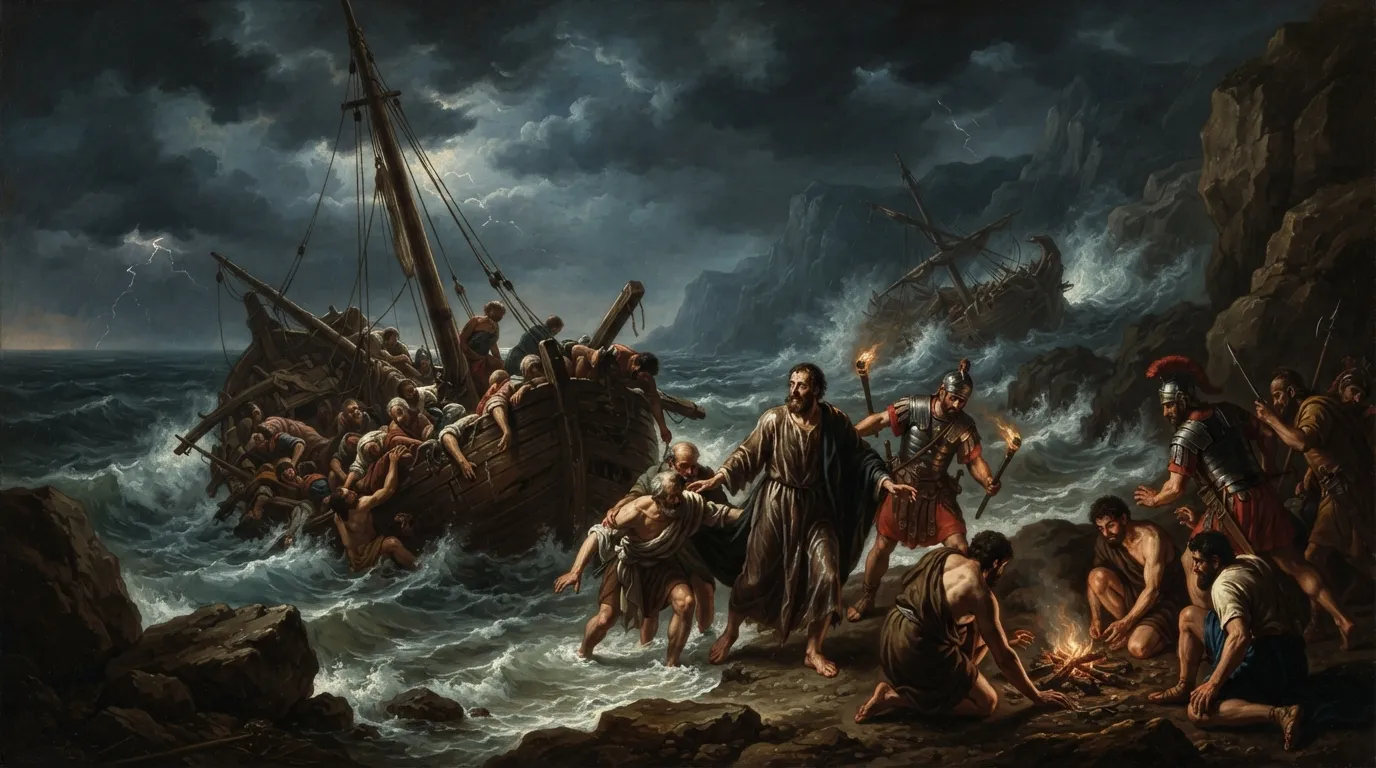
The wind had been against them for days. The ship was being driven. The sailors had thrown the cargo overboard, then the tackle, then their hope. And in the middle of it all, a prisoner stood up and told 276 people they would survive — not because the storm would spare the ship, but because God had said so. The shipwreck of Paul in Acts 27 is one of the most detailed sea-voyage narratives in ancient literature, and it is far more than an adventure story. It is a study in leadership under pressure, divine sovereignty over chaos, and the strange way God keeps His promises — sometimes by letting the ship break apart.
The Voyage That Should Not Have Happened
Paul was traveling to Rome as a prisoner, under the guard of a centurion named Julius, to stand trial before Caesar. The journey began reasonably, but at Fair Havens on Crete, Paul warned that the voyage would bring disaster and loss — of the ship, the cargo, and lives (Acts 27:10). The centurion listened instead to the pilot and the owner of the ship, who wanted to reach Phoenix, a better harbor for winter. The majority agreed. Luke notes, almost dryly, that “the majority decided that we should sail on.” Majorities are often wrong, and this one was.
They had barely left Fair Havens when a violent wind called the Northeaster swept down from the island. The ship could not head into it and was driven before the storm. For fourteen days they drifted, without sun or stars, without bearings, without food taken regularly, and finally without hope. The sailors’ despair is recorded with rare emotional honesty: “we finally gave up all hope of being saved” (Acts 27:20). Hopelessness is a universal human experience, and Luke does not rush past it.
A Prisoner Takes Command
One of the most striking features of the chapter is the reversal of authority. Paul was the prisoner. Julius was the officer. The pilot was the expert. Yet as the crisis deepened, Paul became the de facto leader — not by rank but by clarity, calm, and a word from God. He reminded them of his warning, not to gloat but to establish credibility. Then he delivered the message that changed everything: an angel of God had stood beside him and said, “Do not be afraid, Paul. You must stand trial before Caesar; and God has graciously given you the lives of all who sail with you” (Acts 27:24).
Notice the structure of the promise. The guarantee was Paul’s arrival in Rome, and the gift attached to it was the lives of everyone aboard. God’s promise to one man became the shelter for 276 people. Paul’s faith became the vessel that carried them all. He told them to keep up their courage, “for I have faith in God that it will happen just as he told me” (Acts 27:25). Faith in a storm is not positive thinking. It is confidence in a specific word from a specific God.
The Temptation to Escape
Before the wreck, there was a test. Some sailors tried to lower the lifeboat and abandon ship under the pretense of dropping anchors. Paul saw through it and told the centurion, “Unless these men stay with the ship, you cannot be saved” (Acts 27:31). The soldiers cut the ropes and let the lifeboat fall away. The moment is theologically rich: the promise of survival was unconditional in its source, but it was worked out through means — staying with the ship, following instructions, eating food, trusting the process. Divine sovereignty and human responsibility are not competitors in Acts 27. They are partners.
Paul then urged everyone to eat, took bread, gave thanks to God in front of them all, and broke it. It was a Eucharistic echo — a meal of gratitude in the middle of the storm, offered openly before pagans, soldiers, and sailors. Then they lightened the ship by throwing the grain into the sea. Everything expendable was jettisoned. What remained was what mattered: the people and the promise.
The Wreck and the Shore
At dawn they saw land they did not recognize — a bay with a sandy beach. They cut the anchors, untied the rudders, hoisted the foresail, and ran for the beach. The ship struck a sandbar, the bow stuck fast, and the stern was broken to pieces by the surf. The soldiers wanted to kill the prisoners to prevent escape. Julius, wanting to spare Paul, stopped them. Everyone reached land — some by swimming, some on planks and pieces of the ship. “In this way everyone reached land safely” (Acts 27:44).
The promise had been kept with precision and without spectacle. The ship was lost, exactly as Paul had been told: “we will run aground on some island” (Acts 27:26). God had not promised to save the ship. He had promised to save the people. That distinction matters for anyone who has prayed for God to preserve a plan, a career, a ministry, or a relationship, and watched the plan break apart while their life was preserved. Sometimes God saves us by letting the ship go.
Malta: The Aftermath Becomes the Mission
The story does not end on the beach. The island was Malta, and its people showed “unusual kindness” — the Greek word is philoxenia, love of strangers. They built a fire. Paul gathered brushwood, a viper fastened itself to his hand, and the islanders assumed he was a murderer being pursued by justice. When he suffered no harm, they changed their minds and called him a god. Paul, characteristically, used the opening to heal the father of Publius, the chief official of the island, and then many others came and were cured. Three months later, Paul sailed for Rome on another ship — with the islanders’ honor and supplies.
The shipwreck became a mission field. Malta received the gospel not because Paul planned a campaign there but because a storm put him there. The detour was the assignment. This is one of the most comforting truths in Acts 27: the places we never intended to go can become the places God uses us most.
What the Shipwreck Means
Acts 27 teaches that God’s promises hold in the storm, but they do not always hold in the form we expect. It teaches that leadership in crisis belongs to whoever has a word from God and the courage to speak it. It teaches that hope can be lost and then restored by a single sentence from heaven. And it teaches that shipwrecks are not the end of the story. They are often the beginning of an unexpected shore, an unexpected kindness, and an unexpected mission.
The Centurion Julius: An Unlikely Ally
One of the quiet threads of Acts 27 is the character of Julius, the centurion in charge of Paul. Luke introduces him with a surprising detail: he “treated Paul kindly and gave him leave to go to his friends to be cared for” (Acts 27:3). Julius was a Roman officer, a representative of the empire that held Paul prisoner. Yet he showed Paul courtesy, listened to his warnings, and ultimately saved his life by stopping the soldiers from killing the prisoners during the wreck.
Julius’s arc in the chapter is instructive. He began by siding with the pilot and the ship’s owner against Paul’s warning. He was persuaded by professional expertise and majority opinion. But as the storm wore on and Paul’s words proved true, Julius shifted. By the end, he trusted Paul enough to stake the prisoners’ lives on Paul’s judgment. Trust was earned in the storm. Paul did not demand it. He demonstrated it — through calm, through accurate prophecy, through care for the whole company, and through gratitude shown openly at the meal.
The story reminds us that God works through unlikely allies. The centurion, the sailors, the soldiers, the islanders of Malta — all of them became instruments of God’s preservation. The gospel does not advance only through the church. It advances through the kindness of strangers, the decisions of officials, and the cooperation of people who do not yet believe. God is sovereign over all of it.
The Meal in the Storm
Before the wreck, Paul urged everyone to eat, and then he took bread, gave thanks to God in front of them all, broke it, and began to eat. The scene echoes the Last Supper and the feeding of the multitudes. In the middle of a storm, with death hours away, Paul gave thanks. Gratitude in a crisis is a powerful witness. The pagan sailors and soldiers watched a prisoner thank God before a meal, and they took courage. Paul’s thanksgiving did not change the weather. It changed the atmosphere on the ship. When believers give thanks in the storm, they testify that God is present even when the ship is breaking apart.
For the geography and history of the island where Paul came ashore, the Wikipedia article on Malta is a useful starting point.










