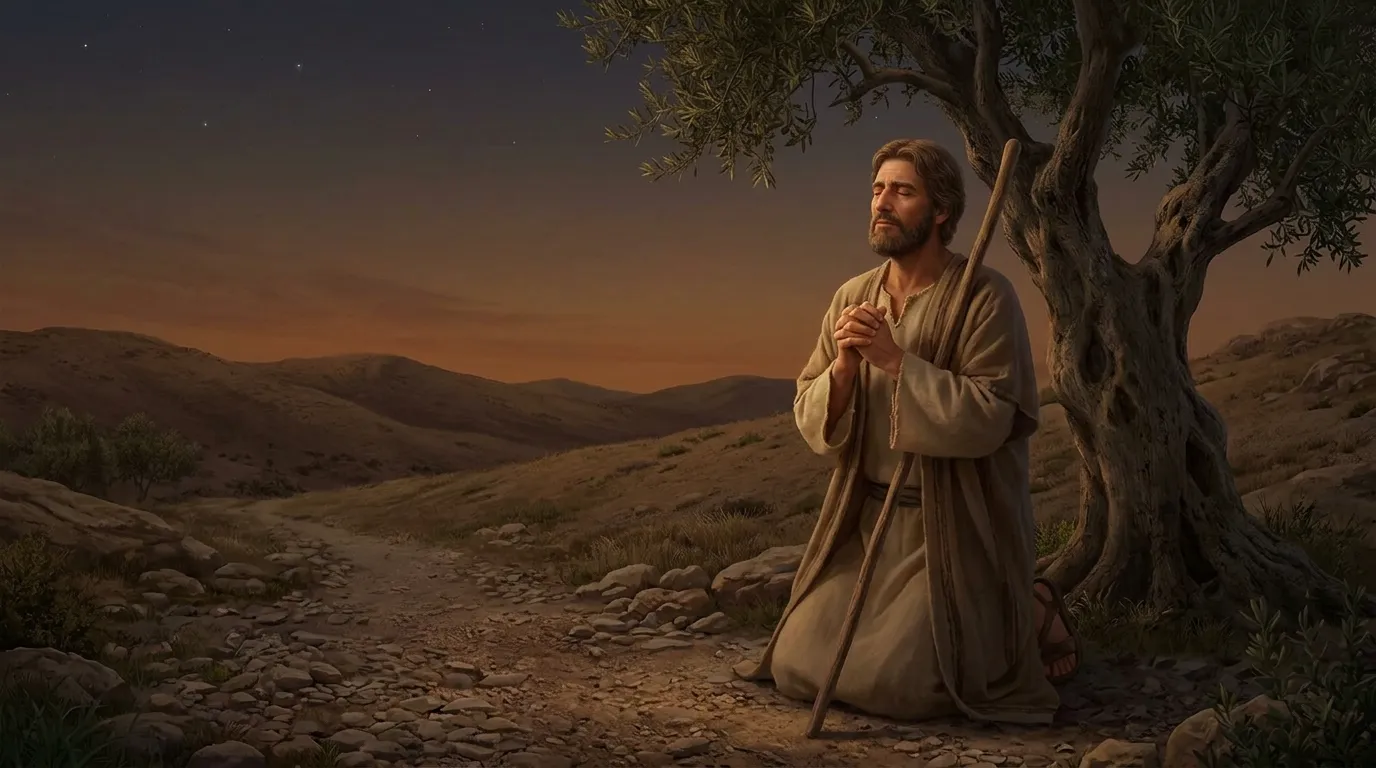
In a courtroom, a verdict is never reached by blind guessing. It is reached by evidence — testimony weighed, documents examined, witnesses cross-examined — until the jury can say, with confidence, this is true. Now hold that picture, because the Bible’s idea of faith is closer to a verdict than to a wish. “Faith” is the most used and most misused word in the Christian vocabulary. It has been reduced to positive thinking, to religious optimism, to believing hard enough to make things happen. Scripture means something sturdier, stranger, and far more demanding. It means a verdict rendered on the evidence of who God is — and then a life lived inside that verdict.
Faith Is Not Blind: Clearing the Biggest Misconception
Let us kill the myth first: biblical faith is not belief without evidence. It is trust based on evidence — specifically, on the character and track record of God. When the Bible calls people to faith, it always points to reasons: Israel was to trust God because He brought them out of Egypt (Exodus 20:2); Christians trust Christ because of the eyewitness testimony to His resurrection (1 Corinthians 15:3-8; 2 Peter 1:16). “We did not follow cleverly devised stories,” Peter insists. Faith in Scripture is never a leap into the dark. It is a step into the light, taken on the strength of what God has already shown.
The Greek word pistis, translated “faith,” carries this weight beautifully. It means trust, reliance, allegiance — the word you would use for trusting a bridge enough to drive across it, or a surgeon enough to go under anesthesia. It is relational before it is intellectual: less “I agree these propositions are true” and more “I am entrusting myself to this Person.” The demons, James notes acidly, have correct theology — “You believe that there is one God. Good! Even the demons believe that — and shudder” (James 2:19). Belief that never becomes trust is not faith. It is trivia.
Hebrews 11:1, Read Slowly
“Now faith is confidence in what we hope for and assurance about what we do not see.” Nearly everyone has heard it; almost no one has slowed down for it. Two words do the heavy lifting. Confidence (Greek hypostasis) literally means “that which stands under” — a foundation, a title-deed. In the ancient world, a hypostasis was the legal document proving you owned something. Faith, says Hebrews, is the title-deed to realities you cannot yet touch. Assurance (elenchos) is a legal term for evidence that convinces — the proof presented at trial.
So the verse is saying: faith is the present ownership papers for future promises, and the convincing evidence for invisible realities. It is not pretending. It is possessing — by trust — what God has pledged. And the rest of Hebrews 11 proves it by biography: Abel, Enoch, Noah, Abraham, Sarah, Moses, Rahab — a whole cloud of witnesses who treated God’s promises as more solid than their circumstances. “By faith” becomes the chapter’s drumbeat, struck sixteen times, each one a life that bet on the unseen and won.
Abraham: The Long Obedience
If faith had a patron saint, it would be Abraham — and his story corrects our impatience. God called him to leave everything for a land he had never seen (Genesis 12:1-4), then promised him descendants as numerous as the stars when he had no children at all (Genesis 15:5). “Abram believed the LORD, and he credited it to him as righteousness” (Genesis 15:6) — the verse Paul will later build the entire doctrine of justification on (Romans 4:3; Galatians 3:6).
But notice: Abraham’s faith was not a single moment of believing. It was decades of stumbling trust — including the disastrous detour with Hagar (Genesis 16), the laughter of disbelief (Genesis 17:17), the lies about Sarah (Genesis 20). Real faith, Abraham shows us, is not flawless believing. It is returning believing — coming back to the promise after every failure, until the promise comes through. By Genesis 22, the man who once schemed is ready to offer Isaac, “reasoning that God could even raise the dead” (Hebrews 11:19). Faith grew. That is the part we forget: faith is not static. It is a muscle, and Abraham’s life is the training log.
Faith That Saves vs. Faith That Sits Still
Here the New Testament draws the line that has divided theologians and saved sinners for two thousand years. Paul: “For it is by grace you have been saved, through faith — and this is not from yourselves, it is the gift of God — not by works, so that no one can boast” (Ephesians 2:8-9). Salvation is received, not achieved. Faith is the empty hand extended to take the gift.
James, apparently disagreeing, thunders: “Faith without deeds is dead” (James 2:26). For centuries readers have pitted them against each other. They are not opponents; they are physicians treating different diseases. Paul is treating legalism — the attempt to earn God’s favor. His prescription: stop working, start trusting. James is treating complacency — the claim to trust God while living identically to the world. His prescription: prove the faith is alive. Paul describes the root (faith alone saves); James inspects the fruit (saving faith never stays alone). A faith that saves is a faith that works — not to earn the gift, but because the gift has rewired the giver. “We are God’s handiwork, created in Christ Jesus to do good works” (Ephesians 2:10) — the very next verse after “not by works.” Saved by faith, saved for works.
The Mustard Seed and the Mountain
Jesus’ most famous faith saying is also His most misunderstood: “If you have faith as small as a mustard seed, you can say to this mountain, ‘Move from here to there,’ and it will move” (Matthew 17:20). Generations have treated this as a formula — believe hard enough, get what you want — and then blamed themselves when the mountain stayed put.
Read it again. The emphasis is not on the size of the faith but on the object of it. A mustard seed is tiny — but it is alive, and it is planted in real soil. Jesus is saying: it is not the volume of your believing that moves mountains; it is the reality of the God you believe in. Tiny faith in a great God outperforms great faith in a tiny god every time. The disciples’ problem in that story was not insufficient positive thinking; it was prayerlessness — “This kind can come out only by prayer” (Mark 9:29). Faith is not a power you generate. It is a connection you maintain.
This reframes every unanswered prayer. The question is never “did I believe enough?” — as if faith were a currency and God a vending machine. The question is “do I trust Him enough to accept His answer?” Sometimes the mountain moves (Acts 12:5-11). Sometimes the thorn stays, and grace proves sufficient (2 Corinthians 12:9). Both are faith. Only one looks like victory.
When Faith Feels Dead
What about the seasons when faith feels like nothing — when God is silent, the promises look hollow, and the title-deed feels like a forgery? Scripture does not pretend these seasons do not exist. It canonizes them. The Psalms are full of them: “How long, LORD? Will you forget me forever?” (Psalm 13:1). Job’s friends called his darkness faithlessness; God called Job’s honesty faithfulness (Job 42:7).
The most honest prayer in the Gospels comes from a desperate father: “I do believe; help me overcome my unbelief!” (Mark 9:24). Jesus did not rebuke the contradiction. He healed the boy. Bring God your fractured, flickering, half-believing faith — it is still faith, because it is still directed at Him. Faith is not the absence of doubt. It is doubt brought to Jesus instead of carried away from Him.
And remember Hebrews 11:6: “Without faith it is impossible to please God, because anyone who comes to him must believe that he exists and that he rewards those who earnestly seek him.” The bar is not perfection. It is coming — showing up, seeking, knocking (Matthew 7:7-8). The father who cried “help my unbelief” pleased God more than the Pharisee who felt no need to cry at all.
Faith, in the end, is the Bible’s answer to the human condition: we cannot see the future, control the outcome, or earn our rescue — but we can trust the One who can. It is confidence with a foundation, assurance with evidence, and a verdict rendered daily: God is who He says He is, and I will live like it. For a broader survey of how this concept has been understood across religions and philosophy, the entry on faith offers useful context — but the definition that changes lives is Hebrews 11:1, where faith is not a feeling to be manufactured but a title-deed to be held, signed in advance by a God who has never defaulted.










