The chariot is rolling down the desert road from Jerusalem to Gaza. Inside sits an Ethiopian official, a man of wealth and influence, reading Isaiah the prophet — and not understanding a word of it. Philip the evangelist, prompted by the Spirit, runs alongside, climbs in, and starting from that very Scripture “told him the good news about Jesus.” Then they come to some water, and the official asks the question that has launched a million baptisms: “Look, here is water. What can stand in the way of my being baptized?” (Acts 8:36). It is the most honest question in the New Testament about baptism — asked by a brand-new believer with no theology degree, no church background, and no time to waste. This article is an attempt to answer him as fully as he deserved.
Buried and Raised: What Baptism Says
The apostle Paul gives the definitive interpretation, and it is more dramatic than most church services suggest: “Don’t you know that all of us who were baptized into Christ Jesus were baptized into his death? We were therefore buried with him through baptism into death in order that, just as Christ was raised from the dead through the glory of the Father, we too may live a new life” (Romans 6:3-4).
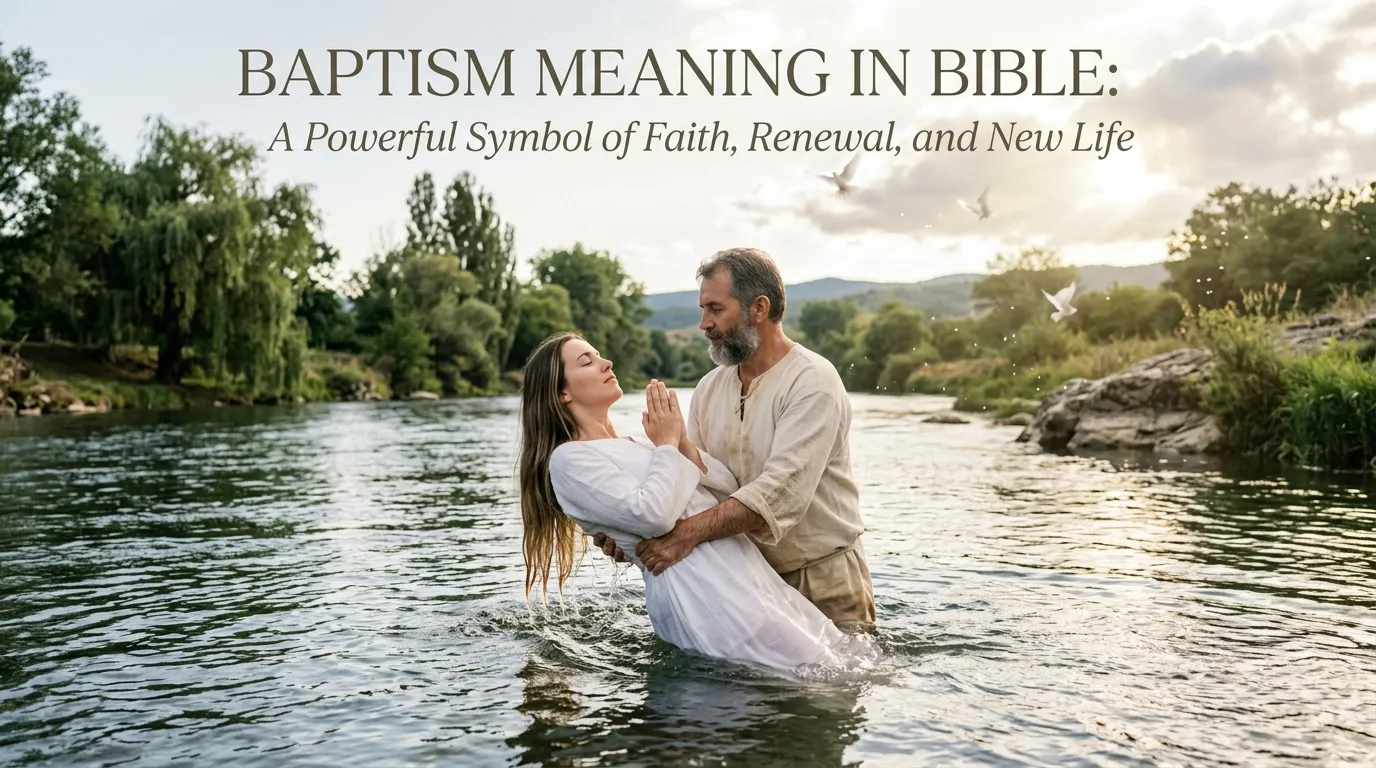
Baptism is a reenactment — a physical parable of the gospel. Going under the water is burial: the old self, crucified with Christ, lowered into the grave. Coming up is resurrection: the new self, raised to “live a new life.” Colossians 2:12 says the same thing: “buried with him in baptism, in which you were also raised with him through your faith.” This is why the ordinance has such gravity. It is not a graduation ceremony for advanced Christians. It is a funeral and a birthday collapsed into a single moment — the believer publicly acting out the death and resurrection that faith has already made real.
Notice what this implies about timing. In the New Testament, baptism follows faith the way a wedding follows an engagement — closely, joyfully, and as the public seal of a union already decided. The Ethiopian official believed and was baptized the same day (Acts 8:36-38). The Philippian jailer believed and was baptized “at once… he and all his household” (Acts 16:33). Three thousand believed at Pentecost and were baptized that day (Acts 2:41). The pattern is invariable: believe, then be baptized. Faith is the reality; baptism is the sign.
Washed: What the Water Does and Doesn’t Do
Alongside burial, Scripture’s second great image for baptism is washing. Ananias tells the newly converted Saul: “Get up, be baptized and wash your sins away, calling on his name” (Acts 22:16). The water signifies cleansing — the conscience scrubbed, the record wiped, the defilement removed.
But here precision matters, because two opposite errors stalk this doctrine. The first error says the water itself saves — that H₂O plus a formula equals regeneration regardless of faith. Peter explicitly rejects this: baptism “saves you… not the removal of dirt from the body but the pledge of a clear conscience toward God” (1 Peter 3:21). The saving element is the pledge — the faith-commitment the water expresses — not the water. The thief on the cross was saved without baptism (Luke 23:43); Simon the magician was baptized without being saved (Acts 8:13, 21-23). Water without faith is a bath. Faith without water is still faith — though a disobedient one.
The second error says baptism is therefore optional, a decorative extra for the enthusiastic. But Jesus commanded it in the Great Commission — “baptizing them in the name of the Father and of the Son and of the Holy Spirit” (Matthew 28:19) — and Peter’s Pentecost sermon made it the immediate response to the gospel: “Repent and be baptized, every one of you” (Acts 2:38). To believe in Christ and refuse baptism is like accepting a marriage proposal and refusing the wedding: possible, but incoherent, and a poor start. Baptism does not earn salvation, but it obeys the Savior — and obedience was never optional.
Why Was the Sinless One Baptized?
The most theologically electric baptism in Scripture is the one that should never have happened. Jesus — sinless, spotless — walks sixty miles to the Jordan to be baptized by John. John is scandalized: “I need to be baptized by you, and do you come to me?” Jesus answers, “Let it be so now; it is proper for us to do this to fulfill all righteousness” (Matthew 3:14-15).
“Fulfill all righteousness” — what does that mean? At least three things. First, identification. Jesus was baptized with sinners, standing in the water alongside the very people He came to save, foreshadowing the cross where He would stand in their place under judgment. His baptism was the first public act of substitution. Second, consecration. As He came up, “heaven was opened, and he saw the Spirit of God descending like a dove and alighting on him. And a voice from heaven said, ‘This is my Son, whom I love; with him I am well pleased'” (Matthew 3:16-17). The Trinity manifests — Father speaking, Spirit descending, Son emerging — to anoint Jesus for His messianic mission. Christian baptism carries an echo of this: it is a consecration moment, heaven’s “well pleased” over a new recruit. Third, example. If the sinless Son of God submitted to baptism, what believer would dare consider themselves above it? His baptism removes every excuse of the proud and every hesitation of the humble.
Mode: What the Water Shows
Honesty requires addressing the question every tradition answers differently: how — immersion, pouring, or sprinkling? The Greek word baptizo fundamentally means “to dip, plunge, immerse.” The New Testament descriptions fit immersion naturally: John baptized where “there was plenty of water” (John 3:23); Jesus “went up out of the water” (Mark 1:10); Philip and the eunuch “went down into the water” (Acts 8:38). And Paul’s burial-and-resurrection imagery (Romans 6:4) is most vividly enacted by going fully under and rising again — you cannot be “buried” by a sprinkle.
That said, the mode debate should never eclipse the meaning. The early church practiced immersion; later traditions developed pouring and sprinkling for practical and theological reasons (infant baptism, climates, the sick). Christians disagree here, and charity is required. But the biblical pattern is clear enough: believers, immersed, upon profession of faith. Whatever your tradition practices, measure it against that pattern with an open Bible and an honest heart.
The Household Questions: Who and When
Two more questions, answered with the same honesty. Who should be baptized? The New Testament pattern is believers — those who have repented and trusted Christ (Acts 2:38, 8:12, 10:47-48). Infant baptism, practiced by many historic churches, is a later theological development (rooted in covenant theology and church tradition, not in any explicit New Testament command or example). Readers should know the difference between Scripture’s pattern and tradition’s development — and decide with their Bibles open.
When? The New Testament answer is: soon. There is no biblical category for the multi-year unbaptized believer. The eunuch did not wait for a class; the jailer did not wait for morning. If you have trusted Christ and have not been baptized, the Bible’s counsel is the eunuch’s: here is water — what is standing in the way?
In whose name? “In the name of the Father and of the Son and of the Holy Spirit” (Matthew 28:19) — the Trinitarian formula — with Acts recording baptisms “in the name of Jesus Christ” (Acts 2:38), describing the same reality from the apostolic-preaching angle. The name invoked is the Triune God; the reality entered is union with Christ.
Ordinance, Not Optional: Why It Matters
Protestants have historically called baptism an ordinance — ordained by Christ — while Catholics, Orthodox, and others call it a sacrament, a means of grace. The terminology differs; the seriousness should not. Both agree on this: Christ commanded it, the apostles practiced it, and the church has never treated it as trivial.
Why does it matter so much? Because human beings are embodied, and God knows it. We do not merely think the gospel; we enact it. Baptism takes the invisible reality of union with Christ and makes it visible, tangible, memorable — something you can point to on your hardest days and say, that happened; I went under; I came up; I am His. It is the gospel you can feel. It binds you to a local body of believers who witnessed it. And it preaches to a watching world without a single word: this person died and rose again, and so can you.
The Ethiopian official went on his way rejoicing (Acts 8:39) — the Bible’s shortest baptismal testimony, and maybe the best. He had come to the water confused, reading Isaiah without understanding. He left it clean, claimed, and glad. That is what baptism means: the old story buried, the new story begun, and heaven rejoicing over one more sinner come home. For the wider history of how this ordinance has been practiced across two thousand years of church life, the survey at Baptism is a useful reference — but the pattern that matters most is the one in Acts 8: a believer, some water, and nothing standing in the way.










