Somewhere there is a birth certificate — or a baby-name list, or a character sketch — with seven letters on it: T-R-I-S-T-E-N. And the parents who wrote it probably did what most parents do: they heard the name, loved the sound, and then Googled what it means. What they found was a tangle — Arthurian knights, tragic romance, “sorrow,” “bold,” “tumult” — and somewhere in the tangle, a quieter question: what does God think of this name? This article will not hand you a legend and call it Scripture. Instead, it offers something the legend never could: the Bible’s profound theology of names, spellings, and the identity no etymology can give or take away.
Tristen Is Not Tristan: Why the Spelling Matters
First, the clarification that changes everything: Tristen is a variant spelling, not the legendary name. Tristan — with an a — is the figure from medieval Arthurian romance, the Cornish knight of the tragic love story with Isolde, a tale retold by Wagner, Tennyson, and Hollywood. Tristen — with an e — is a modern respelling, the kind of variant that becomes popular precisely because parents like the sound but want something a little distinct.
Why does one vowel matter? Because meanings attach to histories, not just sounds. Everything dramatic people associate with the name — the doomed romance, the knightly honor, the sorrow — belongs to Tristan’s literary history, a body of medieval fiction. Tristen, as a spelling, has no separate history; it borrows Tristan’s aura the way a new housing development borrows an old estate’s name. That is not a criticism — variant spellings are a normal, healthy part of how names evolve. But honesty requires saying it: if you chose Tristen, you chose a sound more than a story. And that is actually freeing, because it means you get to write the story.
What the Name (Probably) Comes From — Honestly
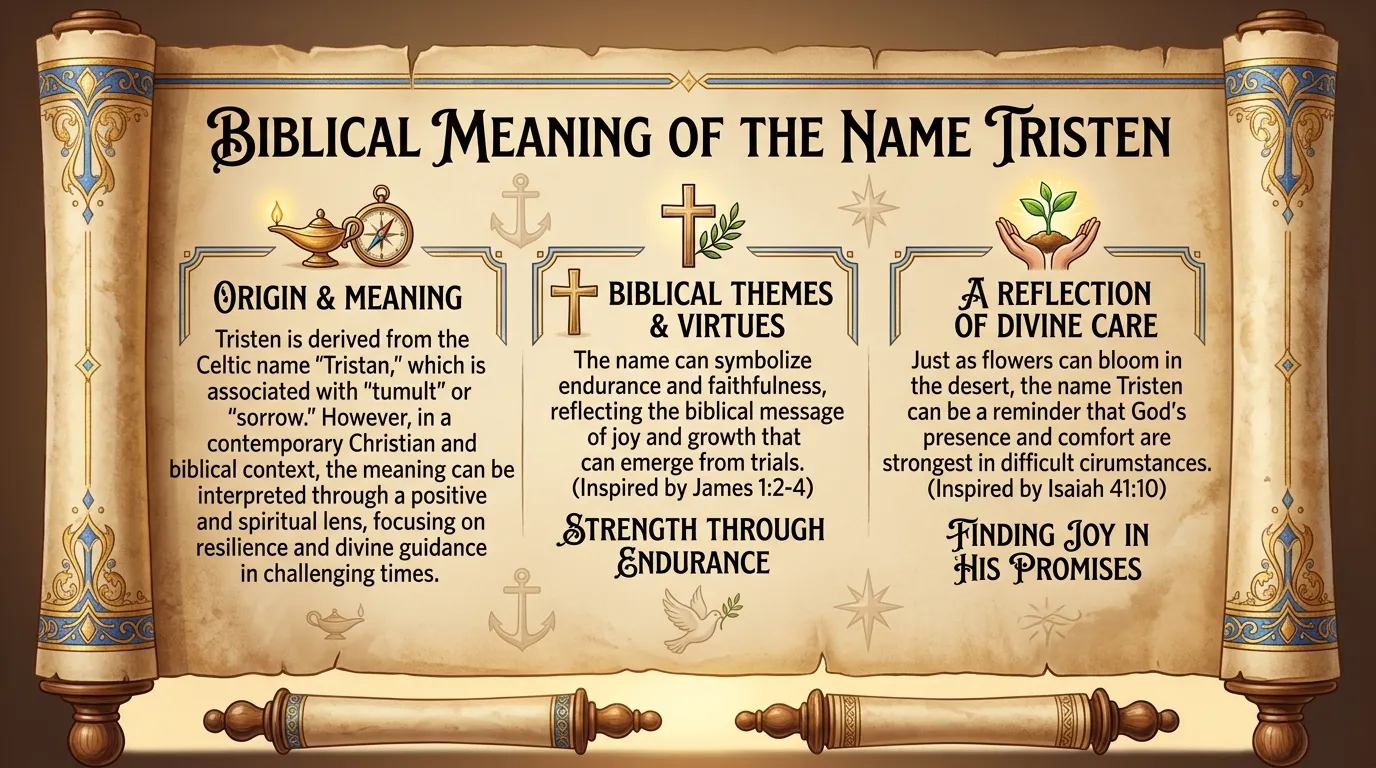
Since we are committed to honesty over romance, here is the genuine etymological picture, uncertainties included. The name Tristan most likely derives from a Celtic root related to noise or tumult — the Old Welsh Drustan is the likely ancestor. Later, medieval writers folk-etymologized it from the Latin tristis, “sad” or “sorrowful,” which fit the tragic legend beautifully but was probably not the original meaning. Modern baby-name books then added glosses like “bold” or “noble,” which have even shakier foundations.
So the “meaning” of Tristen is, to be blunt, a layered guess: possibly “tumult,” possibly “sorrow” (by medieval wordplay), possibly “bold” (by modern wishful thinking). None of these appear in Scripture. The name is not in the Bible, its roots are not Hebrew or Greek, and any website that gives you a confident “biblical meaning of Tristen” is selling you something. A Christian approach to names starts with truth, and the truth here is gloriously ordinary: it is a modern variant of a medieval name with a murky etymology. And that is completely fine. The Bible’s theology of names was never about etymological pedigree.
Variant Names and the God Who Renames
Here is where Scripture takes over, and it is better than any legend. The Bible is fascinated not by names with impressive origins, but by names that change. God is the great editor of human identity, and He keeps revising the title page.
Abram becomes Abraham (Genesis 17:5) — from “exalted father” to “father of many nations,” a rename that contradicted every visible fact of the man’s childless life. Jacob the “heel-grabber” becomes Israel, “he struggles with God” (Genesis 32:28), after a night of wrestling that left him limping and blessed. Simon becomes Peter, “rock” (John 1:42) — and on the day Jesus said it, Simon was anything but rocklike; the name was a prophecy, not a description. Saul the persecutor becomes Paul the apostle, the most famous rebrand in history (Acts 13:9).
Notice the pattern: God does not ask what your name meant. He declares what it will mean. Every divine renaming is forward-looking, a verdict on the future rather than a summary of the past. This is tremendously good news for anyone named Tristen. Whatever “tumult” or “sorrow” or “boldness” the dictionaries argue about, God reserves the right to write a better definition over your life — just as He did for a schemer named Jacob and a denier named Simon.
Spelling, Identity, and the Names That Stick
There is a deeper lesson in the variant-spelling question, and it is pastoral. Many people carry quiet insecurity about their names: Is mine the “real” spelling? Did my parents get it right? Does the variant make it less legitimate? Scripture’s answer is a gentle no. In the Bible, the same person routinely appears under multiple spellings and forms across translations and manuscripts — and God’s covenant with them never wavered over orthography.
More importantly, the Bible distinguishes between the name people call you and the name God knows you by. “I have called you by name; you are mine” (Isaiah 43:1) — the emphasis is on the calling, not the spelling. Revelation promises the overcomer “a new name written on the stone, which no one knows except the one who receives it” (Revelation 2:17): the truest name you will ever carry is one you have not even heard yet, spelled perfectly, known only to you and God. Next to that promise, every debate about a versus e shrinks to its proper size — which is to say, nearly nothing, and lovingly so.
The Trouble With Imported Meanings
A word of caution, offered in love: resist the urge to baptize the Tristan legend into the Bible. It is tempting — the tragic knight, the loyal love, the sorrow — to drape Arthurian romance over a child named Tristen and call it “biblical meaning.” But the legend is medieval fiction, beautiful and Christ-haunted in places, yet not Scripture. Importing it does two disservices: it misrepresents the Bible, and it burdens a child with a story of doomed romance they never auditioned for.
The same caution applies to the folk meanings. If “sorrow” (from tristis) troubles you, remember it is likely a medieval pun, not a prophecy. If “tumult” troubles you, remember that some of Scripture’s greatest figures emerged from tumult — David from the chaos of Saul’s court, Paul from the tumult of his own zealotry. And if you love “bold,” take it as a prayer rather than a promise: “the righteous are as bold as a lion” (Proverbs 28:1) is a fine aspiration for any name. Let meanings be prayers, not prisons.
When Names Become Prophecies: Jabez and the Power of Renaming
Scripture gives us one more name-story that belongs in this article, because it shows what happens when a bad meaning gets redeemed by prayer. “Jabez was more honorable than his brothers. His mother had named him Jabez, saying, ‘I gave birth to him in pain'” (1 Chronicles 4:9). The name Jabez sounds like the Hebrew for “pain” — his mother branded her suffering onto her son’s identity. Every time someone said his name, they pronounced pain over him.
But Jabez refused to let etymology be destiny: “Oh, that you would bless me and enlarge my territory! Let your hand be with me, and keep me from harm so that I will be free from pain.” And the chronicler adds the verdict: “God granted his request” (1 Chronicles 4:10). A man named Pain prayed his way into blessing — not by changing his name’s spelling, but by appealing to the God who outranks every name.
There is a darker mirror-image, too: Nabal, whose name means “fool” — and who lived down to it with lethal accuracy (1 Samuel 25:25). Names can become self-fulfilling, for good or ill, when people accept the verdict instead of appealing it. The biblical counsel for any Tristen who worries about “sorrow” or “tumult” in the name’s history is Jabez’s: pray the bigger prayer. Let God write the definition. And parents: speak blessing over the name daily, the way God spoke blessing over Abram before he had an heir — calling things that are not as though they were (Romans 4:17).
A Prayer for Anyone Named Tristen
So here is what to do with this name — whether it belongs to your child, your friend, or you. Dedicate it the way Hannah dedicated Samuel: not by controlling its future, but by surrendering it (1 Samuel 1:27-28). Pray the renaming prayer: Lord, whatever this name meant in old Wales or medieval France, write Your meaning over it now. Pray for identity rooted not in etymology but in adoption: “See what great love the Father has lavished on us, that we should be called children of God!” (1 John 3:1). Pray Isaiah 43:1 over them by name — the e-spelling and all.
Tristen is not in the Bible. It does not need to be. The Bible’s God specializes in taking names with no pedigree — a heel-grabber, a persecutor, a denier — and making them eternal. Give Him the variant spelling. He is excellent with variants. For the literary history that the a-spelling carries (worth knowing, so you can distinguish it clearly from your e-spelling), the overview of Tristan traces the legend’s medieval roots — and then close that tab, open Genesis 32, and watch what God does with a renamed man, which is the only name-story in this article that can actually change a life.










