Imagine waiting for someone you love to come home. You may feel excited, but you may also feel worried because you do not know when they will arrive. In a similar way, First Thessalonians meaning in the Bible points believers toward a life of faith, hope, love, and readiness while waiting for Jesus Christ.
First Thessalonians is a short but powerful letter written by the apostle Paul to Christians in Thessalonica. These believers were facing pressure, questions, and grief. Paul did not respond with fear. Instead, he reminded them of God’s faithfulness, Christ’s return, holy living, and the hope of resurrection.
The message is still deeply relevant today. Whether you are facing uncertainty, grieving someone you love, or simply wondering what God wants from your life, First Thessalonians offers steady encouragement.
What Is the Meaning of First Thessalonians in the Bible?
First Thessalonians teaches Christians to remain faithful to God while living with hope in Jesus Christ. Its major themes include faith, love, endurance, holiness, encouragement, resurrection, and the second coming of Christ.
Paul wrote the letter after hearing about the Thessalonians’ faith. He wanted to encourage them and answer concerns they had about Christians who had died.
The letter shows that Christian hope is not based on having an easy life. Instead, Christian hope rests on God’s promises and the resurrection of Jesus.
First Thessalonians can be understood through several major biblical truths:
- Faith should produce faithful action.
- Love should grow stronger over time.
- Believers can remain hopeful during suffering.
- Christians should live holy lives.
- Death does not have the final word for those who belong to Christ.
- Jesus will return, and believers should be spiritually ready.
- God calls His people to encourage one another.
These teachings make First Thessalonians both a message of instruction and a message of comfort.
Who Wrote First Thessalonians and Why?
First Thessalonians was written by Paul, together with Silvanus and Timothy, as stated in 1 Thessalonians 1:1.
Paul had helped establish the church in Thessalonica. Acts 17 describes his ministry there. Although his time in the city was difficult and opposition arose, some people believed the gospel.
Afterward, Paul was separated from these new believers. He deeply cared about their spiritual condition and wanted to know how they were doing.
According to 1 Thessalonians 3:6, Timothy returned with encouraging news about their faith and love. Paul then wrote to strengthen them.
This background helps us understand the heart of the letter. First Thessalonians was written to people who were learning how to follow Christ in a difficult world.
That makes its message especially meaningful for Christians today.
First Thessalonians Meaning + Hebrew Meaning
There is an important language detail to understand. First Thessalonians is a New Testament book, and its original text was written in Greek, not Hebrew.
The name “Thessalonians” refers to the people of Thessalonica, an important city in ancient Macedonia. The Greek name of the city is Thessalonikē (Θεσσαλονίκη).
The word “first” distinguishes this letter from Second Thessalonians, another letter attributed to Paul.
So, there is no separate biblical Hebrew meaning of First Thessalonians in the sense of a Hebrew word that defines the book. The book’s title comes from the Greek setting and identifies the Christian community to whom Paul wrote.
However, the letter contains themes that are deeply connected to the wider story of the Hebrew Scriptures. For example, ideas such as holiness, hope, resurrection, God’s judgment, and faithful living are consistent with themes found throughout the Old Testament.
Therefore, it is better to study First Thessalonians through its Greek New Testament context and its connection to the whole biblical story, rather than assigning it an invented Hebrew meaning.
The Main Message of First Thessalonians
One of the clearest summaries appears in 1 Thessalonians 1:3. Paul remembers their “work of faith,” “labor of love,” and “steadfastness of hope” in Jesus Christ.
These three ideas provide a helpful picture of the Christian life.
Faith That Works
Faith is not presented as merely agreeing with religious ideas. The Thessalonians’ faith affected how they lived.
Their trust in Christ produced action.
For example, someone may say they trust God during a financial struggle. That faith may lead them to pray, act honestly, continue working, and refuse to give in to despair.
Biblical faith changes the way we live.
Love That Serves
Paul also praised their love. Christian love is more than a feeling. It seeks the good of others.
In 1 Thessalonians 4:9–10, Paul recognizes their love for fellow believers but encourages them to continue growing.
This gives us an important lesson: spiritual growth never has to stop.
Even when we are doing well, God can teach us to love more deeply.
Hope That Endures
The Thessalonians were experiencing hardship, yet they continued in hope.
Their hope was centered on Jesus.
This is important because biblical hope does not mean pretending that problems are not real. Instead, it means trusting that God remains faithful even when life is painful or uncertain.
First Thessalonians and the Meaning of Christian Suffering
First Thessalonians does not promise believers a trouble-free life.
In 1 Thessalonians 1:6, Paul says the believers received the word “in much affliction” while also experiencing joy through the Holy Spirit.
That combination is striking.
They could experience pain and joy at the same time.
Paul later reminds them in 1 Thessalonians 3:3–4 that suffering should not surprise Christians. Following Christ does not remove every hardship.
For someone going through a difficult season, this provides comfort. Your suffering does not automatically mean that God has abandoned you.
A Christian facing rejection at work, family conflict, financial pressure, or loneliness can remember that faithful believers in the early church also faced hardship.
God’s presence is not measured by how easy our circumstances are.
First Thessalonians and Holy Living
Another major theme is sanctification, or growing in holiness.
Paul writes in 1 Thessalonians 4:3, “For this is the will of God, your sanctification.”
He then discusses sexual purity, self-control, respect, and the way believers treat others.
This shows that Christianity is not only about what happens inside our hearts. Faith should shape our choices, relationships, bodies, words, and habits.
Paul does not present holiness as a way to earn God’s love. Rather, holy living is part of responding to the God who has called believers to Himself.
For example, a Christian may choose honesty when lying would be easier. Another may forgive someone instead of seeking revenge.
These ordinary decisions can become expressions of faith.
First Thessalonians and Jesus’ Second Coming
The return of Jesus is one of the most important themes in First Thessalonians.
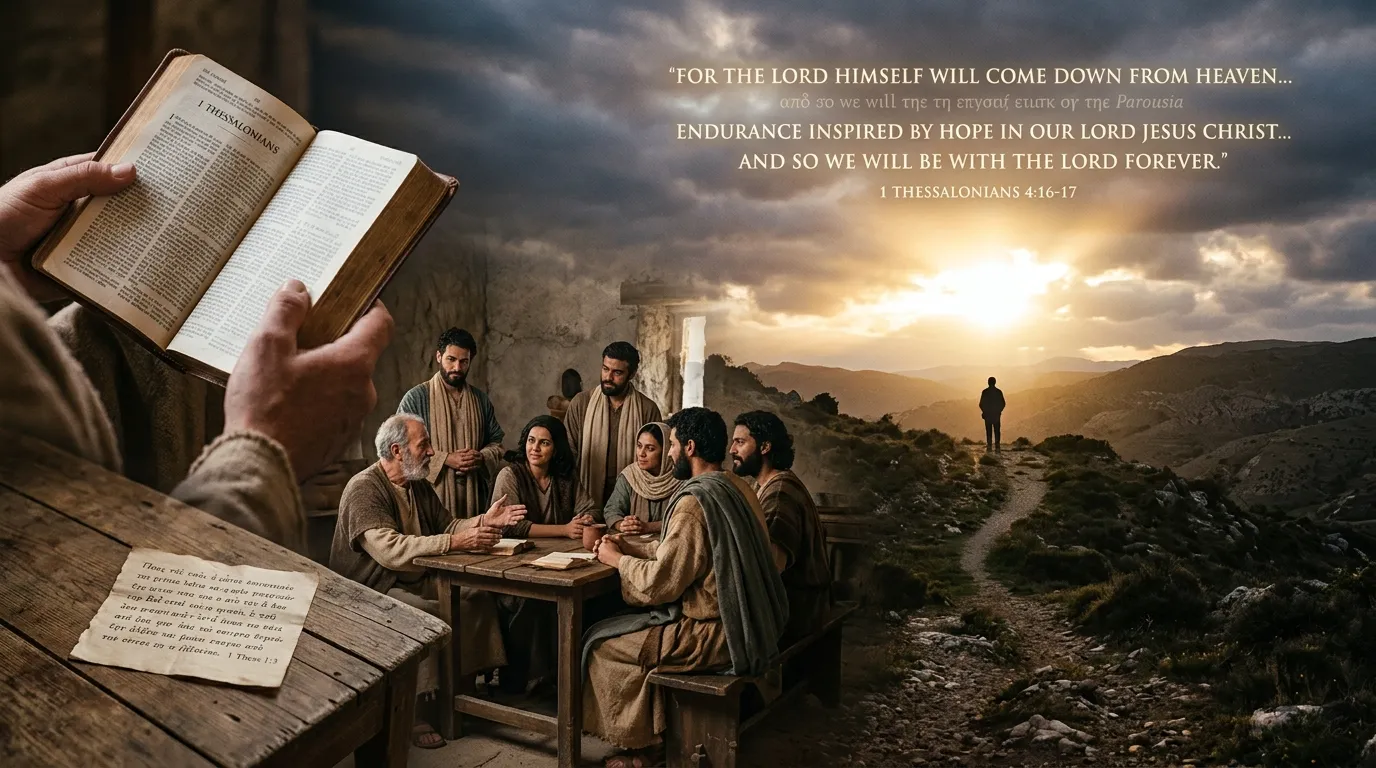
Paul discusses it especially in 1 Thessalonians 4:13–18.
The Thessalonians were concerned about believers who had already died. Paul wanted them to understand that Christians should not grieve “as others do who have no hope.”
He explains that those who have died in Christ will be raised, and believers will ultimately be with the Lord.
Then Paul gives a beautiful statement in 1 Thessalonians 4:17:
“And so we will always be with the Lord.”
The point is not to create fear or encourage date-setting. The passage offers hope in Christ’s victory over death.
Paul continues in chapter 5 to teach that the “day of the Lord” will come unexpectedly. Christians therefore should remain spiritually awake and sober.
The biblical emphasis is readiness, not prediction.
What Does First Thessalonians Say About Death?
First Thessalonians gives one of the Bible’s clearest messages of comfort about Christian death.
Paul acknowledges grief. Christianity does not require believers to pretend that death does not hurt.
However, grief is joined with hope because of Christ.
First Thessalonians 4:13–14 teaches that those who have died in Jesus are not without hope. Paul points believers toward the resurrection and the future coming of Christ.
This means that Christian hope looks beyond the grave.
If you have lost a believing parent, spouse, friend, or another loved one, this passage can remind you that death is not the end of God’s redemptive story.
Verses About the Message and Title of First Thessalonians
Several important passages help explain the heart of the book.
- 1 Thessalonians 1:3 — Paul highlights faith, love, and hope in Jesus Christ.
- 1 Thessalonians 1:6 — The believers received God’s word despite suffering, with joy through the Holy Spirit.
- 1 Thessalonians 2:12 — Paul encourages believers to walk in a way worthy of God, who calls them into His kingdom and glory.
- 1 Thessalonians 3:12 — Paul prays that their love will increase and overflow.
- 1 Thessalonians 4:3 — Paul teaches that God’s will includes the sanctification of believers.
- 1 Thessalonians 4:13–14 — Paul gives hope concerning Christians who have died.
- 1 Thessalonians 4:16–17 — Paul describes Christ’s return and the gathering of believers to be with Him.
- 1 Thessalonians 5:16–18 — Christians are told to rejoice always, pray continually, and give thanks in all circumstances.
- 1 Thessalonians 5:21 — Believers are instructed to test everything and hold firmly to what is good.
- 1 Thessalonians 5:23–24 — Paul points believers toward God’s faithfulness to sanctify them.
Together, these verses show that the book is not mainly about predicting the future. It is about living faithfully while trusting God’s future promises.
What Does First Thessalonians Mean Spiritually?
Spiritually, First Thessalonians can encourage believers to live with an eternal perspective.
When daily problems feel overwhelming, it is easy to focus only on today. Paul repeatedly directs attention toward God’s larger purpose.
The letter encourages:
- Faith when circumstances are difficult
- Love that continues to grow
- Hope when facing grief
- Purity in daily choices
- Patience while waiting for Christ
- Prayer during uncertain seasons
- Encouragement within the church
- Trust in God’s faithfulness
These are spiritual applications drawn from the biblical message. They should not be treated as secret predictions about a person’s future.
Can First Thessalonians Have a Meaning in a Dream?
Some Christians may dream about a Bible book, chapter, verse, church, or biblical word and wonder whether it carries a spiritual message.
If you dream about First Thessalonians, it may naturally lead you to think about themes such as hope, faith, holiness, encouragement, or Christ’s return.
However, the Bible does not teach that every dream is a direct message from God.
Dreams can arise from many sources, including memories, emotions, daily concerns, stress, and ordinary brain activity during sleep. Scripture does describe occasions when God used dreams, but those accounts do not mean every modern dream has divine meaning.
A wise Christian response is to test the experience against Scripture.
Ask:
- Does the interpretation agree with God’s Word?
- Does it point me toward Christ rather than fear?
- Does it encourage obedience and wisdom?
- Am I treating speculation as if it were biblical certainty?
- Should I pray and seek mature Christian counsel?
First Thessalonians 5:21 gives a useful principle: “Test everything; hold fast what is good.”
First Thessalonians Meaning in Everyday Christian Life
The message becomes practical when we bring it into ordinary situations.
When You Are Waiting
Maybe you are waiting for a job, healing, a relationship, an answer, or a change in circumstances.
First Thessalonians teaches you to keep walking faithfully rather than allowing uncertainty to control your life.
When You Are Grieving
If someone you love has died, 1 Thessalonians 4:13–18 reminds you that Christian grief is held together with resurrection hope.
You can cry and still have hope.
When You Are Under Pressure
The Thessalonians faced opposition because of their faith. Their example reminds modern believers that difficulties do not make faithful living pointless.
You can continue to pray, love, serve, and trust God.
When You Need Direction
First Thessalonians 5:16–18 gives simple guidance: rejoice, pray, and give thanks.
This does not mean being happy about every painful event. It means continuing to turn toward God in every circumstance.
What Can Christians Learn From First Thessalonians?
The book gives several lasting lessons.
God Is Faithful
First Thessalonians ends with a powerful reminder in 1 Thessalonians 5:24:
“He who calls you is faithful; he will surely do it.”
The foundation of Christian hope is not human strength. It is God’s faithfulness.
Christians Need One Another
Paul repeatedly encourages the believers to build each other up.
In 1 Thessalonians 5:11, he tells them to “encourage one another and build one another up.”
Faith was never meant to be lived entirely alone.
Readiness Matters More Than Date-Setting
The teaching about Christ’s return should motivate faithful living, not speculation.
Jesus’ return is presented as a reason to stay spiritually awake, sober, loving, and faithful.
Holiness Is Part of Following Christ
First Thessalonians makes clear that Christian faith affects conduct.
God calls believers to live differently because they belong to Him.
Hope Changes How We Face Life
The believers in Thessalonica were not protected from every hardship. Yet they had a hope stronger than their circumstances.
Biblical hope does not deny pain; it places pain inside the larger story of God’s redemption.
Frequently Asked Questions
What is the main message of First Thessalonians?
The main message is to remain faithful to Christ with faith, love, holiness, encouragement, and hope while waiting for His return.
What is the main theme of 1 Thessalonians?
Major themes include faith, love, hope, Christian suffering, holy living, resurrection, Christ’s second coming, prayer, and God’s faithfulness.
What does First Thessalonians say about Jesus’ return?
Chapters 4 and 5 teach that Jesus will return and that believers should live with hope and spiritual readiness. Scripture does not give believers permission to predict an exact date.
What does First Thessalonians say about death?
It teaches that Christians who die in Christ have hope because of the resurrection and Christ’s return. Paul encourages believers to grieve with hope rather than hopelessness.
Is there a Hebrew meaning of First Thessalonians?
Not directly. First Thessalonians belongs to the Greek New Testament and was written in Greek. “Thessalonians” identifies the people of Thessalonica, while the book’s teachings connect with themes found throughout the Hebrew Scriptures.
What does First Thessalonians mean spiritually?
Its spiritual message can encourage believers to trust God, grow in love, pursue holiness, remain hopeful during suffering, encourage others, and look forward to Christ’s return.
Can First Thessalonians be a sign in a dream?
A dream about the book may prompt personal reflection, but Scripture does not teach that every dream is a divine sign. Any interpretation should be tested against God’s Word and should never replace Scripture, prayer, wisdom, or sound Christian counsel.
Conclusion
The meaning of First Thessalonians in the Bible is ultimately a message of hope and faithful living. Paul wrote to Christians who faced hardship, uncertainty, and grief, yet he pointed them toward a faithful God and a risen Savior.
The letter reminds us that faith can endure hardship, love can continue growing, holiness matters, and death does not have the final word for those who are in Christ.
If you are in a season of waiting today, you do not have to know every detail of tomorrow. You can pray, remain faithful, love others, and trust God’s promises.
Take time to read First Thessalonians slowly. Bring your questions to God. Let its words about hope, holiness, resurrection, and Christ’s return strengthen your heart.
Above all, remember the promise at the end of the letter: “He who calls you is faithful.” (1 Thessalonians 5:24)
You may not know what tomorrow holds, but you can trust the God who holds tomorrow.