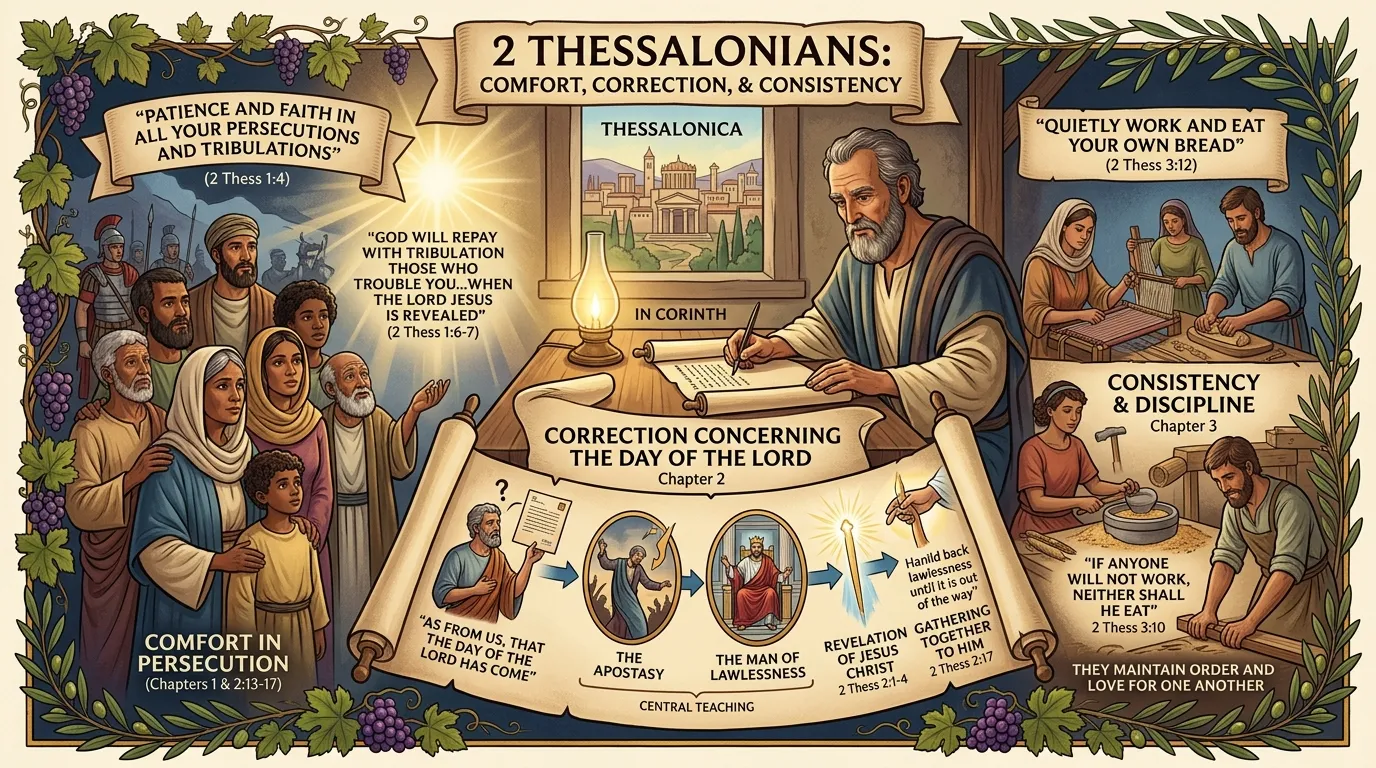
Second Thessalonians is a short letter with a specific job: to calm a frightened church. The believers in Thessalonica were suffering persecution, and on top of that, someone had unsettled them with a claim that the Day of the Lord had already come. Some had stopped working, waiting for the end. Others were confused, afraid they had missed it. Paul writes to steady them — to correct the false teaching, to encourage the persecuted, and to tell the idle to get back to work. It is a pastoral letter, practical and urgent, and its message is as relevant to an age of end-times predictions and internet rumors as it was to a first-century Macedonian church.
The Church in Thessalonica
Thessalonica was a major port city in Macedonia, on the Via Egnatia — the Roman road connecting east and west. Paul founded the church there during his second missionary journey, preaching in the synagogue for three Sabbaths before opposition drove him out of the city (Acts 17:1–9). The church he left behind was young, Gentile-majority, and under pressure. First Thessalonians, written shortly after, is warm and encouraging. Second Thessalonians, written not long after that, is firmer — because new problems had appeared.
The letter opens with Paul, Silvanus, and Timothy greeting the church, and with thanksgiving: the Thessalonians’ faith is growing abundantly and their love for one another is increasing — in the middle of persecution. Paul does not measure their spiritual health by their comfort. He measures it by their growth under pressure. A church that is growing in faith and love while being persecuted is, in Paul’s eyes, a healthy church.
Chapter 1: Suffering Is Not a Sign of Abandonment
The first chapter addresses the persecution directly. Paul tells the Thessalonians that their endurance is evidence of God’s righteous judgment — that He counts them worthy of His kingdom. And he promises that God will repay: “God considers it just to repay with affliction those who afflict you, and to grant relief to you who are afflicted” (2 Thessalonians 1:6–7). The relief will come “when the Lord Jesus is revealed from heaven with his mighty angels in flaming fire.”
The passage is severe, and it should be read carefully. Paul is not saying that suffering earns salvation. He is saying that God sees suffering, that He is just, and that the present imbalance — the wicked prospering, the righteous suffering — will not last forever. The Day of the Lord will set things right. For the persecuted, that promise is not a threat. It is the only thing that makes endurance possible. Justice is coming, and the Judge is Jesus.
The chapter ends with a prayer: that God would make the Thessalonians worthy of His calling, fulfill every resolve for good, and glorify the name of Jesus in them. Paul’s answer to persecution is not a strategy. It is prayer — that God would strengthen the church from the inside while the pressure bears down from the outside.
Chapter 2: Do Not Panic About the Day of the Lord
The second chapter is the heart of the letter, and it is a correction. Somehow — whether by a forged letter, a prophecy, or a rumor — the Thessalonians had been told that the Day of the Lord had already come. Paul tells them not to be “quickly shaken in mind or alarmed” (2 Thessalonians 2:2). The Day has not come, and here is how they will know: certain things must happen first.
Paul describes a “rebellion” that must come, and the revealing of “the man of lawlessness,” a figure who opposes God, exalts himself, and even seats himself in the temple, proclaiming himself to be God (2 Thessalonians 2:3–4). He also speaks of a restrainer who currently holds lawlessness back, and of the Lord Jesus destroying the lawless one “with the breath of his mouth” at His coming.
This passage is one of the most debated in the New Testament, and honesty requires acknowledging what is not clear. The identity of the man of lawlessness, the nature of the rebellion, and the identity of the restrainer have been interpreted in many ways across the centuries — as a future individual, as a recurring pattern of anti-God power, as a specific historical figure. Paul’s original readers apparently knew more about his meaning than we do; he says “you know what is restraining him now” (2 Thessalonians 2:6), referring to teaching he had given them in person that we no longer possess.
What is clear is Paul’s pastoral purpose. He is not giving the Thessalonians a timetable to decode. He is giving them reasons not to panic. The Day of the Lord has not secretly arrived. God is still in control. Evil will rise, but it will be defeated by the coming of Jesus. And the believers’ job in the meantime is not speculation but stability: “So then, brothers, stand firm and hold to the traditions that you were taught by us” (2 Thessalonians 2:15). The answer to end-times confusion is not more prediction. It is firmer grounding in what has already been taught.
Chapter 3: Get Back to Work
The third chapter turns to the most practical problem: idleness. Some in the church, convinced the end was near, had stopped working and become busybodies — living off others while contributing nothing. Paul’s response is blunt. He reminds them of his own example: when he was among them, he worked night and day, eating no one’s bread without paying for it, so as not to be a burden. Then he states the principle that has echoed through the centuries: “If anyone is not willing to work, let him not eat” (2 Thessalonians 3:10).
The principle is about willingness, not ability. Paul is not condemning the sick, the disabled, or the genuinely needy. He is confronting a specific refusal to work, driven by a distorted view of the end times. His theology of waiting is active, not passive. Waiting for Christ does not mean sitting down. It means working faithfully until He comes — doing good, supporting the church, earning an honest living, and refusing to be a burden on others.
Paul closes with a call to discipline: if anyone refuses to obey, the church should take note and have nothing to do with him — not as an enemy, but as a brother to be warned (2 Thessalonians 3:14–15). Discipline, in Paul’s vision, is restorative, not punitive. The goal is not to expel but to reclaim. And the letter ends with a blessing of peace: “Now may the Lord of peace himself give you peace at all times in every way” (2 Thessalonians 3:16). A letter written to a frightened church ends with peace — because the Lord of peace is the one in charge of the future.
What Second Thessalonians Teaches Today
The letter’s lessons translate directly. Do not let end-times speculation unsettle you. Test every claim — every viral prophecy, every confident prediction, every alarming headline — against Scripture. Stand firm in what you have been taught. Endure suffering with the confidence that God is just and that Jesus will return. And keep working. The Christian hope is not an excuse to stop living; it is the reason to live faithfully, do good without growing weary (2 Thessalonians 3:13), and wait with steady hands and a peaceful heart.
The Man of Lawlessness: What Paul Does and Does Not Say
Second Thessalonians 2 is one of the most quoted and most misused passages in debates about the end times, so it is worth being precise about what Paul actually says — and what he leaves unsaid. He says a rebellion must come first, and the man of lawlessness must be revealed. He says this figure opposes God, exalts himself above every so-called god, and takes his seat in the temple of God, proclaiming himself to be God. He says there is a restrainer holding lawlessness back, and that when the restrainer is removed, the lawless one will be revealed — and then destroyed by the Lord Jesus at His coming.
What Paul does not say is equally important. He does not name the man of lawlessness. He does not give a date. He does not provide a checklist for identifying the figure in current events. He does not say the Thessalonians should try to calculate the timing. His purpose is the opposite: to stop them from trying to calculate. The passage is a brake on speculation, not an invitation to it. Every generation that has used this passage to identify a contemporary figure — a pope, a president, a dictator, a celebrity — has been wrong, and the pattern should teach humility.
The passage also contains a sobering warning about deception. Paul says the coming of the lawless one will be accompanied by counterfeit signs and wonders, and that those who refuse to love the truth will be given over to a strong delusion. The warning is not about a lack of information. It is about a lack of love for the truth. People are deceived, Paul says, not because the truth was unavailable, but because they did not love it. The defense against end-times deception is not better charts. It is a deeper love for the truth — the truth about Christ, the gospel, and the God who cannot lie.
First Thessalonians and Second Thessalonians Together
The two letters to Thessalonica form a pair, and reading them together clarifies both. First Thessalonians emphasizes the hope of Christ’s return: the dead in Christ will rise, the living will be caught up together with them, and believers will always be with the Lord (1 Thessalonians 4:13–18). The letter ends with the famous assurance that God has not destined believers for wrath but for salvation. Second Thessalonians corrects the misunderstanding that grew out of that hope: the Day has not come yet, the church must stand firm, and waiting means working.
Together, the letters hold two truths in balance. The first is imminence: Christ could come at any time, and believers should live in readiness. The second is patience: the end has not come yet, and believers should live faithfully in the meantime. Churches that emphasize only imminence become anxious and idle, always watching the skies. Churches that emphasize only patience become complacent, forgetting that the Lord is at hand. Paul holds both together: be ready, and be busy. The Day of the Lord is certain, and the work of the Lord is present. The Christian waits for the first by doing the second.
For an overview of the letter’s authorship debate, structure, and themes, see the article on the Second Epistle to the Thessalonians.