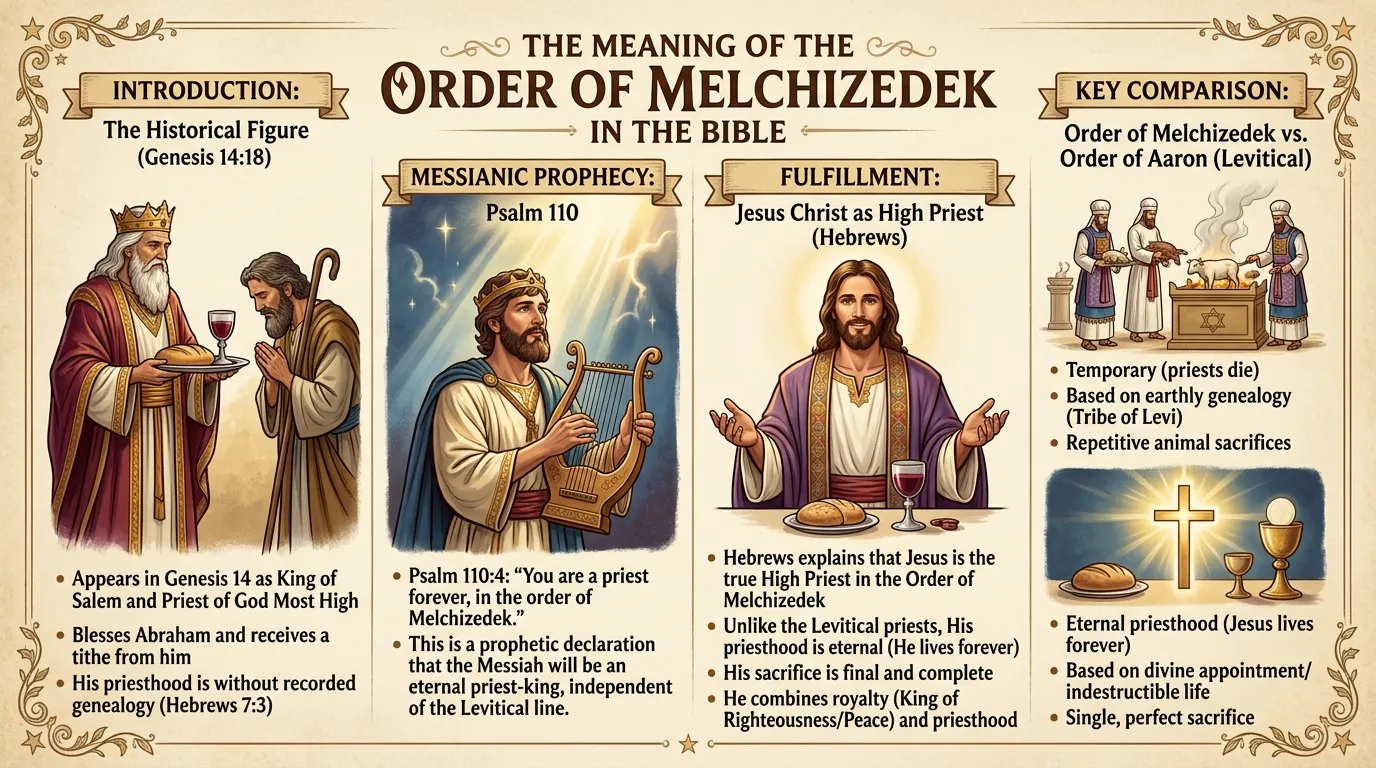
Hebrews 7 reads like a legal brief. The writer is making a case, and his star witness is a man who appears in only three verses of Genesis. Melchizedek walks into Abraham’s story, blesses him, receives a tenth of the spoils, and walks out again. That is all Genesis tells us. Yet the writer of Hebrews builds an entire argument about Jesus on that brief appearance — an argument that ends with one of the most comforting claims in the New Testament: Jesus holds His priesthood permanently, because He continues forever.
Exhibit A: A Strange Meeting in Genesis 14
The scene is set after a battle. Abraham has just rescued his nephew Lot from a coalition of kings and is returning with recovered goods and people. Then, without introduction, Genesis 14:18–20 introduces Melchizedek: king of Salem and priest of God Most High. He brings out bread and wine. He blesses Abraham. Abraham gives him a tenth of everything.
Two details matter enormously for what Hebrews will later do with this story. First, Melchizedek is both king and priest — two offices that Israel’s later law kept strictly separate. Kings came from Judah; priests came from Levi. No one man held both. Second, he is a priest of God Most High who is not an Israelite and not descended from Aaron, because Aaron will not be born for centuries. His priesthood does not depend on the Law of Moses at all. It predates it.
Hebrews 7:2 also draws out the meaning of the names. Melchizedek means “king of righteousness,” and Salem is connected with peace — “king of peace.” The writer is not playing word games; he is showing that this figure embodies, in name and office, exactly what a priest is supposed to bring: righteousness and peace.
Exhibit B: A Prophecy in Psalm 110
Centuries later, David writes a psalm about a coming king who will sit at God’s right hand. In the middle of it comes a startling line: “You are a priest forever, after the order of Melchizedek” (Psalm 110:4). This is strange on purpose. The king in the psalm is from David’s line — the tribe of Judah. By the rules of the Law, a man from Judah cannot be a priest. So how can this king also be a priest? Only if his priesthood belongs to a different order — an older one, one that predates Levi and is not bound by Levi’s rules.
The word “order” here does not mean a secret society or a club with membership cards. It means a pattern, an arrangement, a kind. A priest “after the order of Melchizedek” is a priest of the Melchizedek kind: appointed directly by God, not by genealogy; holding both royal and priestly office; and, crucially, a priest “forever.”
The Argument: Why the Older Priesthood Is Greater
Hebrews 7 lays out the reasoning step by step, and it is worth following because the logic is the theology.
First, Melchizedek is greater than Abraham. In the ancient world, the lesser is blessed by the greater. Melchizedek blessed Abraham, and Abraham gave him a tithe. A tithe is what you give to someone above you in the order of things. If Abraham — the patriarch, the father of the nation — acknowledged Melchizedek as greater, then Melchizedek’s priesthood outranks the priesthood that would later come from Abraham’s own descendants.
Second, the silence of Genesis is itself the point. Hebrews 7:3 says Melchizedek is presented as “without father or mother or genealogy,” without beginning of days or end of life. This does not mean Melchizedek literally had no parents or never died. It means the biblical record gives none of that information — and for a priesthood built entirely on genealogy, that omission is deafening. Levitical priests had to prove their ancestry. Melchizedek’s priesthood rests on no family tree. The writer uses the Genesis silence as a portrait: a priest who simply appears and never leaves the stage, resembling the Son of God, whose priesthood never ends.
Third, the Levitical priesthood was temporary by design. Hebrews 7:23 makes the practical point: there were many priests under the old system because death kept interrupting them. Every priest eventually died and had to be replaced. A priesthood that keeps losing its priests cannot give permanent security. Jesus, by contrast, “holds his priesthood permanently, because he continues forever” (Hebrews 7:24). He will never need a successor.
Fourth, the sacrifices were different. The old priests had to offer sacrifices repeatedly — first for their own sins, then for the people’s. Hebrews 7:27 notes that Jesus did not need to do this. He offered Himself once for all. A repeated sacrifice says the work is not finished. A once-for-all sacrifice says it is.
What This Means for the Person Praying Today
Hebrews does not make this argument for the sake of ancient history. The whole case is aimed at discouraged believers who were tempted to drift back to a system of rituals and human mediators. The writer’s pastoral point lands in Hebrews 7:25: Jesus “is able to save to the uttermost those who draw near to God through him, since he always lives to make intercession for them.”
That is the payoff of the order of Melchizedek. Because the Priest never dies, the intercession never stops. Because the Priest is also the King, His people have both a ruler who commands and a mediator who sympathizes. Because the Priest offered Himself, there is no remaining sacrifice to add and no further payment to make. A believer does not come to God through a chain of intermediaries who might fail, retire, or die. He comes through one living Priest who has already finished the offering and never stops praying for His people.
Hebrews also draws a line against two misunderstandings. Melchizedek himself is not Jesus — Scripture never says that. Some Christians have held that he was a pre-incarnate appearance of Christ; others understand him as a historical king-priest whose biblical portrait foreshadows Christ. The text settles the priesthood question, not the identity question, and wisdom lies in not claiming more than the text claims. Likewise, “the order of Melchizedek” is not a hidden priesthood Christians join. It is a description of Christ’s unique priesthood: one man, one order, one finished sacrifice.
The figure who steps out of Genesis 14 for three verses ends up, in Hebrews, as the key to Christian confidence. A priest who never dies means a salvation that never lapses. That is why a man with no genealogy in the record matters so much: his priesthood points to the one Priest whose life cannot end and whose work never needs repeating.
Bread, Wine, and a Blessing
One detail of the Genesis meeting is easy to overlook but worth pausing on: Melchizedek brought out bread and wine (Genesis 14:18). In the ancient world, bread and wine were the staples of a royal feast — the food of hospitality and celebration. A king returning from battle would be honored with a feast, and Melchizedek, as king of Salem, provided one. But Christians have always noticed something more. Bread and wine are the elements of the Lord’s Supper, the meal Jesus gave His followers on the night before the cross. Melchizedek’s feast and the Last Supper are not the same event, and Genesis does not say Melchizedek’s bread and wine were sacramental. Yet the parallel is striking: the priest-king of Salem serves bread and wine to Abraham, and the Priest-King of the new covenant serves bread and wine to His disciples. The first is a shadow; the second is the substance.
The blessing Melchizedek pronounces is also significant. He blesses Abraham in the name of “God Most High, Possessor of heaven and earth” — a title that stresses God’s universal sovereignty. Melchizedek was not a priest of a tribal god. He served the God who owns heaven and earth, the God who would later promise Abraham the whole world as an inheritance. And Abraham’s response — a tenth of everything — is the first tithe in the Bible. It is given freely, before any law commanded it, as an act of honor. The tithe does not buy the blessing; it answers it. That order — blessing first, giving second — is the pattern of all Christian generosity.
There is a further reason Hebrews leans so hard on Melchizedek. The letter was written to Jewish Christians tempted to return to the old system — to the temple, the sacrifices, the Levitical priests. The writer’s argument is devastating in its simplicity: the old system was always meant to be temporary. It was built on a priesthood that death kept interrupting, sacrifices that had to be repeated, and a law that could remind people of sin but could not remove it. If God intended the Levitical system to be permanent, He would not have promised a priest of a different order in Psalm 110. The very existence of the Melchizedek promise proves the old order was not the final word. To go back to it would be to walk away from the Priest who finished the work.
That is why the writer ends the argument where he does: with access. Because the Priest lives forever, believers can “draw near to God” with confidence (Hebrews 7:25). The old system kept people at a distance — veils, courts, restrictions, one day a year. The new Priest tears the distance down. The order of Melchizedek is not an academic curiosity. It is the reason a Christian can pray at 3 a.m. and be heard.
For background on how this figure has been understood in Jewish and Christian tradition, see the overview of Melchizedek in history and interpretation.










