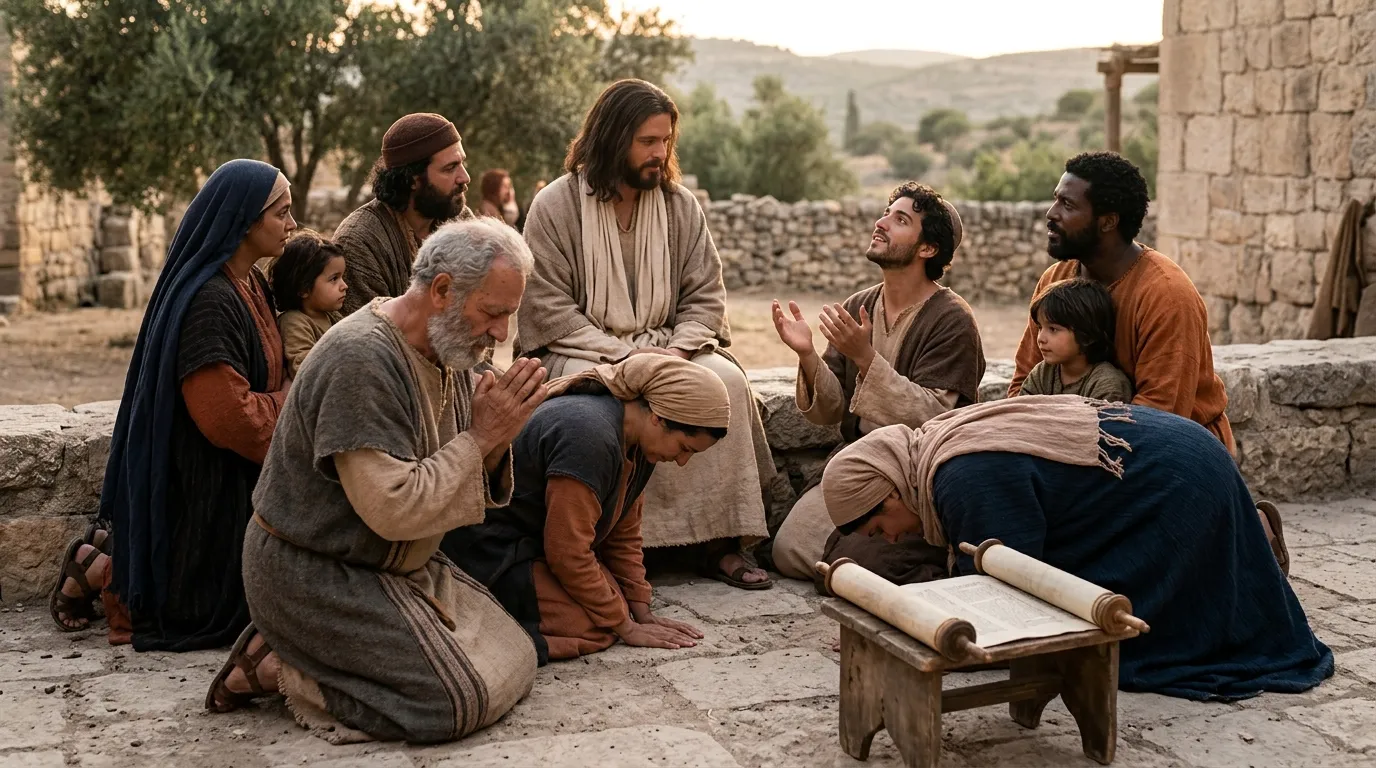
Four scenes, spread across the whole New Testament, show what it means to worship Jesus. None of them takes place in a church service. One happens in a house in Bethlehem, one in the middle of a storm, one in a locked room, and one in heaven itself. Together they show that worship is not first a style of music or a posture of the body. It is what happens when a person sees who Jesus is and responds with everything they have.
Scene One: Strangers Kneel Before a Child
Matthew 2 tells of wise men from the east who follow a star to Bethlehem. When they find the child, they fall down and worship Him, then open their treasures — gold, frankincense, and myrrh. There is no sermon, no hymn, no crowd. Just travelers who have recognized something about this child and answer with their knees and their wealth.
Their worship teaches the first lesson: worship begins with recognition. The wise men did not worship because they were told to or because the moment felt emotional. They worshiped because they understood, at least in part, who this child was. Worship is always a response to a revelation. You see something true about Jesus, and your heart answers.
Scene Two: Disciples Worship in a Storm
Matthew 14 gives the second scene. The disciples are in a boat, the wind is against them, and Jesus comes walking across the water. Peter tries to walk too, begins to sink, and is rescued. When they climb back into the boat, the wind stops, and the disciples worship Jesus, saying, “Truly you are the Son of God” (Matthew 14:33).
Notice what provokes this worship: rescue. The disciples had seen Jesus’ power before, but this time the power was personal. He had reached into their terror and pulled them out of it. Worship often grows this way — not from arguments, but from experience. A person who has been pulled out of deep water does not need to be persuaded that the Rescuer is worthy. The worship of Jesus in the Bible is repeatedly tied to what He has done: He calmed the sea, He healed the sick, He raised the dead, He bore the cross. Worship remembers rescue.
Scene Three: A Doubter Confesses
John 20 gives the third scene, and it is the most intimate. Thomas has said he will not believe unless he sees and touches the wounds. A week later the risen Jesus stands before him and invites him to do exactly that. Thomas answers with the highest confession in the Gospel: “My Lord and my God!” (John 20:28).
Thomas’s worship destroys the idea that worship requires certainty as a precondition. He came with doubts, with conditions, with a refusal to pretend. Jesus did not rebuke him for it; He met him in it. And the doubt, answered, turned into the most complete worship in the book. This matters for every Christian who has ever felt that their questions disqualify them from worship. Thomas shows that honest doubt can be the doorway to deeper worship, not the end of it — provided the doubt is brought to Jesus rather than nursed away from Him.
Scene Four: Heaven Never Stops
Revelation 5 gives the fourth scene, and it is the widest. Around the throne of God, myriads of angels and every creature in heaven and on earth sing to the Lamb: “Worthy is the Lamb who was slain, to receive power and wealth and wisdom and might and honor and glory and blessing!” (Revelation 5:12). The worship of heaven is not centered on God’s power in the abstract. It is centered on the Lamb who was slain — on redemption. The scars are part of the song.
This is the Bible’s answer to the question of whether worshiping Jesus is the same as worshiping God. In Revelation, the Lamb receives the same worship as the One on the throne, and no angel objects. John 1:1 identifies Jesus as the Word who was with God and was God. Hebrews 1:6 says, “Let all God’s angels worship him.” The New Testament does not present worship of Jesus as an optional extra added to the worship of God. It presents it as the worship of God, directed to the Son who perfectly reveals the Father.
What Worship Actually Is
The biblical words for worship carry the picture of bowing down — the Hebrew shachah and the Greek proskuneō both describe prostration, the body saying what the heart believes: You are worthy, and I am not the center. But the Bible refuses to let worship shrink to a posture. Romans 12:1 calls the offering of our bodies and our daily lives “spiritual worship.” Worship includes singing, but it also includes obedience, generosity, prayer, endurance in suffering, and a life that tells the truth about who God is.
That is why the distinction between praise and worship is less important than people often think. Praise declares what God has done; worship bows before who God is. In practice the two run together, and the Bible uses both words freely. The real distinction is not between two styles of song but between worship and its counterfeits: performance that aims at an audience, ritual that runs on autopilot, and emotion that substitutes for surrender. True worship involves the heart, but it is not measured by the intensity of feeling. A quiet act of obedience on a Tuesday can be more genuine worship than a loud song on a Sunday.
Worship When Life Is Hard
The Bible never suggests that worship belongs only to good seasons. Some of the deepest worship in Scripture comes out of grief and fear. The disciples worshiped in the storm. Thomas worshiped after his world had collapsed. Job worshiped after losing everything. Habakkuk sang even when the fig tree did not blossom. Worship in hard times is not denial; it is defiance — a refusal to let circumstances have the last word about who God is.
That is also why worship is a weapon against idolatry. Every human heart worships something. The question is never whether you will worship, but what you will worship: money, reputation, comfort, control, approval. Worshiping Jesus reorders the heart. It puts the one truly worthy object at the center, and everything else falls into its proper, smaller place.
So the worship of Jesus in the Bible is not a ritual to perform or a mood to manufacture. It is the response of people who have seen who He is — the child in Bethlehem, the Lord of the storm, the risen Christ with wounds, the Lamb on the throne — and who answer with their knees, their treasures, their confessions, and their lives. The scenes change; the response is the same: He is worthy.
Scene Five: A Woman Worships With Tears
There is a fifth scene that belongs with the others, though it is quieter. In Luke 7, a woman known in her town as a sinner learns that Jesus is eating at a Pharisee’s house. She comes with an alabaster flask of ointment, stands behind Jesus weeping, wets His feet with her tears, wipes them with her hair, kisses them, and anoints them. The host is scandalized. Jesus is not. He tells a parable about two debtors — one forgiven a little, one forgiven much — and says, “Her sins, which are many, are forgiven — for she loved much” (Luke 7:47).
This is worship in its most unguarded form. There is no song, no crowd, no liturgy. There is a woman, her tears, her hair, and her perfume — the most expensive thing she owns, poured out on feet that the host had not even bothered to wash. Worship, in this scene, is not a performance for an audience. It is a costly, embarrassing, total outpouring on the only One worthy of it. The Pharisee’s religion had no room for her. Jesus’ table did. And her worship exposed the difference between religion that observes and faith that adores.
The scene also corrects a common mistake about worship and emotion. The woman’s worship was deeply emotional — she wept openly. But the emotion was not the worship. The worship was the act: the ointment, the tears, the hair, the kissing of feet, the surrender of dignity. Emotion accompanied the offering; it was not the offering. Worship that chases a feeling will collapse the moment the feeling fades. Worship that offers something real — time, money, reputation, obedience — stands when the feelings are gone.
How the Church Learned to Worship Jesus
The New Testament’s worship of Jesus did not stop with the scenes in the Gospels. The earliest Christians sang hymns to Christ “as to a god,” as the Roman governor Pliny reported with bewilderment around AD 112. Paul’s letters contain fragments of those early hymns — Philippians 2:6–11, Colossians 1:15–20, 1 Timothy 3:16 — poems about a Christ who was in the form of God, who emptied Himself, who died, who was exalted, and before whom every knee will bow. The church was worshiping Jesus in song within years of the resurrection, long before the New Testament canon was settled. Worship was not a later invention imposed on a merely human Jesus. It was the church’s first response to the risen Lord.
That early worship also shaped the church’s understanding of who Jesus is. Christians did not first work out a doctrine of the Trinity and then decide to worship Jesus. They worshiped Jesus because they had met Him risen, and the doctrine came later as an attempt to explain the worship. The cart did not pull the horse. The praise came first; the theology followed, trying to keep up with what the church already knew on its knees.
Readers interested in how these biblical patterns shaped later Christian practice can find a useful survey in the article on Christian worship through the centuries.