Imagine receiving a letter that could change a relationship forever. Someone you love has been hurt, trust has been broken, and you are not sure what will happen next. Now imagine God placing a small message of grace in your hands and asking you to choose forgiveness over anger.
That is the heart of the Philemon meaning in the Bible.
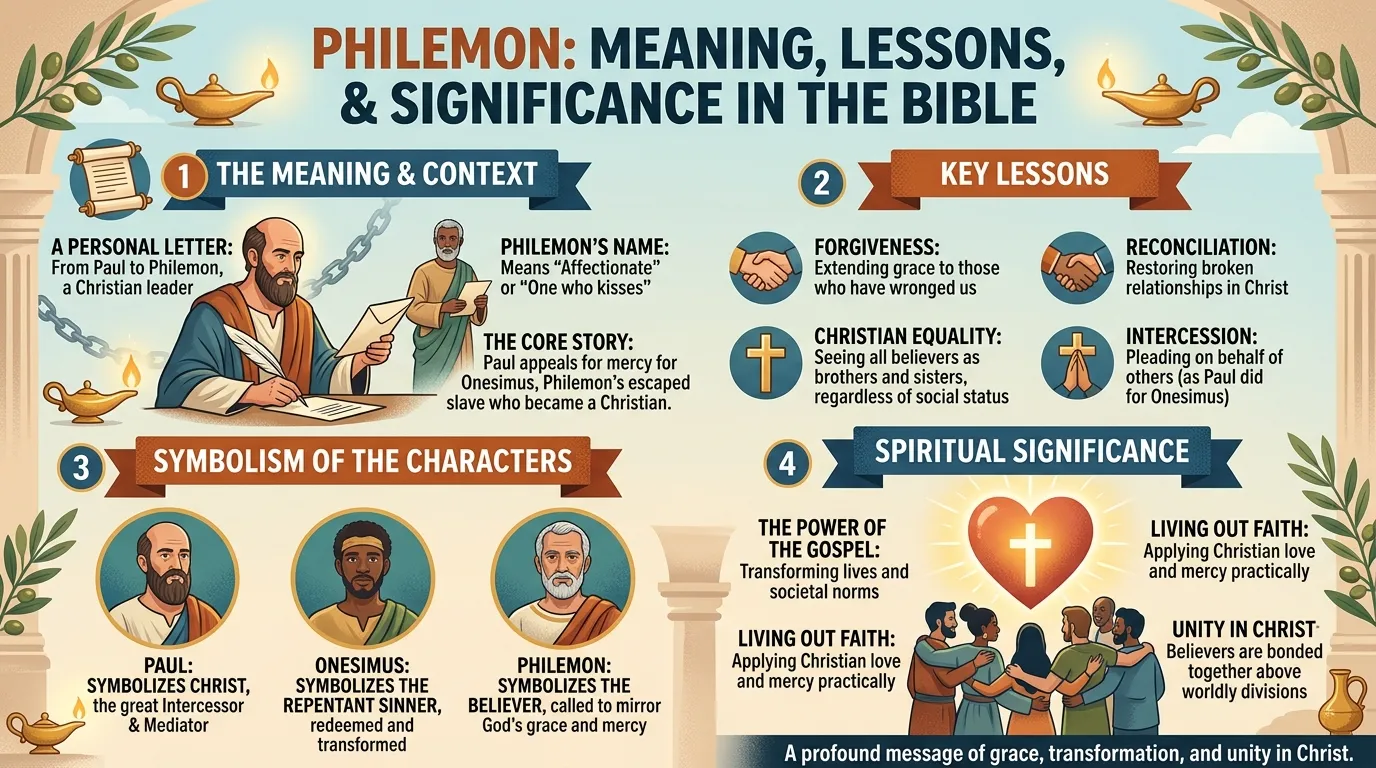
Philemon is a short book in the New Testament, but its message is powerful. It speaks about forgiveness, reconciliation, grace, brotherhood, love, and restoration. The letter was written by Paul to Philemon about Onesimus, a man who had become separated from Philemon and later came to faith in Christ.
Although the Bible does not give a symbolic meaning to the name Philemon itself, the story surrounding Philemon teaches deep lessons about how the gospel can transform relationships.
What Does Philemon Mean in the Bible?
The name Philemon comes from the Greek name Philemon, which is related to the Greek word phileō, meaning to love, show affection, or have friendly affection.
The Bible does not directly say, “Philemon means love.” However, the meaning of the Greek name is commonly connected with the idea of affection and friendship.
This is especially meaningful because the Letter to Philemon focuses strongly on Christian love and reconciliation.
Paul appeals to Philemon not simply as a leader but as a brother. He asks him to receive Onesimus with love because Onesimus has become a fellow believer.
Philemon 1:15–16 says that Onesimus may have been separated from Philemon for a time so that Philemon might receive him “no longer as a slave but more than a slave, a beloved brother.”
The main lesson is clear:
The gospel changes how we see other people.
A person who once seemed like an enemy, servant, stranger, or problem can become a brother or sister in Christ.
Philemon Meaning in the Bible + Hebrew Meaning
The Philemon meaning in the Bible is based on a Greek name, not a Hebrew name.
Philemon was written in Greek, and the name Philemon is generally connected with the Greek root phileō, which expresses love, affection, friendship, or fondness.
There is no direct Hebrew meaning of Philemon given in Scripture. Therefore, it would be misleading to claim that Philemon has a specific Hebrew definition as though the Bible itself provides one.
Still, the biblical theme of love is deeply connected to Hebrew Scripture.
For example, the Hebrew Bible repeatedly teaches God’s people to love others. Leviticus 19:18 commands God’s people to “love your neighbor as yourself.” Jesus later identifies this command as one of the great commandments in Matthew 22:39.
So while Philemon is a Greek name, its story reflects a truth that runs throughout the Bible: God calls His people to love, forgive, and pursue peace.
Who Was Philemon in the Bible?
Philemon was a Christian whom Paul knew personally.
Paul addresses him as a “dear friend and fellow worker” in Philemon 1:1. Philemon’s home also appears to have been a meeting place for believers, as Paul mentions the church that met in his house in Philemon 1:2.
This tells us something important about Philemon.
He was not merely a person who had a Bible connection. He was actively involved with other believers and the work of the Christian community.
Paul also thanks God for Philemon’s love and faith toward the Lord Jesus and toward God’s people in Philemon 1:4–7.
That gives us a picture of a believer whose faith was visible through his treatment of others.
Who Was Onesimus?
Onesimus is one of the key people in the Letter to Philemon.
He had a difficult relationship with Philemon and had become separated from him. The exact details of what happened are not fully explained in the letter, so Christians should be careful not to add details that Scripture does not provide.
At some point, Onesimus met Paul.
Paul describes Onesimus as someone who had become like a son to him while Paul was imprisoned. More importantly, Onesimus had become a believer in Christ.
Paul writes in Philemon 1:10:
“I appeal to you for my son Onesimus, who became my son while I was in chains.”
The gospel had changed Onesimus.
His past did not disappear, but his identity in Christ became central to the situation.
What Is the Main Message of the Book of Philemon?
The central message of Philemon is Christian reconciliation shaped by grace and love.
Paul could have commanded Philemon to accept Onesimus. Instead, Paul makes a loving appeal.
Philemon 1:8–9 shows Paul choosing to appeal based on love rather than simply using his authority.
This teaches an important principle:
Christian leadership should not only seek obedience; it should also encourage love, wisdom, and willing obedience.
Paul wanted Philemon to respond in a way that reflected the gospel.
Philemon Teaches Forgiveness
Paul asks Philemon to receive Onesimus differently because of Christ.
Philemon 1:17 says:
“So if you consider me a partner, welcome him as you would welcome me.”
That is a remarkable request.
Paul places his own relationship with Philemon beside Onesimus’s situation. He encourages Philemon to welcome Onesimus as he would welcome Paul.
This shows how the gospel can create a new kind of relationship.
Philemon Teaches Restoration
Paul does not ignore the past.
In Philemon 1:18–19, Paul says that if Onesimus owes Philemon anything, Paul will take responsibility for it.
The letter therefore does not present grace as pretending that wrong never happened.
Instead, it shows a path toward restoration, responsibility, forgiveness, and reconciliation.
Important Verses From the Book of Philemon
The Letter to Philemon contains only one chapter, but several verses capture its main message.
Philemon 1:4–7 — Faith and Love
Paul thanks God for Philemon’s faith in Jesus and love for the saints.
This passage shows that genuine faith should affect how Christians treat other people.
Faith and love belong together.
Philemon 1:10 — A Transformed Life
Paul calls Onesimus his spiritual son.
The verse shows the transforming power of the gospel. Someone with a complicated past could become part of Paul’s spiritual family through faith in Christ.
Philemon 1:15–16 — A Beloved Brother
Paul asks Philemon to receive Onesimus as more than a servant—as a beloved brother.
This is one of the strongest statements in the letter about how Christian identity changes relationships.
Philemon 1:17 — Welcome Him
Paul asks Philemon to welcome Onesimus as he would welcome Paul.
This verse points toward acceptance, reconciliation, and Christian fellowship.
Philemon 1:18–19 — Taking Responsibility
Paul offers to repay what Onesimus may owe.
This reminds Christians that reconciliation can sometimes involve practical steps, not only words.
Philemon 1:20 — Refresh My Heart
Paul asks Philemon to refresh his heart in Christ.
This beautiful phrase reminds us that our choices can either strengthen or burden the people around us.
What Is the Spiritual Meaning of Philemon?
The Bible does not give a hidden spiritual code for the name Philemon. However, the story provides several important spiritual themes.
Love That Changes Relationships
The name Philemon is associated with affection and love, while the letter itself repeatedly emphasizes love.
Christian love is more than emotion.
It can involve choosing patience, forgiveness, humility, and mercy when relationships become difficult.
Grace for People With a Past
Onesimus had a history with Philemon.
Yet Paul encouraged Philemon to see what God was doing in Onesimus’s life.
This gives Christians hope today.
Your past may explain part of your story, but it does not have to define your future in Christ.
Reconciliation Through Christ
Philemon shows that the gospel reaches beyond personal salvation.
It also affects relationships.
When two people belong to Christ, they have a new reason to seek peace, forgiveness, and restoration.
What Does Philemon Teach Christians About Forgiveness?
Philemon does not give a simple formula for every difficult relationship. However, it strongly encourages Christians to practice grace and reconciliation.
Forgiveness does not mean pretending that harm never happened.
It also does not mean ignoring wisdom, safety, justice, or healthy boundaries.
Instead, biblical forgiveness means refusing to let bitterness control the heart while seeking God’s wisdom about what restoration should look like.
For example, a Christian may forgive someone who hurt them while still recognizing that rebuilding trust can take time.
Forgiveness and restored trust are related, but they are not always identical.
Philemon and the Meaning of Christian Brotherhood
One of the most powerful ideas in Philemon is the transformation of identity.
Paul asks Philemon to see Onesimus as a brother.
This reflects a wider New Testament teaching.
Galatians 3:28 explains that those who belong to Christ are united in Him. James 2:1–9 warns believers against showing favoritism based on social status.
The gospel creates a spiritual family that is bigger than social position, wealth, background, or past mistakes.
That truth remains important today.
A church should be a place where people experience truth and grace together.
What Can Philemon Teach Us About Grace?
Grace is not simply getting what we deserve.
Biblical grace points to God’s undeserved kindness and favor.
The story of Philemon gives us a practical picture of grace because Paul asks Philemon to extend kindness toward someone with whom he had a serious personal history.
Ephesians 4:32 gives a similar Christian principle:
“Be kind and compassionate to one another, forgiving each other, just as in Christ God forgave you.”
The Christian does not forgive because wrongdoing is unimportant.
We forgive because we have received grace from God.
What Does Philemon Mean in a Dream?
Some people search for the meaning of Philemon in a dream, especially if they see the name, read the book, or hear it during sleep.
The Bible does contain examples of God using dreams at important moments. Joseph, Daniel, and others received dreams or visions in Scripture.
However, Christians should not assume that every dream carries a divine message.
Scripture should always be the standard for testing spiritual impressions.
If you dream about Philemon, you might reflect on biblical themes such as:
- Forgiveness
- Reconciliation
- Grace
- Restoration
- Christian love
- A changed identity
- Peace in relationships
But these are possible areas for prayerful reflection, not guaranteed predictions.
A dream should never be used to make major decisions simply because a person believes God gave them a special sign.
Instead, compare every impression with God’s Word. As 1 Thessalonians 5:21 teaches, believers should “test everything” and hold on to what is good.
What Does Philemon Mean Spiritually in Everyday Life?
The message of Philemon can appear in ordinary Christian situations.
Maybe you have an old friend who hurt you.
Maybe someone at church disappointed you.
Maybe a family relationship has become tense.
Or perhaps you are the person who needs another chance.
Philemon reminds us to ask:
How can I respond in a way that reflects Christ?
That may mean having an honest conversation, asking for forgiveness, forgiving someone, making restitution, or patiently rebuilding trust.
Sometimes reconciliation happens quickly.
Sometimes it takes time.
And sometimes wisdom requires distance while forgiveness is still practiced in the heart.
Practical Lessons From Philemon for Christians Today
Choose Love Over Bitterness
When someone hurts you, bitterness can feel natural.
Instead, bring the pain to God in prayer and ask Him to help you respond with wisdom.
Remember That People Can Change
Onesimus was not viewed only through his past.
The gospel had changed his life.
Christians should leave room for genuine repentance and spiritual growth.
Practice Forgiveness With Wisdom
Forgiveness is biblical, but Christians should not confuse forgiveness with allowing repeated abuse or refusing appropriate boundaries.
Seek God’s wisdom and, when needed, trusted pastoral or professional counsel.
Let Your Faith Affect Your Relationships
Philemon’s faith was connected to his love for other believers.
Our faith should also become visible in how we speak, forgive, serve, and treat people.
Trust God With Broken Relationships
You cannot control another person’s response.
You can control whether you choose bitterness or bring the situation honestly before God.
Romans 12:18 gives balanced wisdom:
“If it is possible, as far as it depends on you, live at peace with everyone.”
Notice the words “if it is possible” and “as far as it depends on you.”
God calls us to pursue peace, but Scripture also recognizes that reconciliation may not always be fully within our control.
Frequently Asked Questions
What does the name Philemon mean?
Philemon is a Greek name commonly connected with the Greek root phileō, which relates to love, affection, or friendship. The Bible does not assign a special symbolic definition to the name.
What is Philemon known for in the Bible?
Philemon is known as the recipient of Paul’s personal letter concerning Onesimus. The letter focuses on faith, love, forgiveness, reconciliation, grace, and Christian brotherhood.
What is the main lesson of Philemon?
The main lesson is that the gospel should transform relationships. Paul encourages Philemon to receive Onesimus with love and to recognize him as a beloved brother in Christ.
Is Philemon a Hebrew name?
No. Philemon is generally understood as a Greek name. It does not have a Hebrew meaning given in the Bible.
What does Philemon teach about forgiveness?
Philemon teaches that Christians should pursue grace and reconciliation while taking wrongdoing seriously. Forgiveness does not require pretending that the past did not happen.
What does Philemon mean in a dream?
There is no biblical rule saying that dreaming about Philemon has one fixed meaning. A Christian may prayerfully reflect on the book’s themes of love, forgiveness, restoration, and reconciliation, while testing any spiritual impression against Scripture.
Final Thoughts
The Philemon meaning in the Bible is best understood through the story and message of the book rather than through the name alone.
Philemon was a Christian who faced a difficult relationship. Onesimus was a man with a complicated past who became connected to Paul and to Christ. Paul stood between them and appealed for grace, welcome, and reconciliation.
The Bible does not tell us exactly how Philemon responded. But it gives us enough to see the powerful lesson.
The gospel can change people, and God’s grace can change relationships.
If you are carrying anger today, bring it to God.
If you need forgiveness, ask Him for courage and humility.
If someone has changed, ask God for wisdom about how to respond.
And if a relationship cannot be restored right now, remember that God still sees your heart and knows your pain.
Philemon points us back to the heart of the Christian message: Christ changes our identity, teaches us to love, and calls us to walk in grace and truth.
Take time to pray, read Philemon slowly, and ask God what He wants you to learn from its message. You may discover that this tiny New Testament letter carries a very personal reminder: God is still working through forgiveness, redemption, love, and grace. Trust Him with what you cannot fix, and faithfully follow Him in what you can.