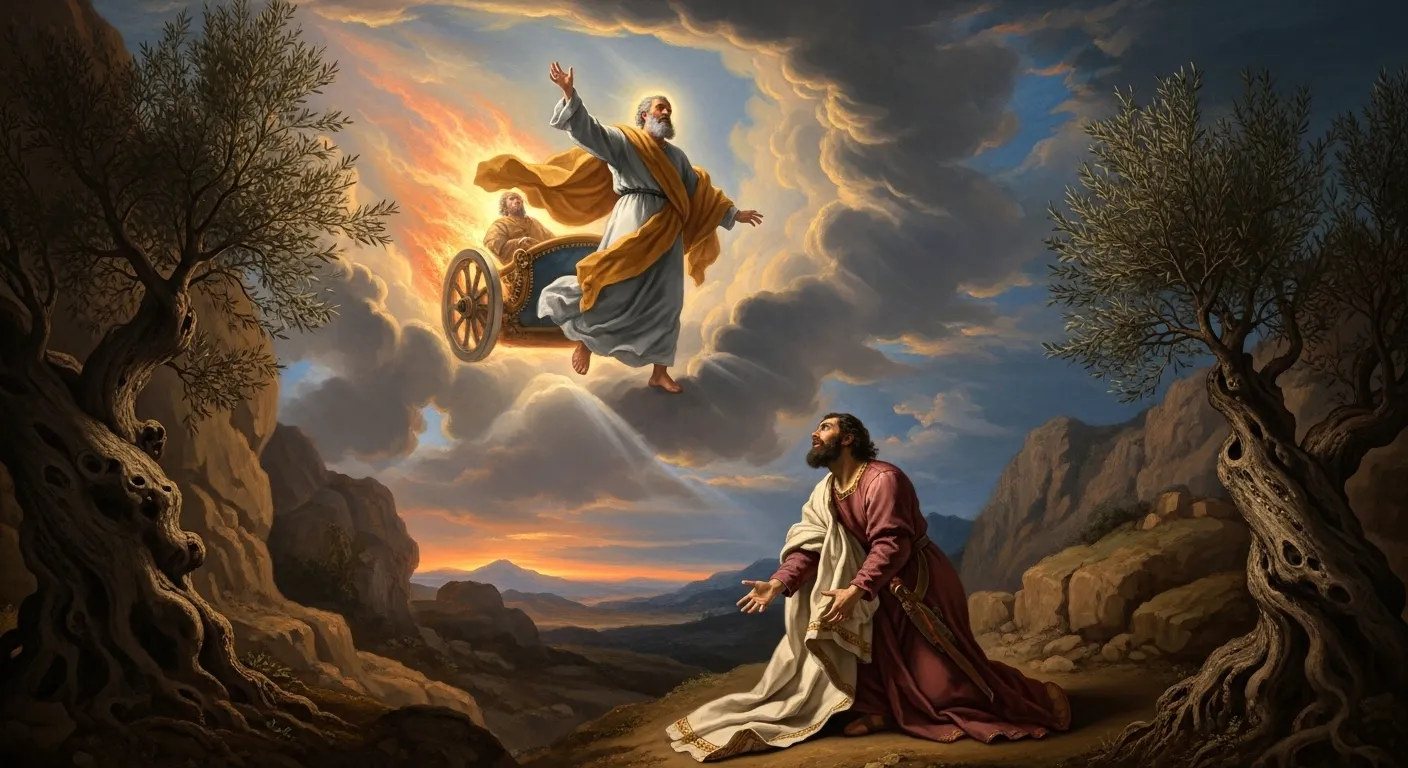
One of them called down fire from heaven and then ran for his life from a queen’s threat. The other inherited a double portion of his spirit and then died of an ordinary illness — yet even his bones raised a dead man. Elijah and Elisha, master and disciple, are the Bible’s great study in succession: how God’s work passes from one generation to the next, how the spectacular and the steady belong to the same mission, and how no servant of God, however mighty, is the whole story. Their ministries span 1 Kings 17 through 2 Kings 13, and together they form a single arc — from drought to downpour, from one prophet’s loneliness to another’s legacy.
The meaning of Elijah and Elisha in the Bible is not primarily about miracles, though the miracles are unforgettable. It is about continuity: God raising up, God handing over, God refusing to let His purposes depend on any single life. The mantle that fell from Elijah’s shoulders onto Elisha’s is the image that governs everything — ministry as something received, carried, and passed on.
Elijah: The Prophet of Fire
Elijah appears from nowhere — “Elijah the Tishbite, from Tishbe in Gilead” (1 Kings 17:1) — with no genealogy, no backstory, just a word from the Lord and a confrontation with the most powerful man in Israel: “As the Lord, the God of Israel, lives, whom I serve, there will be neither dew nor rain in the next few years except at my word.” In one sentence, an unknown prophet shuts the sky over Ahab’s kingdom.
What follows is a ministry of dramatic confrontations. Fed by ravens at the Kerith Ravine. Sustained by a widow’s inexhaustible flour and oil at Zarephath — and raising her son from the dead, the first resurrection in Scripture (1 Kings 17:17–24). Then Mount Carmel, the showdown that defines him: 450 prophets of Baal against one prophet of the Lord, two altars, and Elijah’s famous taunt — “Shout louder! Surely he is a god!” (1 Kings 18:27). When his turn comes, he soaks the sacrifice three times with water and prays a 63-word prayer, and “the fire of the Lord fell and burned up the sacrifice, the wood, the stones and the soil” (1 Kings 18:38). The people fall facedown: “The Lord — he is God! The Lord — he is God!” (1 Kings 18:39).
And then the collapse. Jezebel threatens his life, and the man who faced 450 prophets flees from one woman, sits under a broom tree, and asks to die: “I have had enough, Lord” (1 Kings 19:4). Scripture’s honesty here is breathtaking — and deeply merciful. God does not rebuke Elijah’s despair with theology. He gives him food, sleep, and a forty-day journey, and then speaks — not in the wind, earthquake, or fire, but in “a gentle whisper” (1 Kings 19:12). The God of Carmel is also the God of the whisper, and the prophet of fire needed to learn that power is not always loud.
Elijah’s meaning includes this valley as much as the mountaintop. He is the Bible’s proof that burnout, depression, and despair can strike the most faithful — and that God’s response is rest, nourishment, and a quiet voice, not condemnation. He is also proof that no one is irreplaceable: God tells him to anoint Elisha as his successor (1 Kings 19:16). The ministry was never about Elijah. It was about the God who would keep speaking after Elijah was gone.
The Mantle Passes: A Double Portion
Elisha’s call is one of Scripture’s most vivid scenes. Elijah finds him plowing with twelve yoke of oxen — a wealthy farmer’s son — throws his cloak over him, and keeps walking (1 Kings 19:19). Elisha slaughters the oxen, burns the plowing equipment as fuel, feeds the people, and follows. He burns his bridges literally: there is no going back to the farm.
Years of apprenticeship follow — the text compresses them into the repeated phrase “my master” and the quiet detail that Elisha “poured water on the hands of Elijah” (2 Kings 3:11), the servant’s task. Then the final journey: Gilgal, Bethel, Jericho, the Jordan — at each stop Elijah tells him to stay, and at each stop Elisha refuses: “As surely as the Lord lives and as you live, I will not leave you” (2 Kings 2:2, 4, 6). Persistence as devotion. When the chariot of fire separates them and Elijah is taken up in a whirlwind, Elisha’s cry is revealing: “My father! My father! The chariots and horsemen of Israel!” (2 Kings 2:12). He saw what Israel’s true defense had always been — not armies, but the prophet.
The mantle falls. Elisha picks it up, strikes the Jordan, and cries, “Where now is the Lord, the God of Elijah?” (2 Kings 2:14). The waters part. The succession is confirmed — and Elisha had asked for “a double portion” of Elijah’s spirit (2 Kings 2:9), the inheritance share of a firstborn son (Deuteronomy 21:17). He was asking to be the heir, not the replacement. Scripture’s count is suggestive: roughly twice as many miracles are recorded for Elisha as for Elijah. The student exceeded the teacher — which is exactly what faithful succession is supposed to produce.
Elisha: The Prophet of Compassion
Where Elijah’s ministry was confrontation, Elisha’s was restoration — and the contrast is the point. Elijah called down fire; Elisha purified poisoned stew (2 Kings 4:38–41). Elijah outran chariots; Elisha multiplied a widow’s oil to save her sons from slavery (2 Kings 4:1–7). Elijah raised one dead boy; Elisha raised the Shunammite’s son (2 Kings 4:32–37). Elijah prayed for drought; Elisha prayed for rain and for healing.
His most famous act of compassion crossed enemy lines. Naaman, the Syrian general — the commander of Israel’s oppressors — comes seeking healing from leprosy. Elisha does not even meet him in person; he sends word: wash seven times in the Jordan (2 Kings 5:10). Naaman rages at the simplicity, his servants talk him into it, and “his flesh was restored and became clean like that of a young boy” (2 Kings 5:14). The foreign general’s confession — “Now I know that there is no God in all the world except in Israel” (2 Kings 5:15) — is one of the Old Testament’s great missionary moments. And when Elisha’s servant Gehazi chases Naaman for a payoff, the leprosy transfers to him (2 Kings 5:27): grace cannot be monetized.
Then Dothan: the Syrian army surrounds the city to capture Elisha, his servant panics, and Elisha prays, “Open his eyes, Lord, so that he may see” (2 Kings 6:17). The servant sees the hills “full of horses and chariots of fire.” Elisha strikes the army with blindness, leads them to Samaria, and then — astonishingly — feeds them and sends them home (2 Kings 6:22–23). “So the bands from Aram stopped raiding Israel’s territory.” Kindness accomplished what armies could not. The prophet of compassion disarmed an empire with a meal.
The Bones and the Legacy
Elisha’s end is as instructive as his beginning. Unlike Elijah, he was not taken up in glory. He died of an illness (2 Kings 13:14) — the man of miracles could not miracle himself well. King Joash wept over him with Elisha’s own old cry: “My father! My father!” But the story has one final wonder: a dead man thrown hastily into Elisha’s tomb touches the prophet’s bones and comes back to life (2 Kings 13:21). Even in death, the ministry continued. God’s power was never Elisha’s possession; it was God’s presence, and it outlasted him.
Together, Elijah and Elisha teach the church its most important lesson about leadership. Elijah shows that faithfulness includes weakness — the whisper after the fire, the despair after the victory, the successor after the solitary years. Elisha shows that the next generation is not a lesser copy but a doubled anointing — if it will serve, persist, and ask. The mantle still falls. It falls on those pouring water on the hands of their masters, refusing to leave, burning the plows. And centuries later, both prophets would stand with Moses beside Jesus at the Transfiguration (Matthew 17:3) — the Law and the Prophets bearing witness that the succession they served had reached its destination. For the broader historical portrait of the senior partner in this pair, the Wikipedia article on Elijah traces his biblical career and his vast legacy in Judaism, Christianity, and Islam.










