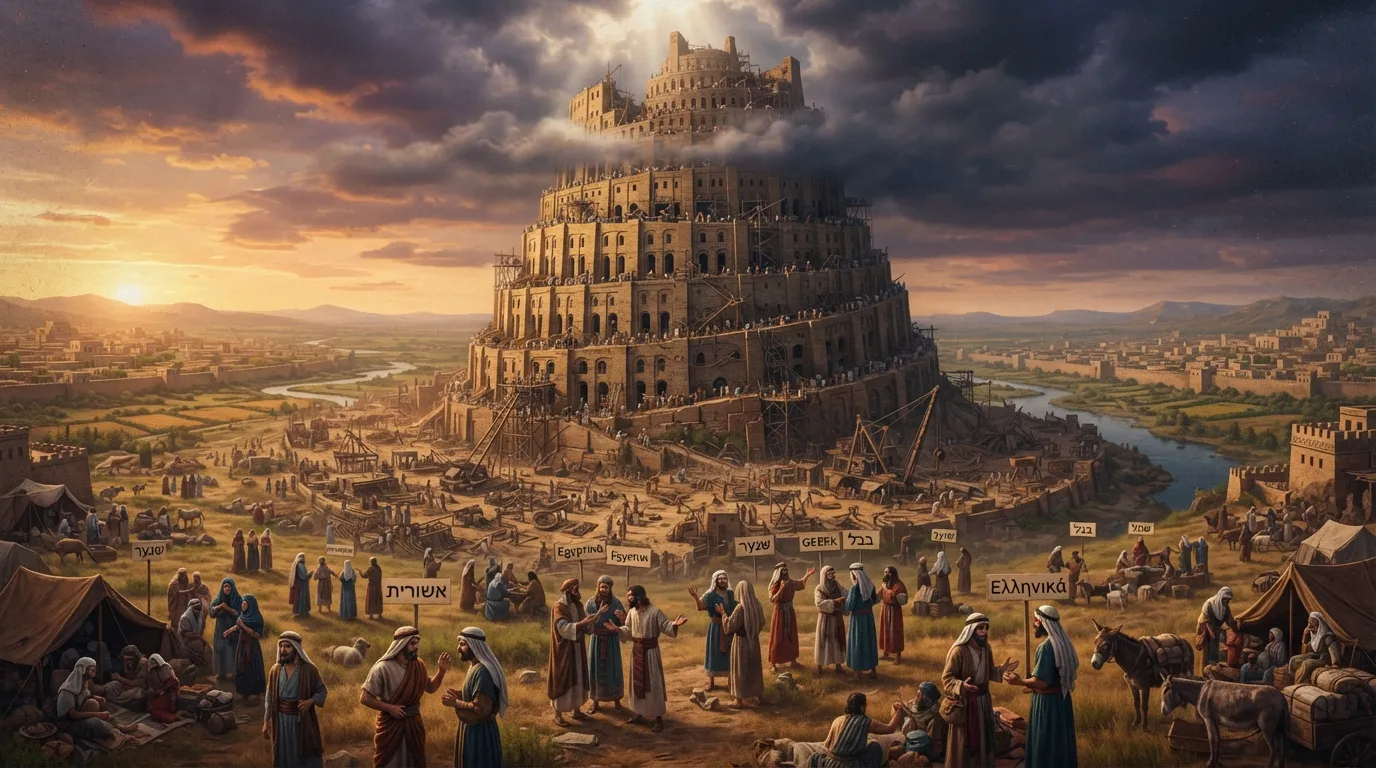
The people of Shinar had a plan, and it was a good plan by every human measure. They had unity: “the whole earth had one language and the same words” (Genesis 11:1). They had technology: they had learned to bake bricks and use bitumen for mortar instead of relying on scarce stone. They had a location: a fertile plain in Mesopotamia. They had a goal: build a city and a tower with its top in the heavens. What could go wrong?
Everything — because of one phrase in their mission statement. “Come, let us build ourselves a city and a tower with its top in the heavens, and let us make a name for ourselves, lest we be dispersed over the face of the whole earth” (Genesis 11:4). Make a name for ourselves. The tower was not the problem. The name was.
After the Flood: A Fresh Start, an Old Problem
Genesis 11 comes shortly after the flood. Humanity had been given a fresh start. God had blessed Noah and his sons and repeated the creation mandate: “Be fruitful and multiply and fill the earth” (Genesis 9:1). The command was to scatter — to fill the earth, spread out, and steward the whole world.
The people of Shinar did the opposite. They settled in one place. They said, “lest we be dispersed.” The tower project was not just architecture; it was rebellion against the filling mandate. God said spread out. Humanity said huddle together. God said fill the earth. Humanity said fortify one city.
The story also sits in a line of “make a name” attempts. In Genesis 4, Cain built a city and named it after his son Enoch. In Genesis 6, the “mighty men of old, the men of renown” made names for themselves. Now, in Genesis 11, an entire civilization tries it. The pattern is consistent: when people seek their own glory instead of God’s, the project eventually collapses — not because God is threatened, but because self-glory is a foundation that cannot hold.
What Were They Actually Building?
The tower of Babel was likely a ziggurat — a stepped, pyramid-like temple tower common in ancient Mesopotamia. Archaeologists have uncovered ziggurats at Ur, Babylon, and other sites: massive structures with staircases rising toward a shrine at the top. The phrase “with its top in the heavens” is probably not a claim that the builders thought they could literally reach God’s dwelling. It is the language of height and grandeur — the way we say a skyscraper “touches the sky.” The tower was a temple, a monument, and a statement: we can reach heaven on our own terms.
The name “Babel” is a play on words. In Akkadian, bab-ilu meant “gate of God.” The Babylonians were proud of that name — their city was the gate to the divine. Genesis turns the name inside out: the Hebrew word balal means “to confuse” or “to mix.” The place humans called the gate of God became the place where God confused their language. The Bible does this kind of wordplay often, and here it is devastating: the monument to human achievement became the monument to human confusion.
“Let Us Go Down”: God’s Response
The most ironic verse in the story is Genesis 11:5: “And the LORD came down to see the city and the tower, which the children of man had built.” The builders thought their tower reached the heavens. God had to come down to see it. The verse is a masterpiece of understatement. Humanity’s greatest construction project was so small that God had to stoop to examine it.
Then God said, “Behold, they are one people, and they have all one language, and this is only the beginning of what they will do. And nothing that they propose to do will now be impossible for them” (Genesis 11:6). This is not fear. God is not threatened by bricklayers. It is a statement of mercy and wisdom: unified rebellion is more dangerous than divided rebellion, because it accelerates sin. A humanity united in pride would reach catastrophe faster. God intervened to slow the project — for humanity’s own good.
So “the LORD confused the language of all the earth” (Genesis 11:9). People who had worked side by side suddenly could not understand each other. The construction stopped — not because the bricks ran out, but because communication broke down. The city was abandoned unfinished. And the people were dispersed over the face of the earth — which is exactly what God had commanded in the first place.
Judgment That Is Also Mercy
It is easy to read Babel as pure punishment. It is better to read it as discipline wrapped in mercy. God did not destroy the builders. He did not send a second flood. He confused their language — an intervention that frustrated their project but preserved their lives. The scattering that resulted was not only judgment; it was the fulfillment of the original command to fill the earth.
The confusion of languages also explains something the rest of the Bible takes for granted: the diversity of nations and languages in the world. Genesis 10, the “Table of Nations,” lists the peoples and languages that spread across the earth. Genesis 11 explains how that diversity began. The Bible treats linguistic and cultural diversity not as an accident but as part of God’s design — a design that a single empire tried to erase, and that God restored.
There is also a subtle grace in the fact that God confused language rather than destroying unity altogether. Human beings would still cooperate, still build, still create. But they would do it in many languages, many cultures, many nations — none able to claim total control. Babel is God’s permanent check on empire: no single human project will ever unify the world under one name again. Every empire since — Babylon, Persia, Rome, and all their successors — has eventually met the same fate: confusion, division, and dispersal.
Babel Reversed: Pentecost
The full meaning of Babel only becomes clear at Pentecost. In Acts 2, the Holy Spirit descended on the disciples, and they began speaking in other tongues. Devout Jews “from every nation under heaven” were in Jerusalem, and each one heard the gospel “in his own native language” (Acts 2:6). At Babel, one language became many, and people could not understand each other. At Pentecost, many languages remained, but everyone understood the same message. Babel scattered people through confusion. Pentecost gathered people through comprehension.
The difference is the name. At Babel, people tried to make a name for themselves. At Pentecost, the apostles proclaimed the name of Jesus — “and there is salvation in no one else, for there is no other name under heaven given among men by which we must be saved” (Acts 4:12). The tower that humans built to reach heaven failed. The Savior whom heaven sent down to reach humans succeeded.
Revelation completes the arc. The final vision is not of one city abandoned but of a city filled: “a great multitude that no one could number, from every nation, from all tribes and peoples and languages, standing before the throne and before the Lamb” (Revelation 7:9). The diversity that began at Babel is not erased in eternity. It is redeemed. Every language will sing the same song, and the name that is glorified will not be ours but His.
What Babel Teaches Today
First, unity without God is not a virtue. The builders of Babel were perfectly unified — and perfectly wrong. Unity is good only when it is unity around truth. A team, a company, a nation, or a church can be completely aligned and completely misaligned with God at the same time.
Second, technology and skill are morally neutral, but ambition is not. Bricks and bitumen were not the problem. The problem was the purpose: “let us make a name for ourselves.” Every generation has its own tower — its own monument to self-sufficiency. The question is never whether we can build it. The question is whose name it glorifies.
Third, God opposes pride, but His opposition is merciful. He confused the languages rather than destroying the people. He scattered them rather than ending them. Even His judgments carry a thread of grace, because His goal is not to crush humanity but to redirect it.
Fourth, our confusion is not the end of the story. The world is still fragmented by language, culture, politics, and pride. But Pentecost proved that the fragmentation is not final. The gospel crosses every language barrier, and the church is the living proof that Babel’s curse is being reversed one converted heart at a time.
The people of Shinar wanted to build a tower to heaven and make a name for themselves. God had a better plan: He would send His Son down from heaven, make a name above every name, and gather people from every language into a city that would never be abandoned. For the archaeological and historical background on ziggurats and the ancient city of Babylon, see the Wikipedia article on the Tower of Babel.










