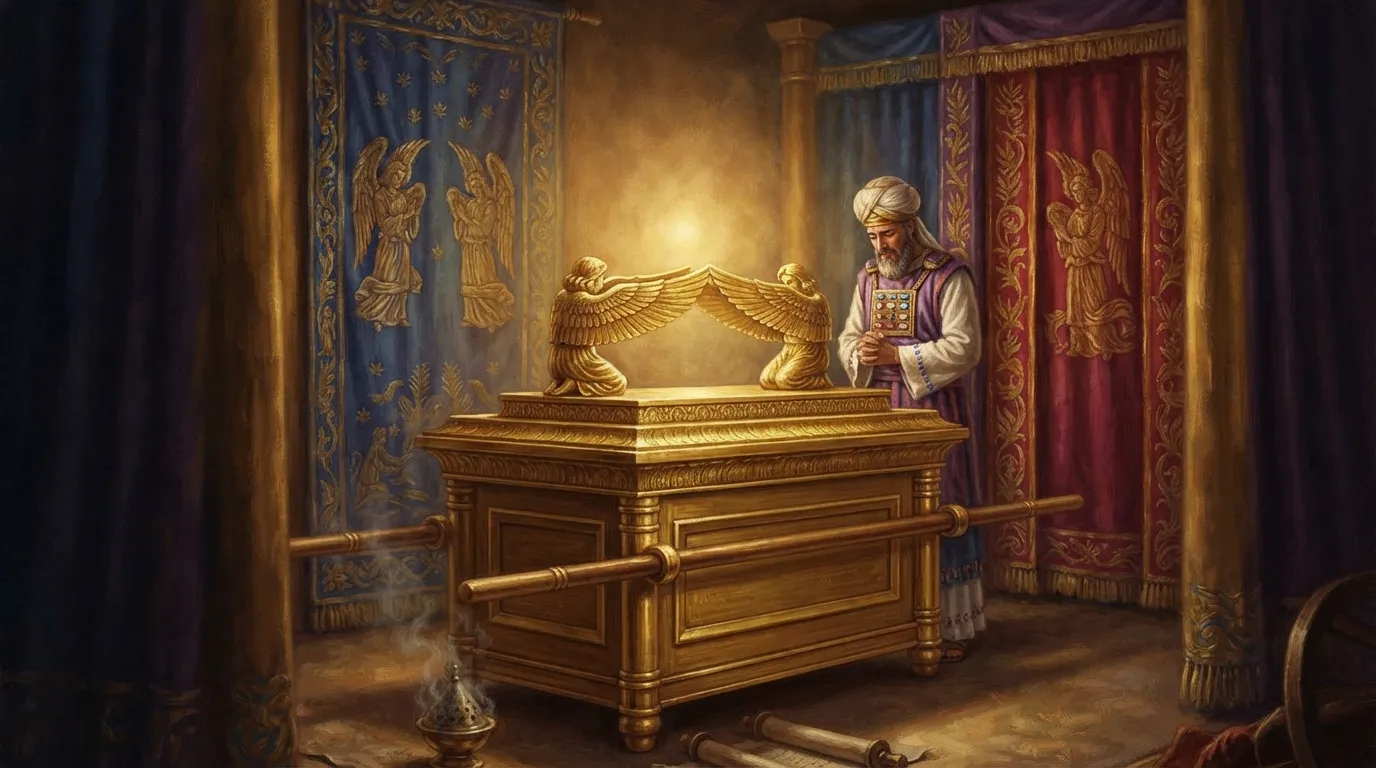
Of all the objects in the Bible, none has inspired more fascination, more treasure hunts, and more movies than the Ark of the Covenant. It was a gold-covered wooden chest, about the size of a large trunk, carried on poles by priests. It contained stone tablets, a jar of manna, and a staff. And yet nations trembled before it, armies fell because of it, and a man died for touching it. The Ark was never magic. It was a sign — the visible, tangible pledge that the invisible God was present with His people, bound to them by covenant, and holy beyond their comprehension.
The Ark appears in Scripture for roughly a thousand years, from its construction at Sinai to its disappearance around the Babylonian conquest. Then it vanishes. The Bible never tells us where it went. That silence has fueled two millennia of speculation — but the silence itself is part of the lesson.
Built to a Pattern: What the Ark Was
God gave Moses precise instructions for the Ark in Exodus 25:10–22. It was a chest of acacia wood, about 3 feet 9 inches long, 2 feet 3 inches wide, and 2 feet 3 inches high, overlaid inside and out with pure gold. Four gold rings held two wooden poles, also overlaid with gold, by which the Ark was carried. The poles were never to be removed — the Ark was made to be carried, not settled, a reminder that God was journeying with His people.
On top sat the mercy seat — a solid gold cover with two cherubim, their wings spread upward, facing each other, gazing down at the cover. God told Moses, “There I will meet with you, and from above the mercy seat, from between the two cherubim that are on the ark of the testimony, I will speak with you” (Exodus 25:22). The Ark was not an idol. It was not God. It was the footstool of His throne, the designated place where heaven met earth.
Inside the Ark were three items, listed in Hebrews 9:4: the stone tablets of the covenant — the Ten Commandments, God’s law given to Israel; a golden jar of manna — the bread God provided in the wilderness; and Aaron’s staff that budded — the rod that miraculously blossomed to confirm Aaron’s priesthood (Numbers 17). Together they told Israel’s story: God’s law, God’s provision, God’s chosen priesthood. The Ark was a covenant chest — a physical archive of the relationship between God and His people.
The Ark on the March: Presence and Power
When Israel marched through the wilderness, the Ark went first. “Whenever the ark set out, Moses said, ‘Arise, O LORD, and let your enemies be scattered'” (Numbers 10:35). The cloud of God’s presence led the way, and the Ark was its earthly counterpart. When the Ark moved, God moved. When the Ark rested, God rested.
The Ark’s power was on display at the Jordan River. When the priests carrying the Ark stepped into the water, the river stopped flowing and piled up in a heap, and Israel crossed on dry ground (Joshua 3–4). At Jericho, the Ark circled the city for seven days, and the walls fell (Joshua 6). The pattern was clear: victory came not from Israel’s strength but from God’s presence, and the Ark was the sign of that presence.
But the Ark was not a lucky charm, and Israel learned that the hard way. In 1 Samuel 4, Israel was losing a battle with the Philistines. Someone had the idea: bring the Ark to the battlefield, and God will have to save us. They carried it into camp like a mascot. The result was catastrophe. The Philistines captured the Ark, killed thirty thousand Israelites, and killed Eli’s sons. The glory had departed — so much so that Eli’s daughter-in-law named her newborn “Ichabod,” meaning “the glory has departed” (1 Samuel 4:21).
The Philistines soon discovered that capturing the Ark was not a victory. Plagues broke out in every city that held it. Their god Dagon fell face-down before it, then fell again with his head and hands broken off (1 Samuel 5). After seven months of torment, the Philistines sent the Ark back on a cart pulled by two cows, with gold offerings as a guilt offering. The message was unmistakable: the God of Israel could not be captured, used, or controlled. He was present in the Ark — but He was not contained by it.
David, Uzzah, and the Holiness of God
When David became king, he wanted to bring the Ark to Jerusalem. His first attempt ended in tragedy. The Ark was placed on a new cart — a Philistine method, not the God-commanded method of poles carried by priests. When the oxen stumbled, a man named Uzzah reached out to steady the Ark. He died on the spot (2 Samuel 6:6–7). David was angry and afraid, and the Ark was left at the house of Obed-edom for three months.
Uzzah’s death shocks modern readers, and it shocked David too. But the lesson is precise: God’s holiness is not casual. The Ark’s instructions had been explicit — carry it on poles, by Levites, do not touch it. Uzzah’s intentions were good. His method was disobedient. The incident teaches that sincerity does not substitute for obedience, and that familiarity with holy things can breed carelessness. David learned the lesson. On the second attempt, the Ark was carried properly, by priests, on poles, with sacrifices every six steps, and David danced before the Lord with all his might (2 Samuel 6:12–15).
Solomon’s Temple and the Ark’s Disappearance
When Solomon built the temple, the Ark was placed in the Most Holy Place, under the wings of two great cherubim (1 Kings 8:6–9). At its dedication, the glory of the Lord filled the temple so powerfully that the priests could not stand to minister. The Ark had reached its home — the center of Israel’s worship, the heart of the nation’s life.
And then, gradually, the Ark fades from the story. The last clear historical mention comes during the reign of Josiah, who told the Levites to put the Ark back in the temple (2 Chronicles 35:3) — implying it had been removed, perhaps for safekeeping during the reign of the idolatrous king Manasseh. After that, silence. When Nebuchadnezzar conquered Jerusalem in 586 BC and burned the temple, the Ark is not listed among the treasures carried to Babylon (2 Kings 25). It simply disappears.
What happened to it? The Bible does not say. Later traditions offer competing theories: that Jeremiah hid it in a cave on Mount Nebo (2 Maccabees 2:4–8); that it was taken to Ethiopia, where the church in Axum claims to guard it; that it was hidden under the temple mount; that it was destroyed in the fire. None of these can be confirmed from Scripture. The honest answer is: we do not know. And the fact that the Bible, which records the Ark’s construction in meticulous detail, says nothing about its fate is itself significant.
The Ark in the New Testament: A Greater Reality
The New Testament mentions the Ark only a few times, and each mention points beyond the object to the reality it foreshadowed. Hebrews 9 describes the Ark as part of the old covenant’s earthly sanctuary — a copy and shadow of heavenly things. The mercy seat, where the high priest sprinkled blood once a year on the Day of Atonement, foreshadowed Christ’s atoning work. The word translated “mercy seat” in Hebrews 9:5 is hilasterion — the same word Paul uses in Romans 3:25 when he says God “put forward” Christ as a “propitiation” by His blood. Jesus is the mercy seat. The place where God’s justice and mercy met is no longer a gold lid; it is a person.
Revelation 11:19 gives the final glimpse: “Then God’s temple in heaven was opened, and the ark of his covenant was seen within his temple.” The Ark reappears — not on earth, but in heaven. The earthly copy is gone. The heavenly reality remains. The covenant it represented has been fulfilled, not lost.
That is why the Ark’s disappearance is not a tragedy. The Ark was a signpost. When the destination arrives, you do not mourn the signpost. The presence of God that the Ark signified is now available to every believer through Christ, and the Holy Spirit dwells in every Christian as God’s temple (1 Corinthians 6:19). The Ark was carried by priests; now God carries His people. The Ark sat in a room only one man could enter once a year; now every believer can boldly approach the throne of grace (Hebrews 4:16).
The Ark of the Covenant existed to teach Israel — and us — that God is holy, that He keeps His promises, that He dwells with His people, and that His presence cannot be manipulated. Its disappearance teaches one more lesson: God was never in the box. The box pointed to Him. And the One it pointed to has come, has died, has risen, and will never be lost. For the archaeological and historical discussion of the Ark’s fate and the theories about its location, see the Wikipedia article on the Ark of the Covenant.










