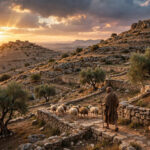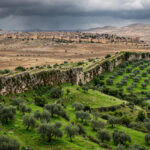
Every language has words that carry a place inside them. “Waterloo” means defeat. “Chernobyl” means disaster. In the New Testament, one of those words is “Gehenna” — and Gehenna was a real valley outside Jerusalem called the Valley of Hinnom. To understand what Jesus meant when He warned about Gehenna, we need to walk into that valley’s history: what happened there, what the prophets said about it, and how a ravine southwest of Jerusalem became the Bible’s most sobering picture of judgment.
The valley on the map
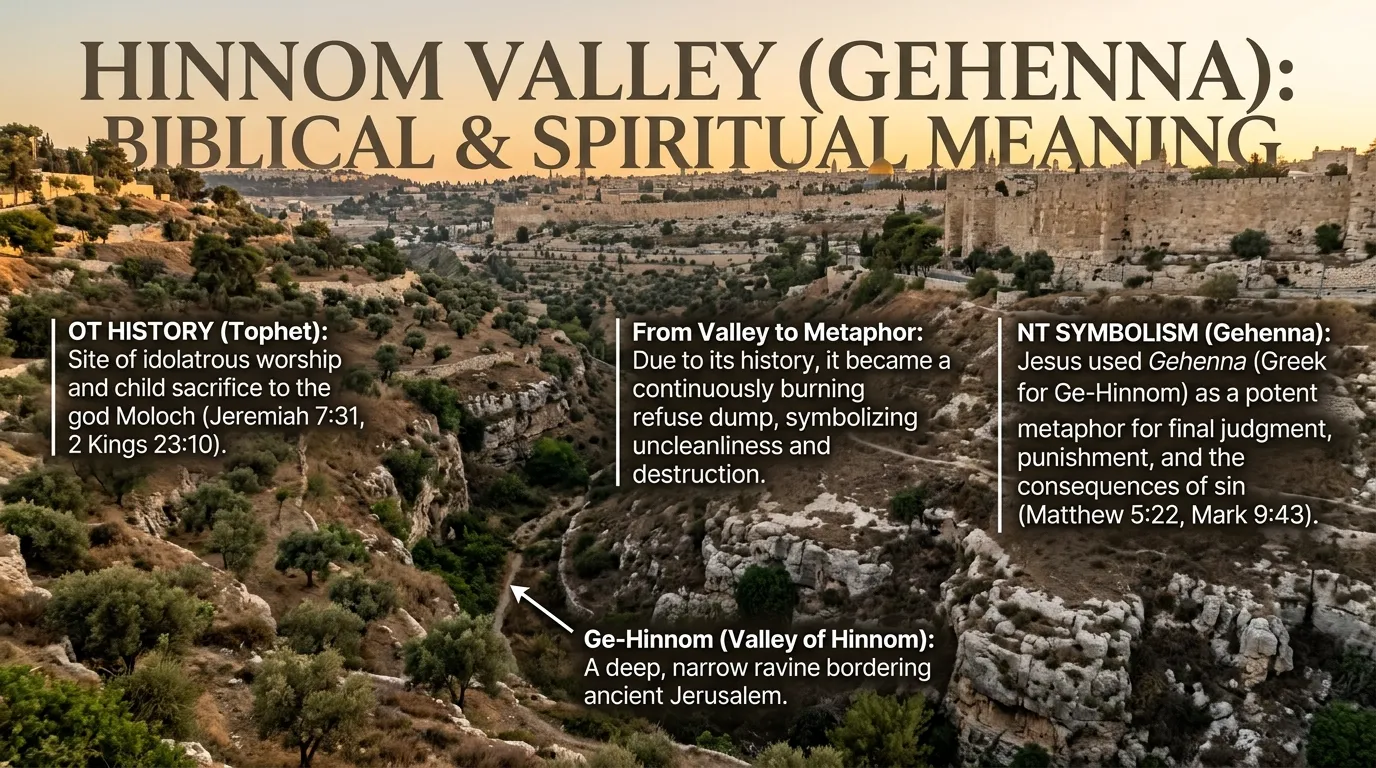
The Valley of Hinnom — in Hebrew, Ge-Hinnom, “Valley of Hinnom” — runs along the south and southwest sides of Jerusalem, meeting the Kidron Valley at the city’s southeast corner. It was one of the boundaries of the tribe of Judah (Joshua 15:8) and a landmark any Jerusalem resident knew. Today it is a quiet, green ravine with gardens and walking paths. In biblical times it carried a reputation that made people shudder.
The name “Hinnom” probably comes from a person or family who owned land there, though the Bible never tells us who he was. What matters is not the name’s origin but the events that stained the place. The valley became associated with the worst sin in Israel’s history, and then with the most severe warnings in the prophets, and then with Jesus’ own teaching about final judgment.
The horror at Topheth: child sacrifice
The valley’s darkest chapter is child sacrifice. At a spot in the valley called Topheth, some kings of Judah — Ahaz and Manasseh among them — burned their children as offerings to the god Molech (2 Kings 16:3; 21:6). The practice is described in Leviticus 18:21 and 20:2–5 as an abomination, and it was one of the sins that the prophets said would bring judgment on the nation. Jeremiah’s language is furious: the people built the high places of Topheth “to burn their sons and daughters in the fire — something I did not command, nor did it enter my mind” (Jeremiah 7:31).
That last phrase deserves attention. God says the practice never entered His mind. It was not a harsh command He gave and later regretted; it was a human evil He never willed. The valley stands as a monument to what happens when people invent gods in their own image and sacrifice the most vulnerable to them. The victims were children — the ones who could not consent, could not resist, and could not run. Scripture’s anger about Hinnom is, at its core, anger on behalf of the powerless.
Jeremiah’s warning: the valley of slaughter
Jeremiah preached in the valley itself. God told him to buy a clay jar, go to the Valley of Hinnom, and smash the jar before the elders as a sign: just as the jar could not be repaired, so Jerusalem’s judgment would be irreversible if the people refused to repent (Jeremiah 19). He renamed the place: it would no longer be called Topheth or the Valley of Hinnom, but “the Valley of Slaughter” (Jeremiah 19:6). The valley that had received the blood of children would receive the bodies of those who had shed it.
Jeremiah’s prophecy was fulfilled in the Babylonian destruction of Jerusalem in 586 BC. The valley became a place of corpses and disgrace. But Jeremiah’s message was not only doom. The same prophet who smashed the jar also promised a new covenant written on hearts (Jeremiah 31:31–34). The valley of judgment sits inside a book of hope. God’s warnings are severe because His love is serious — He will not let His people destroy themselves without speaking.
Josiah’s cleansing: the valley defiled
Between the horror and Jeremiah’s warning came a reform. King Josiah, in his great cleansing of Judah’s worship, “desecrated Topheth, which was in the Valley of Ben Hinnom, so no one could use it to sacrifice their son or daughter in the fire to Molech” (2 Kings 23:10). Josiah’s method was blunt: he defiled the site, likely by scattering human bones or refuse on it, making it ritually unclean and unusable for worship.
Tradition holds that the valley later became Jerusalem’s refuse ground — a place where garbage and the bodies of criminals were burned. That tradition is often overstated; the archaeological evidence for a continuously burning garbage dump is thin, and scholars debate how much of the popular picture is later legend. What is certain is that by Jesus’ day, the valley’s name had become a byword for disgrace, fire, and destruction. Whether or not fires literally burned there constantly, the association was fixed in the public imagination.
Gehenna in the teaching of Jesus
Jesus used the word “Gehenna” eleven times in the Gospels, more than any other biblical writer. He warned that it is better to lose an eye or a hand than to have the whole body thrown into Gehenna (Matthew 5:29–30). He told His disciples to fear the One who can destroy both soul and body in Gehenna (Matthew 10:28). He denounced the Pharisees for making converts “twice as much a child of hell as you are” (Matthew 23:15).
Jesus’ language is deliberately graphic. He speaks of “unquenchable fire” (Mark 9:43) and of a place “where the worms that eat them do not die, and the fire is not quenched” (Mark 9:48), borrowing the imagery of Isaiah 66:24. The point of the imagery is not to give a tour of the afterlife’s geography. It is to impress the seriousness of the reality: final separation from God is real, terrible, and to be avoided at any cost. Jesus’ warnings are the opposite of casual. He speaks about judgment more than anyone else in the New Testament — and He speaks about it because He came to save people from it.
Christians have debated the precise nature of final judgment — its duration, its consciousness, its relationship to God’s justice and mercy — and this article does not settle those debates. What the Hinnom Valley teaches clearly is that God takes evil seriously, that idolatry destroys the vulnerable first, and that the warnings of Scripture are meant to drive people toward repentance, not toward despair.
How the valley’s name entered the world’s vocabulary
Gehenna did not stay in Jerusalem. Through the Greek New Testament, the word passed into Christian theology in every language, and from there into the vocabulary of judgment in Western culture. The valley’s name became the standard word for hell in the Gospels precisely because it was already loaded with meaning for first-century Jews: a real place of horror, fire, and shame. When Jesus said “Gehenna,” His hearers did not need a footnote. They pictured the ravine south of the city, and they understood the warning.
That is why precision matters when we read Jesus’ words. He used Gehenna, not the Greek underworld (Hades), and not the abyss of Revelation. The terms overlap but are not identical, and careful readers should not flatten them into one image. What they share is the Bible’s consistent insistence that choices have eternal weight, that evil will not be ignored, and that God’s judgment is as real as His mercy. The valley teaches us to hold both truths without softening either.
The valley and the love of neighbor
There is one more lesson in the valley, and it is practical. The sins committed at Topheth were not private sins. They were public, communal, and defended by religion. The prophets’ response was also public: Jeremiah stood in the valley and spoke. Christians sometimes treat evil as a matter of private belief, but Hinnom Valley shows that evil becomes systemic — it builds altars, it recruits kings, it sacrifices children, and it calls itself worship. Resisting it requires public courage: naming what is wrong, protecting the vulnerable, and refusing to let religious language cover cruelty. The valley is a reminder that faithfulness is not only about personal piety. It is about what a community does with its power, and whom it protects.
What Hinnom Valley means for believers
The valley leaves us with three sober lessons. First, idolatry always costs someone. The people who sacrificed children at Topheth believed they were securing prosperity or protection. They were actually destroying their own future. Every false god demands a sacrifice, and the sacrifice is usually someone weaker than the worshiper. Second, God’s warnings are mercy. Jeremiah’s shattered jar was a rescue attempt, not cruelty. God warns because He wants repentance. Third, judgment is real, but it is not the last word of the gospel. The God who warned about Gehenna is the God who sent His Son to bear judgment in our place. The cross is where the valley’s fire and God’s love meet.
Christians should not use Gehenna as a weapon or a punchline. Jesus’ warnings were spoken with tears — He wept over Jerusalem (Luke 19:41). Our tone about judgment should match His: urgent, honest, and grieving. The valley outside Jerusalem reminds us that evil is not a game, that God sees the vulnerable, and that repentance is always open while there is breath.
For the valley’s geography, archaeology, and the history of the name Gehenna, the Wikipedia article on Gehenna is a useful reference.