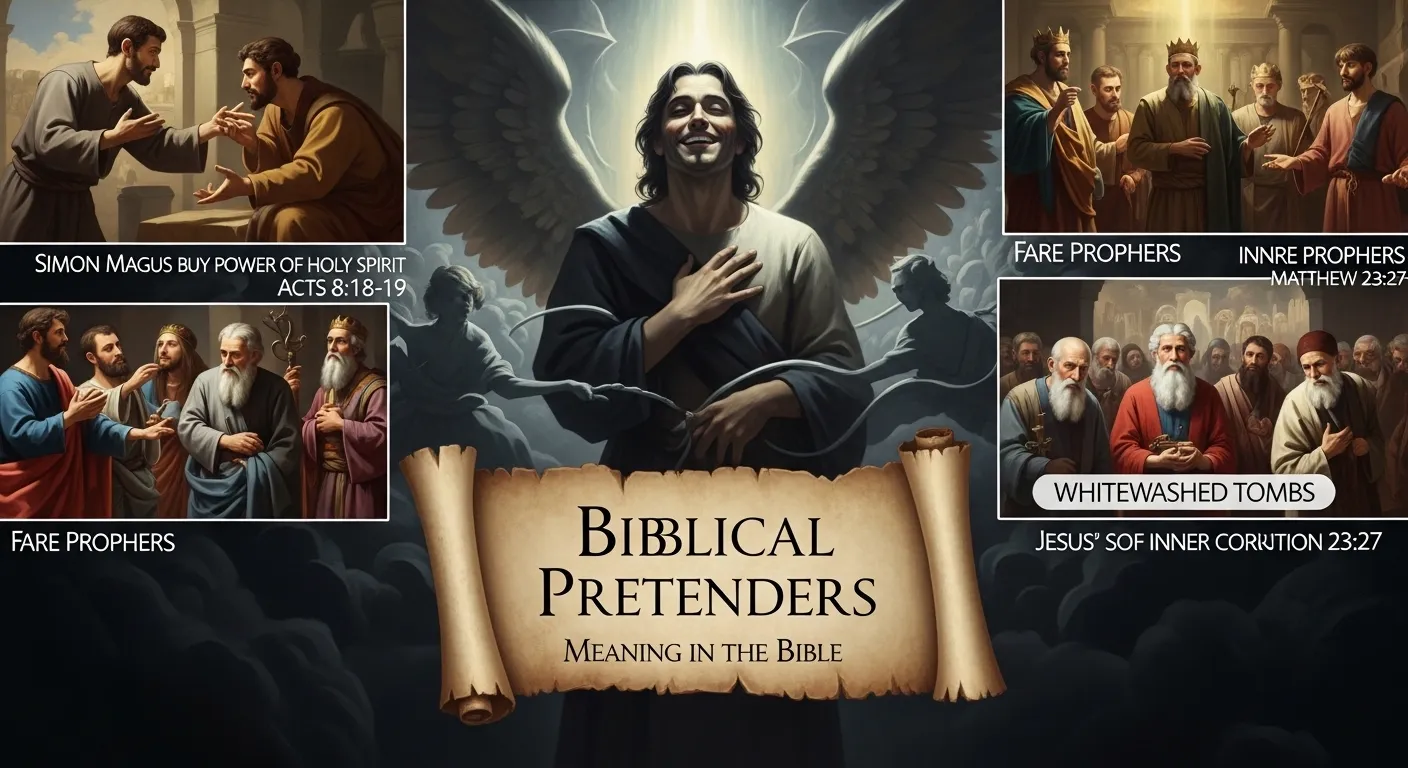
In first-century Jerusalem, wealthy families painted their burial tombs a brilliant white. The effect was striking: gleaming monuments along the roadside, beautiful in the sun, advertising the righteousness of the families inside. Jesus looked at the religious leaders of His day and reached for that exact image: “Woe to you, scribes and Pharisees, hypocrites! For you are like whitewashed tombs which indeed appear beautiful outwardly, but inside are full of dead men’s bones and all uncleanness” (Matthew 23:27). It was the most devastating compliment-reversal in Scripture — you look like a monument, you are a graveyard. The Bible has a name for this condition: the pretender. Not the struggling sinner, not the honest doubter, but the person whose outside and inside tell different stories. And Scripture treats it as one of the most serious spiritual dangers there is — not only when you meet it in others, but when you discover it in yourself.
The Anatomy of Pretense
Jesus diagnosed the condition with a physician’s precision in Matthew 15:8, quoting Isaiah: “These people draw near to Me with their mouth, and honor Me with their lips, but their heart is far from Me.” Three parts, all present in every case of spiritual pretense. The mouth says the right things — the prayers, the vocabulary, the amens in all the right places. The lips perform honor — the visible gestures of devotion that an audience can applaud. But the heart is far — distant, disengaged, pursuing other loves while the lips are busy. Pretense is not the absence of religious activity. It is religious activity with the heart somewhere else.
Notice what this means: the pretender is often the most religious person in the room. The tax collector in Jesus’ parable went home justified, not the Pharisee who fasted twice a week and tithed everything (Luke 18:9-14). The difference was never the volume of religious activity. It was the honesty of the heart behind it. This is why pretense is so hard to detect — in others and in ourselves. It wears the uniform of devotion. It knows the language. It can pray a beautiful prayer while mentally rehearsing a business deal. The whitewash is always fresh; the bones are always hidden. Only God sees both at once, which is why Proverbs 21:2 warns that “every way of a man is right in his own eyes, but the Lord weighs the hearts.”
Why Jesus Reserved His Harshest Words for This
It is worth asking why Jesus, who was gentle with prostitutes and patient with doubters, unleashed seven “woes” on the pretenders. The answer is that pretense does damage nothing else does. An open sinner knows he is sick; a pretender has convinced himself he is well, which makes him untreatable. Worse, pretense misrepresents God to everyone watching. When the watching world sees religious performance covering cruelty, greed, or indifference, it does not conclude “that person is a hypocrite.” It concludes “that is what God is like.” Jesus said the Pharisees were shutting the kingdom of heaven in people’s faces (Matthew 23:13) — pretense does not merely fail to enter; it blocks the door for others.
There is also a quieter reason for the severity: pretense is chosen. The struggling believer who falls and repents is fighting; the pretender has stopped fighting and started posing. Ananias and Sapphira in Acts 5 were not struck down for keeping part of their money — they were struck down for lying about it, for staging generosity they did not possess. God can work with failure. What He will not bless is the performance of a virtue that is not there. The whitewashed tomb is worse than the honest grave, because at least the grave does not pretend to be a garden.
Discernment: Recognizing Pretense in Others
Scripture does not tell believers to become cynics, but it does tell them to become discerning. Jesus said you will know false prophets “by their fruits” (Matthew 7:16) — not by their gifts, their following, their eloquence, or their confidence, but by their fruit. The test of any spiritual claim is the life behind it: Is there humility or only authority? Generosity or only fundraising? Repentance or only image management? 1 John 4:1 commands believers to “test the spirits,” and the test it gives is doctrinal and moral together — what they confess about Christ and how they live.
Practically, this means watching for the gaps. Pretense always leaks at the seams: the leader whose public tenderness never appears at home; the teacher whose doctrine is precise and whose character is not; the friend whose spiritual counsel for you is stricter than his own conduct. None of this calls for public accusation on thin evidence — Proverbs warns against slander as strongly as it warns against hypocrisy. It calls for wise distance: do not build your spiritual life on an untested foundation, do not follow a voice you have not watched over time, and pray for discernment as a daily discipline rather than an emergency measure. God promises wisdom to those who ask (James 1:5), and discernment is one of wisdom’s first gifts.
The Harder Mirror: Recognizing Pretense in Yourself
Here is where the article must turn, because every reader who has nodded along at the description of pretenders in others needs to face the harder question: where am I performing? The human heart is a skilled actor. It can sing worship songs while nursing a grudge. It can post Scripture while ignoring the poor. It can pray long prayers in public and short ones in private — Jesus specifically warned against loving to pray “standing in the synagogues and on the corners of the streets, that they may be seen by men” (Matthew 6:5). The audience is the tell. When the audience disappears, what remains of your devotion?
The diagnostic questions are simple and searching. Do I repent, or do I manage my image? Am I the same person in private that I perform in public? Do I hunger for God’s approval, or for people’s? When no one would know, do I still choose the right? David’s prayer after his own catastrophic failure is the model: “Behold, You desire truth in the inward parts” (Psalm 51:6). Not truth in the outward performance — truth in the inward parts, the places no audience ever sees. That is where God is looking, and that is where pretense dies: in the honest admission that the whitewash needs to come off and the real work needs to begin.
Clean the Inside First
Jesus did not leave the pretender without a remedy, and the remedy is characteristically inside-out. “Blind Pharisee, first cleanse the inside of the cup and dish, that the outside of them may be clean also” (Matthew 23:26). The religious instinct is always to start with the outside — adjust the behavior, polish the image, learn the vocabulary. Jesus reverses the order: start with the inside, and the outside will follow honestly rather than theatrically. A clean inside produces a clean outside as fruit; a scrubbed outside with a dirty inside produces exactly what the Pharisees produced — whitewash over bones.
What does cleaning the inside look like in practice? David’s prayer gives the pattern: “Create in me a clean heart, O God, and renew a steadfast spirit within me” (Psalm 51:10). Note the verb — create. David does not ask for renovation tips; he asks for a miracle, because he knows the heart is beyond self-repair. Confession is the doorway: “If we confess our sins, He is faithful and just to forgive us our sins and to cleanse us from all unrighteousness” (1 John 1:9). Confession specifically, not vaguely — naming the actual pretense, the actual gap between the performance and the heart. Then comes the slow work of integrity: aligning private habits with public claims, letting the audience shrink until the only audience that matters is God. The whitewashed tomb becomes, gradually, a living temple — not by better paint, but by resurrection power working from the inside out.
The Beautiful Alternative: Authentic Faith
The opposite of pretense is not perfection. It is honesty — the willingness to be seen as you are by God and, in appropriate measure, by others. The Psalms are full of it: David’s rage, despair, confusion, and joy poured out without editing. “Search me, O God, and know my heart” (Psalm 139:23) is the prayer of someone who has stopped posing. Authentic faith confesses quickly, repents specifically, loves quietly, and serves without calculating the audience. It is less impressive than pretense and infinitely more alive — because it is real, God can actually work with it.
And here is the grace at the center of it all: God already knows about the bones. The whitewash fools people; it never fooled Him. “For the word of God is living and powerful… and there is no creature hidden from His sight, but all things are naked and open to the eyes of Him to whom we must give account” (Hebrews 4:12-13). That verse sounds terrifying until you realize it is also the most liberating sentence in Scripture: you do not have to perform for the One who already sees everything. You can drop the act, bring the real heart — the struggling, inconsistent, genuine heart — and find that He meets honesty with mercy every time. The tomb does not need whiter paint. It needs resurrection. For a wider look at how this ancient biblical warning maps onto the universal human pattern it names, the article on hypocrisy traces the concept across philosophy, psychology, and culture — confirming, from an entirely different angle, what Jesus said about whitewashed tombs two thousand years ago.










