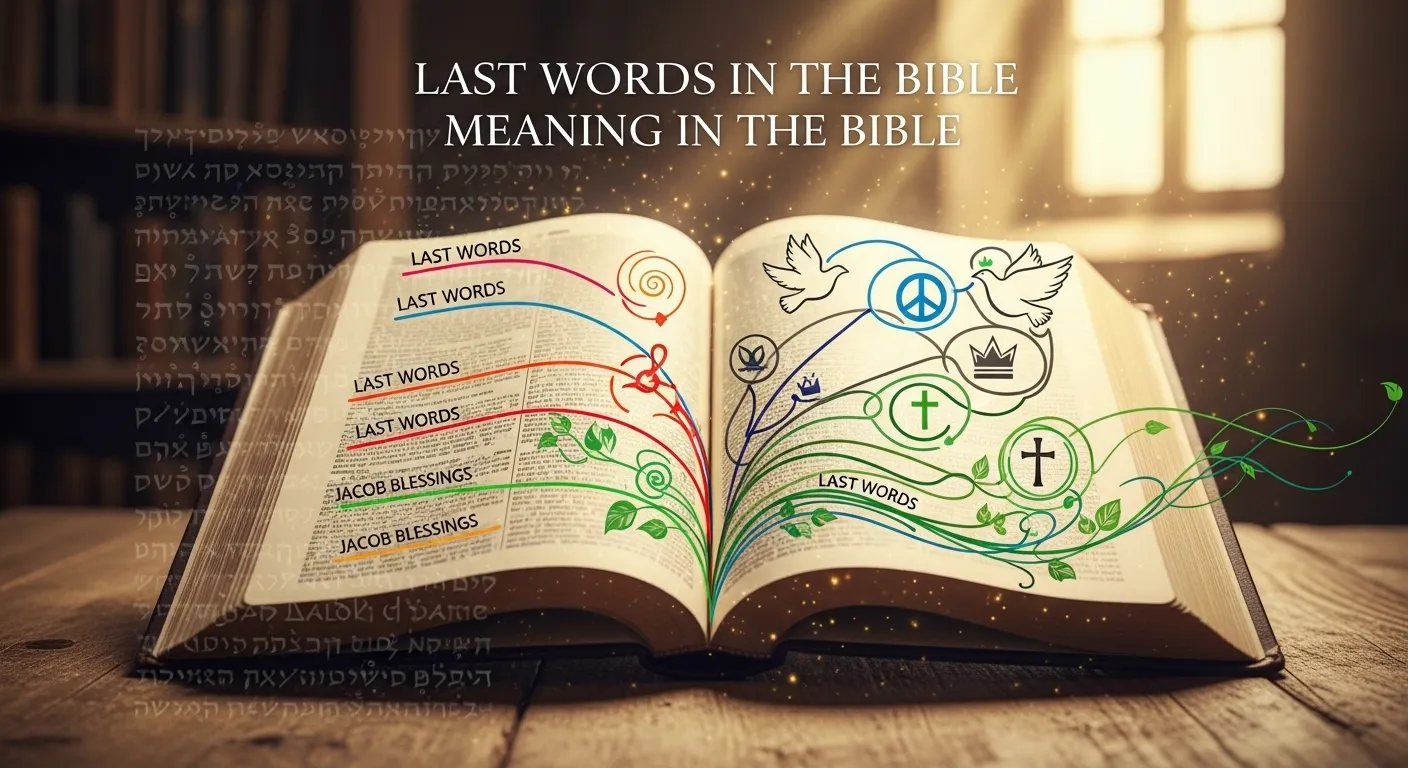
Books are remembered by their endings. A great novel’s last line can reframe everything before it; a weak ending can undo a strong story. The Bible — sixty-six books, forty-odd authors, fifteen centuries in the writing — ends with a single verse: “The grace of our Lord Jesus Christ be with you all. Amen” (Revelation 22:21). After plagues and prophecies, after judgments and the unveiling of the end of all things, the last word of Scripture is grace.
That is not an accident of arrangement. It is a theological statement. And it becomes even more striking when you set it beside the Bible’s first words — “In the beginning, God created the heavens and the earth” (Genesis 1:1) — and beside the last words of the great figures within the story. Endings reveal priorities. Here is what the Bible’s endings reveal.
The Last Words of Jesus
Before the Bible’s last words, there were His last words — and they set the pattern. From the cross, Jesus spoke seven times, and the final two are the gospel in miniature. “It is finished” (John 19:30) — tetelestai, the cry of a task completed, a debt paid, a sacrifice accepted. Not “I am finished” but “it is finished” — the work, the mission, the atonement. Then: “Father, into your hands I commit my spirit!” (Luke 23:46) — the trust of a Son placing Himself in the Father’s care.
Finished work. Committed spirit. Accomplishment and trust — that is how the Savior ended His earthly course. And His last words to the church, spoken from the Mount of Olives, were a commission, not a conclusion: “you will be my witnesses… to the end of the earth” (Acts 1:8). Jesus did not end with endings. He ended with beginnings — the work finished, the witnesses sent. Every Christian ending since has followed His template.
The Last Words of the Patriarchs and Apostles
Scripture preserves the deathbed words of its great figures, and they form a remarkable chorus.
Jacob, dying in Egypt, gathered his sons and blessed them — each with the blessing “appropriate to him” (Genesis 49:28), seeing further than any of them: Judah’s scepter (49:10), Joseph’s fruitfulness (49:22-26). His last act was prophetic generosity — speaking future over his children.
Moses, on the edge of the promised land he would not enter, spent his final words on a song (Deuteronomy 32) and a blessing (Deuteronomy 33) — warning and benediction together, the whole Torah distilled into poetry. His last command: “take to heart all the words by which I am warning you today, that you may command them to your children” (32:46). A teacher to the end.
David, charging Solomon, was blunt: “Be strong, and show yourself a man, and keep the charge of the LORD your God, walking in his ways” (1 Kings 2:2-3). No sentimentality — covenant fidelity as a father’s final gift.
Paul, in a Roman cell, wrote his own epitaph: “I have fought the good fight, I have finished the race, I have kept the faith. Henceforth there is laid up for me the crown of righteousness” (2 Timothy 4:7-8). Fight, race, faith — struggle, perseverance, loyalty — and then the crown, awarded by the righteous Judge.
See the pattern? None of them ended with regret. None ended with fear. Blessing, song, charge, confidence — the last words of the faithful are not about death at all. They are about the God who outlasts it.
The Last Words of the Old Testament
Here is the contrast that makes the Bible’s ending so stunning. The Old Testament does not end with grace. It ends with a threat: “Behold, I will send you Elijah the prophet before the great and awesome day of the LORD comes. And he will turn the hearts of fathers to their children… lest I come and strike the land with a decree of utter destruction” (Malachi 4:5-6). The Hebrew Bible’s last word is cherem — curse, utter destruction. Four hundred years of silence followed.
Then the New Testament opens — “the genealogy of Jesus Christ” (Matthew 1:1) — and thirty-three years later, the cross absorbs the curse, and the whole canon closes with “the grace of our Lord Jesus Christ be with you all.” The Bible’s last word answers the Old Testament’s last word. What the law could only threaten, grace has accomplished. The story that ended in cherem ends in charis — curse to grace, in one Messiah. If you ever doubt that the Bible is one story, read its last verses back to back: destruction threatened; grace given. That is the whole gospel in two endings.
The Warning Before the Blessing
The Bible’s own last chapter is honest enough to include a warning before its blessing. “I warn everyone who hears the words of the prophecy of this book: if anyone adds to them, God will add to him the plagues described in this book, and if anyone takes away… God will take away his share in the tree of life” (Revelation 22:18-19).
This is Scripture’s seal — the ancient equivalent of a king’s signet pressed into wax. It guards the canon the way Deuteronomy guarded the law (Deuteronomy 4:2; 12:32) and the way Proverbs guarded wisdom (Proverbs 30:6): do not tamper with God’s words. The warning is severe because the stakes are eternal — but notice its placement. It comes before the final blessing, not after. The last thing God says to humanity is not a threat but a benediction. The warning protects the message; the blessing is the message.
“Surely I Am Coming Soon”
Between the warning and the benediction stands the Bible’s second-to-last sentence — the words of Jesus Himself: “Surely I am coming soon” (Revelation 22:20). And the church’s answer, the Bible’s second-to-last prayer: “Amen. Come, Lord Jesus!”
This exchange is the heartbeat of Christian hope. The early church’s Aramaic prayer — Maranatha, “our Lord, come” (1 Corinthians 16:22) — was whispered under persecution, prayed at the Lord’s table, and carried through two thousand years to this page. “Surely I am coming soon” has been “soon” for twenty centuries, and the church has not stopped answering “Amen. Come.” That is not failed timing; it is living expectation — the posture of a bride who knows the Bridegroom is coming and lives dressed for His arrival (Revelation 19:7-8; Matthew 25:1-13).
The promise also reframes every suffering. Paul called the church’s afflictions “this light momentary affliction” — light and momentary, against the weight of coming glory (2 Corinthians 4:17). “Surely I am coming soon” is what makes that math work. The ending is not in doubt; only the date is unknown. Hope is not optimism about circumstances; it is certainty about the ending.
The Grace With Which It All Ends
And then — the last line. “The grace of our Lord Jesus Christ be with you all. Amen.”
Consider what this doesn’t say. After the seals, the trumpets, the bowls, the beasts, the judgments — after everything humanity deserves — the Bible does not end with “you had your chance.” It does not end with law, or wrath, or even justice. It ends with grace — the unmerited favor of God, with you all. Not with the deserving. Not with the strong. All.
Paul’s letters end the same way, again and again — “the grace of our Lord Jesus Christ be with you” (Romans 16:20; 1 Corinthians 16:23; Galatians 6:18; Philippians 4:23; 1 Thessalonians 5:28; 2 Thessalonians 3:18). It was the apostolic signature: “I, Paul, write this greeting with my own hand. This is the sign of genuineness in every letter of mine; it is the way I write” (2 Thessalonians 3:17-18). John — or the Spirit through John — closes the whole canon with Paul’s signature. The Bible ends the way the gospel begins: with grace.
“My grace is sufficient for you” (2 Corinthians 12:9). “For by grace you have been saved through faith” (Ephesians 2:8). “The grace of our Lord Jesus Christ be with you all.” First word of the Christian life, middle word of the Christian struggle, last word of the Christian Scriptures. If you remember nothing else from the Bible’s ending, remember this: God’s final word to you is not condemnation. It is grace. Amen. For the book in which these last words stand — its visions, its history, and its hope — Wikipedia’s article on the Book of Revelation provides a comprehensive overview of its background and interpretation.










