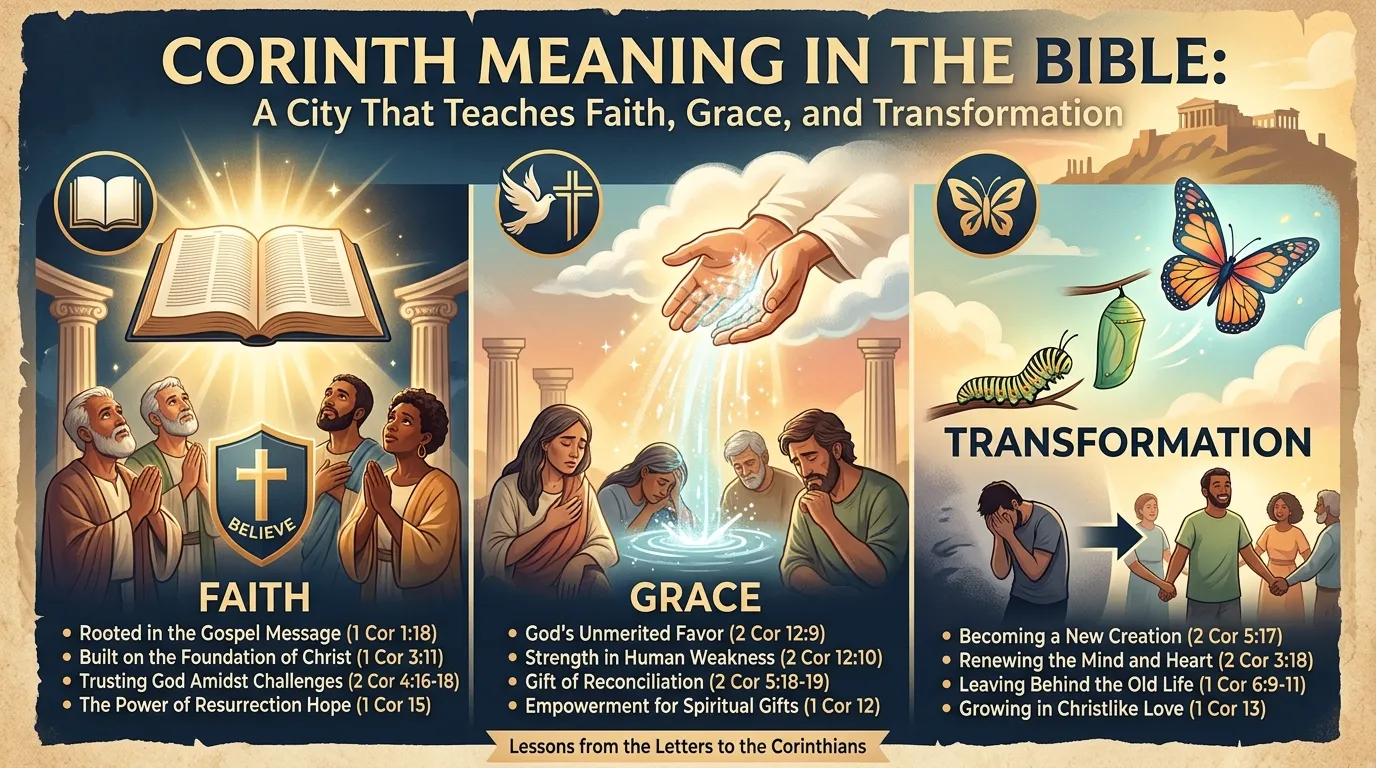
Paul spent eighteen months in Corinth, longer than in any other city on his missionary journeys except Ephesus. That fact alone tells us something. Corinth was not an easy place. It was wealthy, crowded, sexually permissive, religiously diverse, and fiercely competitive. It was also the place where Paul wrote some of his most personal and searching letters. To understand what Corinth means in the Bible, we should not start with a dictionary definition of the name. We should start with the church that lived there — a real congregation of flawed people learning what grace looked like in a city that rewarded the opposite of everything grace teaches.
A port city built on trade and pride
Corinth sat on the narrow isthmus connecting mainland Greece with the Peloponnese, with harbors on both sides. Ships could be dragged across the isthmus on a paved trackway, saving the long and dangerous voyage around the southern cape. The result was a city that grew rich on transit trade, full of sailors, merchants, freedmen, and travelers. Julius Caesar refounded Corinth as a Roman colony in 44 BC, and by Paul’s day it was the capital of the province of Achaia and one of the busiest cities in the eastern Mediterranean.
Corinth was also famous — or infamous — for its morals. The city hosted the temple of Aphrodite on the Acrocorinth, the steep hill above the town, and Greek writers used the verb “to Corinthianize” as a synonym for sexual immorality. The city’s Isthmian Games, second only to the Olympics, drew crowds and athletes from across the Greek world. It was a place of spectacle, status, and self-display. Success in Corinth meant being seen, being clever, and being first.
That is the city Paul entered alone, around AD 50, during his second missionary journey. Acts 18 says he was afraid. He worked as a tentmaker with Aquila and Priscilla, fellow Jewish Christians who had been expelled from Rome, and he reasoned in the synagogue each Sabbath. When opposition hardened, he moved next door to the house of Titius Justus and kept preaching. “Many of the Corinthians who heard Paul believed and were baptized” (Acts 18:8). Crispus, the synagogue leader, believed. So did a mixed crowd of Gentiles and Jews, slaves and householders, rich and poor.
Why Paul stayed so long
God spoke to Paul in a night vision: “Do not be afraid; keep on speaking, do not be silent. For I am with you, and no one is going to attack and harm you, because I have many people in this city” (Acts 18:9–10). Paul stayed a year and a half, teaching the word of God. That promise matters for how we read the Corinthian letters. The church was not an accident or a failure. God had people in Corinth — people who needed the gospel precisely because Corinth was Corinth.
Paul’s letters to the church, written from Ephesus a few years later, show what happened after he left. The congregation was gifted and troubled in equal measure. They had teachers, prophets, and people with impressive spiritual gifts. They also had factions, lawsuits, sexual sin, disorderly worship, and confusion about marriage, food, and the resurrection. Paul’s letters do not flinch from any of it. They are the longest sustained pastoral work in the New Testament, and they read like a pastor who loves a church too much to leave it as it is.
First Corinthians: the cross against the culture
First Corinthians organizes itself around a clash of values. Corinth prized wisdom, eloquence, status, and power. Paul answers with the cross. “The message of the cross is foolishness to those who are perishing, but to us who are being saved it is the power of God” (1 Corinthians 1:18). The church’s factionalism — “I follow Paul,” “I follow Apollos,” “I follow Cephas” — was not a harmless preference for preachers. It was Corinthian celebrity culture baptized into the church. Paul insists that the church is one body with many members, and that the greatest gift is not tongues or prophecy but love (1 Corinthians 12–13).
The letter’s most famous chapter, the hymn to love in 1 Corinthians 13, was not written for weddings. It was written for a church that was using spiritual gifts as weapons of status. Love, Paul says, is patient and kind; it does not envy or boast; it does not dishonor others or insist on its own way. In a city that rewarded self-promotion, love was the most countercultural thing a Christian could practice.
First Corinthians also gives the earliest written account of the Lord’s Supper (1 Corinthians 11:23–26) and the fullest early defense of the resurrection (1 Corinthians 15). The resurrection chapter matters because some Corinthians were denying that the dead rise. Paul’s answer is not abstract. If Christ has not been raised, preaching is useless, faith is futile, and “we are of all people most to be pitied” (1 Corinthians 15:19). But Christ has been raised, and so the whole Christian life — including suffering, giving, and moral courage — rests on solid ground.
Second Corinthians: weakness, reconciliation, and generosity
Second Corinthians is a different kind of letter: more personal, more emotional, and more revealing of Paul himself. The relationship between Paul and the church had been strained. There had been a painful visit, a severe letter, and a confrontation with someone who opposed him. Paul writes to confirm his love, to defend his ministry, and to complete a collection for the poor in Jerusalem.
The letter’s central theme is strength in weakness. Paul’s opponents boasted of their credentials, their visions, and their eloquence. Paul boasts of his sufferings, his beatings, his shipwrecks, and a “thorn in the flesh” that God refused to remove. “My grace is sufficient for you, for my power is made perfect in weakness” (2 Corinthians 12:9). In Corinth, where strength was everything, Paul announces that God works through the very things the world despises.
The letter also contains the New Testament’s fullest teaching on reconciliation. “God was reconciling the world to himself in Christ, not counting people’s sins against them. And he has committed to us the message of reconciliation” (2 Corinthians 5:19). The Corinthian church, torn by factions and hurt, needed to hear that reconciliation is not just a doctrine to believe but a ministry to practice — first with God, then with one another.
Corinth and the resurrection hope
One more Corinthian problem deserves attention: some in the church denied the resurrection of the dead. Paul’s response in 1 Corinthians 15 is the most extended argument for the resurrection anywhere in the New Testament. He lists the witnesses — Peter, the Twelve, more than five hundred brothers and sisters at once, James, all the apostles, and finally Paul himself, “as one abnormally born” (1 Corinthians 15:8). This is not philosophy; it is testimony. The resurrection is presented as a public event with living witnesses, not a private spiritual idea.
Then Paul draws out the consequences. If the dead are not raised, then Christ has not been raised either, and the whole faith collapses. But Christ has been raised, “the firstfruits of those who have fallen asleep” (1 Corinthians 15:20). The image is agricultural: the first sheaf of harvest guarantees the rest. Because Jesus rose, His people will rise. That hope changes how Christians face death, suffering, and the daily grind of faithfulness. “Therefore, my dear brothers and sisters, stand firm. Let nothing move you. Always give yourselves fully to the work of the Lord, because you know that your labor in the Lord is not in vain” (1 Corinthians 15:58). In a city obsessed with the present moment, Paul gave the church a horizon beyond it.
What Corinth teaches Christians today
Corinth teaches us that no church is beyond grace and no culture is beyond the gospel. The Corinthian believers were not models of maturity. They were argumentative, proud, confused, and sometimes immoral. Yet Paul calls them “those sanctified in Christ Jesus and called to be his holy people” (1 Corinthians 1:2). He does not wait for them to clean themselves up before calling them saints. He calls them saints and then shows them how saints should live. That order — identity before behavior, grace before effort — is the heart of Paul’s pastoral method.
Corinth also warns us that the church absorbs the values of its city unless it consciously resists them. First-century Corinth rewarded eloquence, wealth, and sexual freedom; our own cultures reward their own versions of the same things. The Corinthian letters remain relevant because the pressures are the same, only the packaging has changed. The answer is the same too: the cross, the resurrection, love, and the patient work of reconciliation.
Finally, Corinth shows us that God uses unlikely places. A port city famous for its vices became the home of a church that produced two of the most influential letters ever written. The gospel did not need a respectable address. It needed faithful people willing to live differently in a city that noticed everything — and to keep coming back to grace when they failed.
Corinth’s archaeological remains and civic history are well documented, and readers who want the background on the ancient city itself can start with the Wikipedia entry on ancient Corinth.










