The New Testament mentions two cities named Caesarea, and confusing them changes the story. One sits on the Mediterranean coast, built by Herod the Great as a showcase of Roman power. The other sits at the foot of Mount Hermon in the north, where a spring feeds the Jordan River. Jesus asked His most important question at one of them; Peter opened the door of the gospel to the Gentiles at the other; Paul spent two years under house arrest at the coastal one. To understand Caesarea in the Bible, we need to keep the two cities straight — and then watch what God did in each.
Caesarea Maritima: Herod’s harbor city
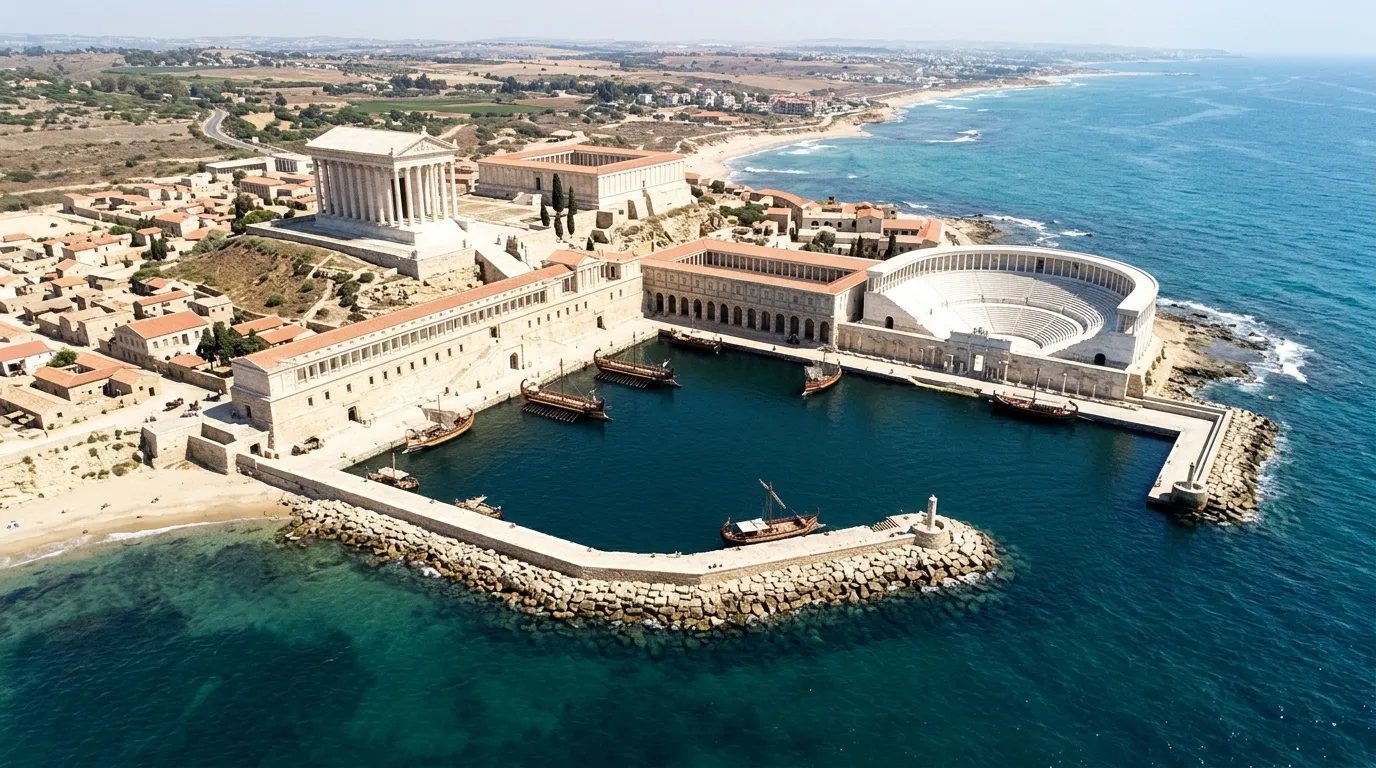
Caesarea Maritima — “Caesarea by the sea” — was Herod the Great’s most ambitious building project. Between about 22 and 10 BC he transformed a small anchorage called Strato’s Tower into a deep-water harbor with a palace, a temple to Caesar, a theater, an amphitheater, and a city laid out on a Roman grid. He named it for Caesar Augustus, and it became the seat of the Roman governors of Judea. The harbor, called Sebastos, was an engineering marvel of concrete blocks sunk into the sea. The city was also a statement: Rome was here to stay, and Herod was its loyal client.
By the time of the New Testament, Caesarea Maritima was the administrative capital of Judea. Pilate governed from there. The Roman garrison was based there. The city was largely Gentile in population, with a Jewish minority, and the two groups clashed repeatedly. It was, in short, the center of Roman power in the region — the place where the empire’s authority was most visible and most felt.
Caesarea Philippi: the city at the spring
Caesarea Philippi stood about a hundred kilometers northeast, near one of the sources of the Jordan River at the base of Mount Hermon. The site had long been associated with pagan worship — the Greeks dedicated a grotto there to the god Pan, and the place was known as Paneas. Herod’s son Philip rebuilt the town and renamed it Caesarea in honor of Augustus, adding his own name to distinguish it from the coastal city. It was a beautiful, religiously crowded place: temples, shrines, and grottoes dedicated to various gods, with the sound of running water everywhere.
It was here, in this landscape of competing gods, that Jesus brought His disciples and asked the question that defines the whole Gospel: “Who do people say the Son of Man is?” and then, “But what about you? Who do you say I am?” (Matthew 16:13–15). Peter answered, “You are the Messiah, the Son of the living God.” Jesus replied that this confession was revealed by the Father, and that on this rock He would build His church, and “the gates of Hades will not overcome it” (Matthew 16:18).
The confession and its setting
The setting of Peter’s confession is not accidental. In a region full of shrines to dead gods and imperial cults, Jesus asks who He is. The contrast is deliberate. Pan’s grotto, Caesar’s temple, and the local gods all claimed loyalty. Jesus claims something else: He is the living God’s Son, and His church will outlast every rival power — even the gates of the realm of death. Matthew places the Transfiguration immediately after this confession, as if to confirm it: on a high mountain, Jesus is revealed in glory, and the Father’s voice repeats the verdict.
The name of the place also carries a quiet irony. Caesarea was named for Caesar, the man who claimed to be lord of the world. At Caesarea Philippi, Peter confesses a different Lord. The church’s foundation is not imperial power but the revealed identity of Jesus. That is the theological heart of this Caesarea’s place in Scripture.
Cornelius: the gospel crosses its first great boundary
The coastal Caesarea hosts one of the most important chapters in the Book of Acts. A Roman centurion named Cornelius lived there — a devout man who feared God, gave generously to the poor, and prayed regularly (Acts 10:1–2). An angel told him to send for Peter in Joppa. Meanwhile Peter, praying on a rooftop, saw a vision of a sheet filled with unclean animals and heard the words, “Do not call anything impure that God has made clean” (Acts 10:15). When Peter arrived in Caesarea and heard Cornelius’s story, he understood: God does not show favoritism but accepts people from every nation who fear Him and do what is right (Acts 10:34–35).
As Peter preached, the Holy Spirit fell on Cornelius and his household — Gentiles — just as He had fallen on the Jewish believers at Pentecost. The Jewish Christians who had come with Peter were astonished. Peter’s conclusion was unavoidable: “Can anyone keep these people from being baptized with water? They have received the Holy Spirit just as we have” (Acts 10:47). The gospel had crossed its first great boundary. The church could no longer be a Jewish sect; it was becoming a worldwide people.
Caesarea Maritima was a fitting place for this. It was the empire’s city, full of Gentiles, soldiers, and officials. If the gospel could take root there — in the household of a Roman officer — it could take root anywhere.
Paul’s long detention in Caesarea
Caesarea appears again in the later chapters of Acts as the stage of Paul’s imprisonment. After his arrest in Jerusalem, Paul was transferred to Caesarea by night under heavy guard to escape a plot against his life (Acts 23:23–35). He remained there for two years under Governor Felix, who kept him in custody hoping for a bribe, then under Festus, before whom Paul appealed to Caesar (Acts 24–25). During this time Paul defended himself before Felix, Festus, and King Agrippa II, who famously said, “Do you think that in such a short time you can persuade me to be a Christian?” (Acts 26:28).
These hearings are not filler. They show the gospel being presented to the highest levels of Roman and Herodian power. Paul’s chains did not silence him; they gave him an audience he could never have arranged himself. From Caesarea he eventually sailed for Rome, where the Book of Acts ends with him preaching “boldly and without hindrance” (Acts 28:31) under house arrest. The city that symbolized Roman authority became the launching point for the gospel’s journey to the empire’s capital.
Agrippa, Bernice, and the gospel on trial
One of the most vivid scenes in Acts takes place in Caesarea’s audience hall. Festus, wanting to do the Jews a favor, kept Paul in custody; then King Agrippa II and his sister Bernice arrived with great pomp to hear the case (Acts 25:23). Paul stood before them in chains and told his own story: his former life as a persecutor, the blinding light on the road to Damascus, and his commission to preach repentance and forgiveness to Jews and Gentiles alike. He ended with an appeal: “I pray to God that not only you but all who are listening to me today may become what I am, except for these chains” (Acts 26:29).
Agrippa’s response is one of the saddest lines in Scripture: “This man could have been set free if he had not appealed to Caesar” (Acts 26:32). The gospel was presented clearly, persuasively, and personally to a king — and the king walked away. Caesarea reminds us that the gospel’s success is not measured by the rank of its hearers or by immediate results. Paul was faithful; Agrippa was unmoved. The seed was sown, and the sower’s duty ended there. Two thousand years later, the name of the prisoner in chains is honored around the world, while the king who heard him is a footnote. That is how the gospel measures outcomes.
Philip and the Ethiopian: Caesarea as a crossroads
Caesarea Maritima also appears in the story of Philip the evangelist. After preaching to the Ethiopian eunuch on the road to Gaza, Philip was “found at Azotus,” and he preached his way up the coast until he reached Caesarea, where he settled (Acts 8:40). Luke later notes that Paul and his companions stayed in Philip’s house in Caesarea, where Philip’s four unmarried daughters prophesied (Acts 21:8–9). The city that hosted Cornelius’s conversion also hosted a prophet-evangelist’s household. Caesarea was not merely a seat of Roman power; it became a crossroads of the gospel, where apostles, evangelists, prophets, and Gentile converts all passed through.
What the two Caesareas teach
Together, the two cities named Caesarea trace the shape of the gospel’s advance. At Caesarea Philippi, the question is one of identity: who is Jesus? At Caesarea Maritima, the question is one of scope: who is the gospel for? The answers are the two load-bearing pillars of the church’s faith: Jesus is the Messiah, the Son of the living God, and His salvation is for every nation. Everything else in Acts flows from those two confessions.
There is also a lesson about place. God did not work only in Jerusalem or in quiet villages. He worked in a pagan shrine town, in a Roman garrison city, and in a governor’s courtroom. The gospel is not embarrassed by power centers or by religiously crowded landscapes. It speaks in them, and it outlasts them. The shrines of Paneas are ruins; the harbor of Herod is silted. The confession Peter made there is still being made by Christians today.
For the history and archaeology of the coastal city, including Herod’s harbor and its later centuries, the Wikipedia entry on Caesarea Maritima offers a good historical overview.










