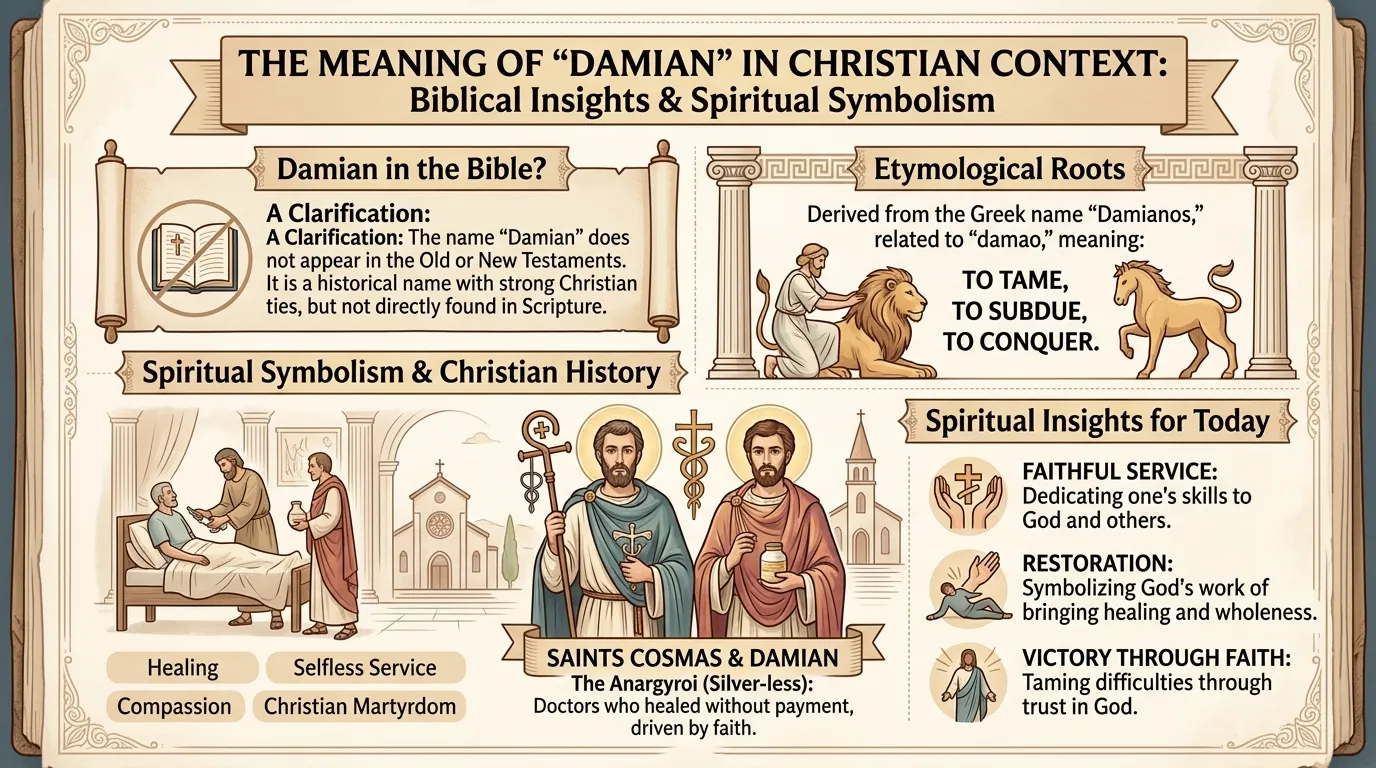
Here is the honest starting point: the name Damian never appears in the Bible. You will not find it in the genealogies of Chronicles, among the apostles, or in any epistle’s greetings. But the idea inside the name runs all through Scripture like a underground river. Damian comes from the Greek damazō — “to tame, to subdue, to bring under control.” A Damian, by the ancient meaning of the name, is a tamer. And taming — of tongues, of tempers, of wild desires — is one of the Bible’s great themes.
Why the Name Feels Christian Anyway
If Damian is not biblical, why does it sound like it belongs in a sanctuary? Largely because of two third-century brothers, Cosmas and Damian — physicians in Asia Minor who treated the sick without charge and were martyred for their faith under Diocletian around AD 303. The early church honored them as the anargyroi, the “moneyless ones,” and their story carried the name Damian deep into Christian tradition across the East and West. Countless churches, hospitals, and children have borne it since.
So the name’s Christian resonance is real, even though its origin is Greek rather than Hebrew and its fame comes from church history rather than Scripture. That distinction matters for honesty — but it should not trouble faith. As with any name outside the Bible, the question is never “does a verse contain it?” but “does a life lived under it honor the God of the verses?”
Taming: The Bible’s Favorite Metaphor
The Greek root damazō actually does appear in the New Testament — once, memorably, in James’s devastating chapter on the tongue: “For every kind of beast and bird, of reptile and sea creature, can be tamed [dedamastai] and has been tamed by mankind, but no human being can tame the tongue” (James 3:7–8). Humanity has subdued elephants and falcons, James says, and still cannot subdue the three inches of muscle behind its own teeth. The untamed tongue sets forests ablaze, poisons communities, and praises God on Sunday while cursing his image-bearers on Monday.
James’s point is not despair but diagnosis: taming is God’s specialty, and the tongue is exhibit A of what only he can handle. “Set a guard, O Lord, over my mouth; keep watch over the door of my lips!” (Psalm 141:3). The psalmist does not ask for a stronger will; he asks for a divine sentry. Every “tamer” in Scripture succeeds the same way — not by greater force but by surrendered weakness.
The Taming Stories of Scripture
The Bible is full of wild things brought under control, and each one preaches:
- Jacob the deceiver, tamed into Israel. Twenty years of scheming end in a midnight wrestling match at the Jabbok, where God touches his hip and renames him (Genesis 32:24–28). The tamer of Jacob was not Laban’s justice but God’s grip — and the limp became the mark of the blessing.
- Saul the persecutor, tamed into Paul. “It is hard for you to kick against the goads” (Acts 26:14) — the image is of an ox fighting the plow, until the Farmer’s persistence wins. The church’s fiercest enemy became its greatest tamer of Gentile hearts.
- The Gerasene demoniac, tamed into an evangelist. Legion could not be bound with chains (Mark 5:4); one word from Jesus, and the wild man sits “clothed and in his right mind” (5:15) — and then begs to follow, and is sent instead to “tell them how much the Lord has done for you” (5:19). Tamed people become tellers.
- The passions themselves, tamed by the Spirit. “The fruit of the Spirit is… self-control” (Galatians 5:22–23) — the Greek enkrateia is literally inner mastery. The Spirit does in the human heart what no human resolve achieves alone.
What “Tamer” Means for Character
A name meaning “tamer” carries a built-in vocation. Not taming others — Scripture has sharp words for those who try to dominate people (Mark 10:42–44) — but taming the wild country within: the temper that flares, the appetite that demands, the tongue that wounds, the pride that struts.
“Whoever is slow to anger is better than the mighty, and he who rules his spirit than he who takes a city” (Proverbs 16:32). Read that twice. In God’s economy, the person who masters himself outranks the general who conquers cities. The world hands trophies to those who subdue others; the Bible hands wisdom to those who subdue themselves. If you bear the name Damian, that proverb is your family crest.
And the method is always the same: “Walk by the Spirit, and you will not gratify the desires of the flesh” (Galatians 5:16). Taming, biblically, is not suppression — white-knuckled willpower holding the beast down. It is replacement: a stronger affection displacing a weaker one, the Spirit’s life crowding out the flesh’s noise. The tamed life is not the constricted life; it is the liberated one.
The Taming of the Tongue, in Practice
James’s claim that “no human being can tame the tongue” (3:8) sounds like surrender — but the verse is a setup, not a verdict. The tongue cannot be tamed by human beings; it can be tamed by God working in human beings. Scripture gives the practical curriculum:
- Slow the mouth down. “Let every person be quick to hear, slow to speak, slow to anger” (James 1:19). Most tongue-trouble is speed-trouble. The pause between stimulus and speech is where the Spirit does his taming work.
- Weigh words like cargo. “Death and life are in the power of the tongue” (Proverbs 18:21). Before speaking, ask the ancient three-gate test the rabbis loved: Is it true? Is it necessary? Is it kind? Words that fail all three gates stay inside.
- Trade cursing for blessing. The same mouth that blesses God must not curse people “who are made in the likeness of God” (James 3:9). When the urge to tear down rises, deliberately speak a blessing instead — out loud if possible. The habit retrains the reflex.
- Confess tongue-sins specifically. Vague guilt (“forgive my sins”) rarely tames anything. Name it: the gossip at lunch, the harsh word to your spouse, the sarcasm that drew blood. “If we confess our sins, he is faithful and just to forgive us” (1 John 1:9) — and forgiveness is the doorway to change.
Meekness: Taming’s Quiet Crown
The Bible’s supreme picture of the tamed life is Moses — “very meek, more than all people who were on the face of the earth” (Numbers 12:3). Meekness is not weakness; Moses confronted Pharaoh, shattered tablets in righteous anger, and led a nation. Meekness is strength under control — the wild horse tamed, not the horse broken. Every ounce of power remains; it simply answers to the Rider now.
Jesus claims the same quality for himself — “I am gentle and lowly in heart” (Matthew 11:29) — and then promises the earth to the meek (Matthew 5:5). The tamer’s paradox runs through the whole Bible: those who master themselves inherit everything; those who cannot master themselves lose even what they have. “A man without self-control is like a city broken into and left without walls” (Proverbs 25:28). The untamed life is the undefended life.
A Blessing for Bearers of the Name
Names in Scripture were often spoken as blessings over the future. In that spirit: may every Damian be a tamer in the biblical sense — not of people but of passions; not by force but by the Spirit; known not for dominating rooms but for mastering himself. May the tongue be guarded, the temper be gentled, and the wild energies of the heart be harnessed to mercy — like the physician-martyrs who gave the name its Christian fame, healing without charge and serving without fear.
“He has told you, O man, what is good; and what does the Lord require of you but to do justice, and to love kindness, and to walk humbly with your God?” (Micah 6:8). Do that, and the name Damian will mean, in the only sense that finally matters, exactly what it should.
The Tamer’s Prayer
Names in Scripture were often sealed with prayer, and so we end where the Bible always ends — on our knees. If Damian means “tamer,” here is the tamer’s prayer, assembled from the verses above: “Set a guard, O Lord, over my mouth; keep watch over the door of my lips” (Psalm 141:3). “Create in me a clean heart, O God, and renew a right spirit within me” (Psalm 51:10). “Let the words of my mouth and the meditation of my heart be acceptable in your sight, O LORD, my rock and my redeemer” (Psalm 19:14).
Pray it in the morning before the tongue wakes up. Pray it in the evening when the day’s words need reviewing. And watch what the divine Tamer does with a yielded tamer: “the fruit of the Spirit is… self-control” (Galatians 5:23) — not self-manufactured but Spirit-grown, the wild made gentle, the impulsive made wise. That is the whole project, and it is God’s project as much as yours.
For the historical side — the martyred physician brothers, the spread of their veneration, and the churches and traditions that carried the name through the centuries — the encyclopedia’s account of Saints Cosmas and Damian tells the full story. Scripture supplies the deeper meaning underneath it: the God who tames tongues, tempers, and rebels — and calls the tamed to heal.










