Everyone has met one. The person who returns the extra change. Who tells the truth when a lie would be easier. Who treats the waiter and the CEO with the same courtesy. Who does the right thing when no one is watching and it costs them something. We call such people “good,” and the Bible calls them righteous. But what does that word actually describe? Not a status in heaven, but a life on earth. Not what God declares about a person, but what a person’s life declares about God.
A Gallery of the Righteous
Scripture does not define the righteous person with a dictionary entry. It shows us portraits. Noah was “a righteous man, blameless among the people of his time, and he walked faithfully with God” (Genesis 6:9). In a generation of corruption, one man walked the other way. Righteousness looked like a ship built on dry land because God said so.
Job was “blameless and upright; he feared God and shunned evil” (Job 1:1). His righteousness was not the absence of suffering but the presence of integrity inside suffering. When everything was stripped away, what remained was a man who would not curse God, a portrait of righteousness under pressure.
Joseph, the husband of Mary, is called “a righteous man” in the same breath as his decision not to expose her to public disgrace (Matthew 1:19). His righteousness looked like mercy: he had the law on his side and chose kindness instead. Sometimes the most righteous thing you can do is refuse to use a right you possess.
Simeon, who held the infant Jesus in the temple, was “righteous and devout, waiting for the consolation of Israel” (Luke 2:25). His righteousness looked like patience, decades of waiting without bitterness, hope without an expiration date. Put the portraits together and a composite emerges: integrity, mercy, patience, and a walk with God when the crowd walks elsewhere.
The Habits: Psalm 1’s Portrait
If the narratives give us portraits, Psalm 1 gives us the daily habits. “Blessed is the one who does not walk in step with the wicked or stand in the way that sinners take or sit in the company of mockers, but whose delight is in the law of the Lord, and who meditates on his law day and night” (Psalm 1:1-2).
Notice the progression the psalmist warns against: walk, stand, sit. Sin is a slope, and the righteous person refuses the first step. Righteousness is often less about heroic moments and more about the small refusals: the conversation you do not join, the website you do not open, the compromise you do not make. Nobody applauds these refusals. God sees every one.
And notice what replaces the refusals: delight. The righteous person does not merely avoid evil with gritted teeth. They delight in God’s law. The difference between the moralist and the righteous person is affection. One obeys from duty; the other from love. The result is the same on the outside, a life of integrity, but the engine is entirely different. One runs on willpower, which fails. The other runs on delight, which endures.
Proverbs’ Sketchbook: Righteousness in Daily Life
The book of Proverbs sketches the righteous person in dozens of quick scenes, like a sketchbook of ordinary holiness. “The righteous give without sparing” (Proverbs 21:26). Generosity is not an event for them; it is a reflex. “The righteous care about justice for the poor” (Proverbs 29:7). Their compassion has a social dimension; they notice the people the world overlooks.
“The mouth of the righteous is a fountain of life” (Proverbs 10:11). Their words give life rather than draining it. People leave conversations with the righteous feeling stronger, not smaller. “The righteous are as bold as a lion” (Proverbs 28:1). There is a courage that comes from a clear conscience, a willingness to stand alone that the compromised cannot muster.
Perhaps most tellingly: “Though the righteous fall seven times, they rise again” (Proverbs 24:16). The righteous person is not the person who never falls. It is the person who never stays down. Righteousness includes repentance, the sacred habit of getting up, confessing, and walking on. Perfection was never the requirement. Perseverance is.
Jesus’ Portrait: The Beatitudes
Jesus painted His own portrait of the righteous life in the Beatitudes, and it is gloriously counterintuitive. The righteous, in His description, are the poor in spirit, the mourners, the meek, those who hunger for righteousness, the merciful, the pure in heart, the peacemakers, and the persecuted (Matthew 5:3-10).
This is not the world’s picture of a good person. The world admires the confident, the successful, the untroubled. Jesus blesses the broken, the gentle, the hungry. His portrait insists that righteousness is not self-sufficiency but God-dependence, not the absence of need but the honest admission of it.
And He closed the sermon with the test: “Not everyone who says to me, ‘Lord, Lord,’ will enter the kingdom of heaven, but only the one who does the will of my Father” (Matthew 7:21). The righteous life is a done life, not merely a said life. Hearing the words is not enough; the house must be built on the rock of obedience.
The Root Beneath the Fruit
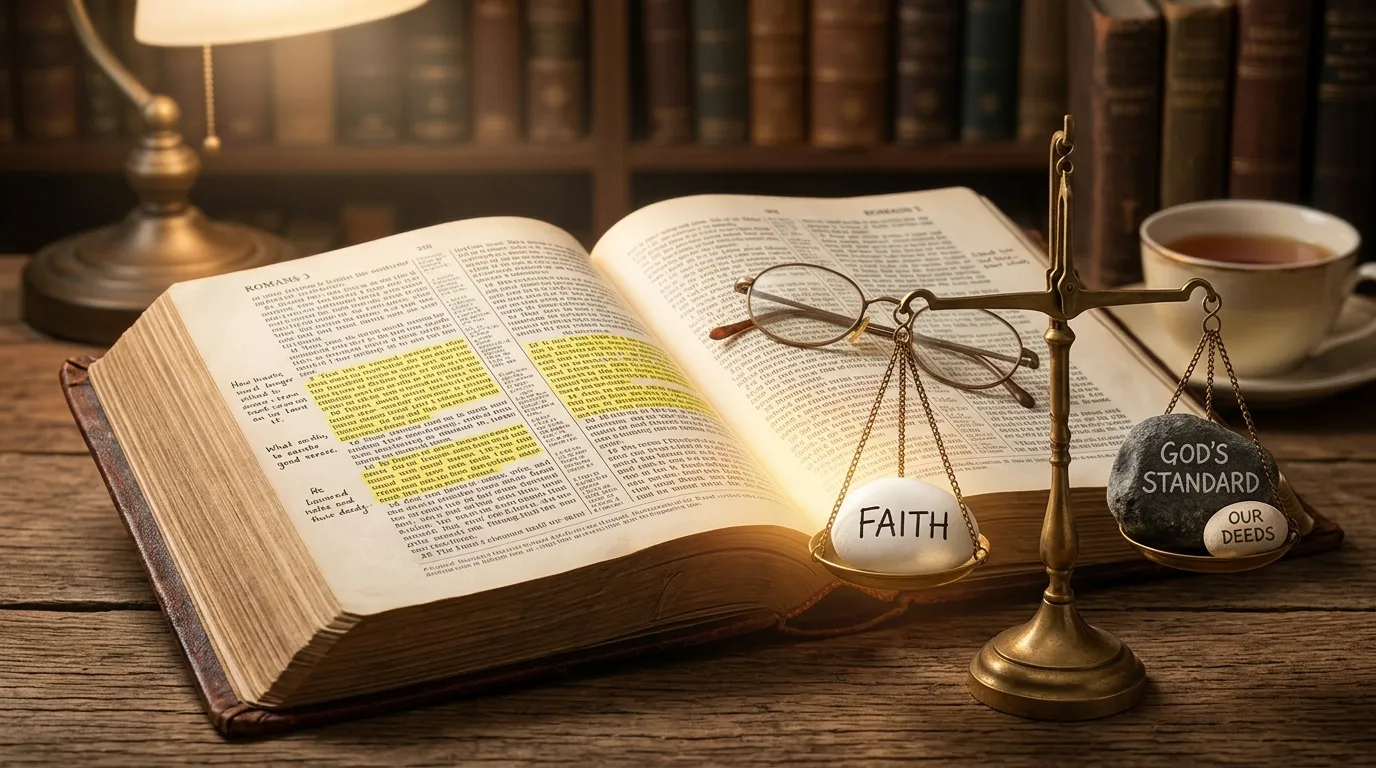
Here a vital clarification is needed, because the Bible holds two truths about righteousness in tension. Everything described above, the portraits, the habits, the Beatitudes, is the fruit. But fruit needs a root. The Bible is clear that no one lives this way by nature, and no one earns God’s acceptance by achieving it.
The root is what God does for us in Christ: He credits Christ’s righteousness to all who believe, the great exchange of the cross. The lived righteousness of the portraits flows from that gift; it never produces it. Get this backward and you get either pride (“look how righteous I am”) or despair (“I will never be righteous enough”). Get it right and you get gratitude: He made me righteous, so now I get to live like it.
This is why 1 John gives the test the way it does: “If you know that he is righteous, you know that everyone who does what is right has been born of him” (1 John 2:29). Doing what is right is the evidence of the new birth, not the cause of it. The righteous life is the family resemblance of God’s children.
The Quiet Power of an Ordinary Righteous Life
We tend to think righteousness must be dramatic to matter. Scripture suggests the opposite. Most of the righteous people in the Bible are not famous. They are the ones who showed up, told the truth, shared the bread, forgave the debt, and waited on God. Their lives were quiet, and their influence was enormous.
Think of the righteous person’s effect on a community. They are the neighbor everyone trusts, the employee no one has to supervise, the friend whose counsel you seek because you know it will be honest. A single righteous life is a standing rebuke to cynicism and a standing invitation to hope. “The memory of the righteous is a blessing” (Proverbs 10:7).
And their influence outlasts them. Noah’s righteousness saved his family. Joseph’s righteousness protected the infant Jesus. Simeon’s righteousness meant he recognized the Messiah when the scholars missed Him. You never know what your quiet integrity is preparing, what ark it is building, what child it is sheltering, what promise it is waiting for.
The Contrast That Clarifies: Two Ways
Scripture sharpens the portrait by contrast. Psalm 1 sets the righteous like a tree planted by streams of water against the wicked, who are “like chaff that the wind blows away” (Psalm 1:4). The tree has roots; the chaff has none. The tree endures seasons; the chaff scatters at the first wind. The difference is not luck or temperament. It is where you are planted and what you feed on.
This contrast runs through the whole Bible, not to make the righteous proud, but to make the choice clear. “The Lord watches over the way of the righteous, but the way of the wicked leads to destruction” (Psalm 1:6). Every day presents the two ways. Every small decision is a step down one of them. The righteous person is simply the one who keeps choosing the tree’s way, day after ordinary day.
Becoming the Portrait
So what does it mean to be righteous, in the lived sense? It means belonging to God by faith, and then letting that belonging reshape everything: your words, your money, your relationships, your private hours. It means falling seven times and rising eight. It means delighting in God’s ways when the crowd walks elsewhere.
Start where Psalm 1 starts: with delight. You cannot white-knuckle your way into righteousness. But you can ask God to make His ways delightful to you, to give you a taste for what is right. Then watch the habits follow: the small refusals, the quiet generosities, the words that give life. The portrait is painted one brushstroke at a time, over a lifetime, by an Artist who never gives up on His work. The ethic underneath it all is beautifully simple, and the wider world has a name for it too: the Wikipedia article on the Golden Rule shows how the principle of treating others as you would be treated echoes across cultures, while Scripture grounds it in the character of God Himself.