Alexander the Great conquered the known world before his thirty-third birthday and was dead before his thirty-third year ended. No other career in ancient history combined such speed with such sudden collapse. The Bible never names him. Yet many interpreters believe Daniel’s visions describe him with unmistakable clarity: a goat that crossed the earth without touching the ground, a great horn that broke off, and a kingdom shattered into four pieces. Alexander’s meaning in the Bible is therefore a study in contrast: the fastest empire ever built, and the clearest proof that speed is not permanence.
The Goat From the West
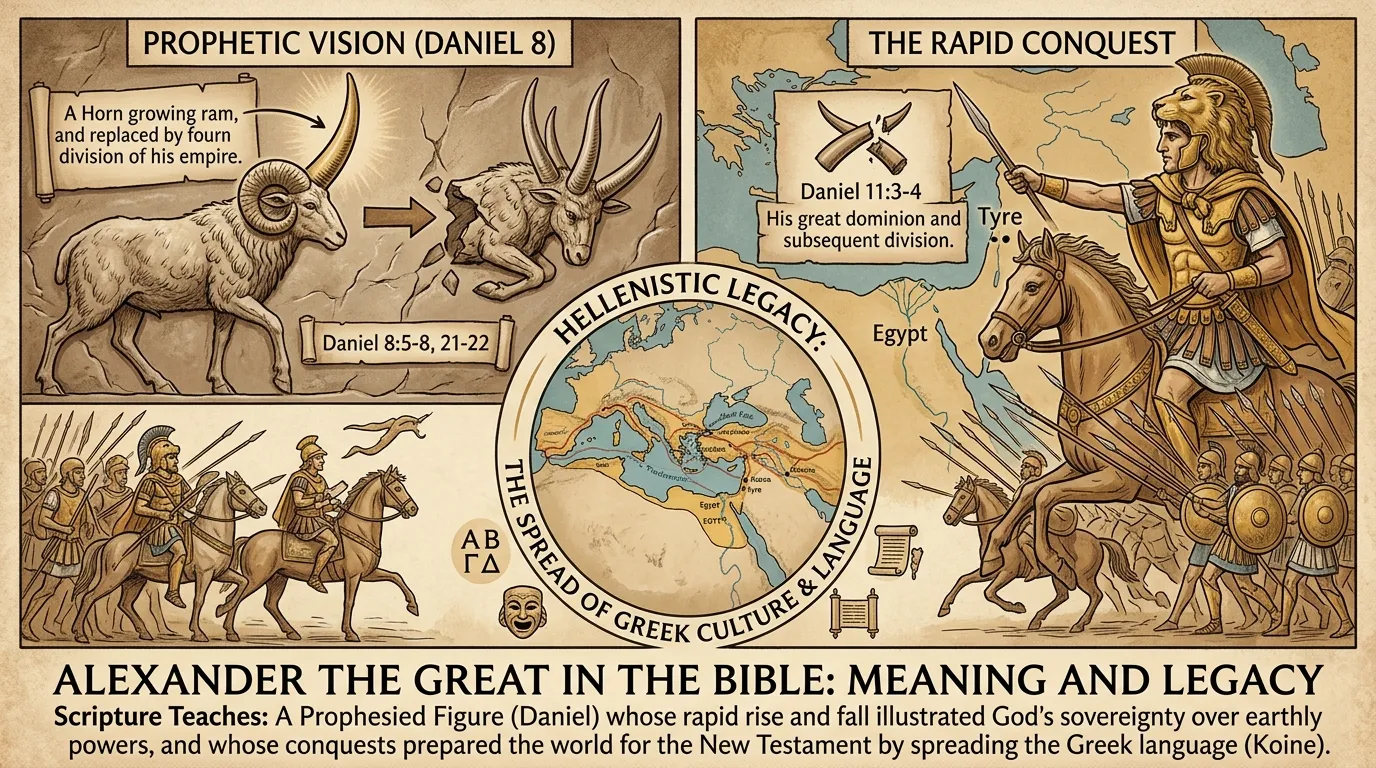
Daniel 8 records a vision from the prophet’s youth. A ram with two horns charged west, north, and south, and no one could stand against it. Then a goat came from the west, crossing the whole earth without touching the ground, with a conspicuous horn between its eyes. The goat struck the ram, broke its horns, and trampled it. Then, at the height of its power, the great horn was broken, and four smaller horns grew in its place (Daniel 8:3-8).
The vision comes with its own interpretation. The angel Gabriel explains that the ram is the kings of Media and Persia, and the goat is the king of Greece (Daniel 8:20-21). The great horn is the first king, and the four horns that replace it are four kingdoms that will arise from his nation, though not with his power (Daniel 8:22). For readers who know the history, the fit is striking. Alexander of Macedon, the first great king of a united Greece, destroyed the Persian Empire in a campaign of astonishing speed, from the Granicus in 334 BC to Babylon and beyond within a few years. The goat that did not touch the ground is a poet’s image for an army that seemed to fly.
The Horn That Broke
Alexander died in Babylon in 323 BC, at about thirty-two years old. The cause is still debated: fever, poisoning, and the accumulated effects of wounds and drinking are all candidates. What is not debated is the result. His empire, the largest the ancient world had yet seen, stretching from Greece to Egypt to India, did not survive him. He left no competent adult heir and no plan for succession. Within a generation, his generals, the Diadochi, had carved the empire into rival kingdoms. The four that mattered most were those of Ptolemy in Egypt, Seleucus in Syria and the east, Cassander in Macedon, and Lysimachus in Thrace and Asia Minor. Daniel’s four horns, growing where the great horn had broken, describe this fracture with precision.
For the Jewish people, the breakup mattered enormously. Judea lay between the Ptolemaic and Seleucid kingdoms, and for two centuries it was caught between them. The persecution under the Seleucid king Antiochus IV Epiphanes, which the book of Daniel also anticipates (Daniel 11), led to the Maccabean revolt. Alexander’s conquests set in motion a chain of events that shaped Jewish history for three hundred years, even though Alexander himself never ruled Judea for long.
A Common Language for the Gospel
Alexander’s most lasting legacy was not political but cultural. His conquests spread Greek language and culture across the Near East, a process historians call Hellenization. Greek became the common language of trade, government, and learning from Alexandria to Babylon. When the Old Testament was translated into Greek at Alexandria, producing the Septuagint, it was written in the language Alexander’s armies had spread.
That fact matters for the New Testament. The apostles wrote in Greek because Greek was the language everyone could read. The gospel traveled along roads Rome built, but it spoke in a language Alexander’s conquests had spread. The empire that lasted barely a decade left behind a linguistic world that endured for centuries. God used even the wreckage of Alexander’s empire as part of the preparation for the gospel, a reminder that He works through history’s unintended consequences as well as through its intentions.
Daniel’s Larger Lesson About Kingdoms
Alexander appears in Daniel not as a hero but as an illustration. Daniel 2 pictures human kingdoms as a statue of gold, silver, bronze, iron, and clay, struck and shattered by a stone not cut by human hands. Daniel 7 pictures them as beasts rising from the sea. In every image, the pattern is the same: kingdoms rise, display their power, and pass away, while God’s kingdom endures. Alexander is the most dramatic instance of that pattern. No one rose faster. No one fell faster.
The Bible’s view of human power is therefore realistic rather than romantic. It does not deny that Alexander was brilliant, courageous, and extraordinary. It insists that brilliance, courage, and extraordinariness are not enough to build anything permanent. The kingdoms of this world, even the greatest of them, are temporary arrangements. Only the kingdom of God, established through the crucified and risen Jesus, will never be destroyed (Daniel 2:44).
What Alexander Teaches Christians Today
The first lesson is about the limits of achievement. Alexander wept, according to legend, because there were no more worlds to conquer. Whether or not the story is true, it captures a real emptiness. A life spent acquiring power, territory, or fame eventually runs out of worlds. The Christian answer to that emptiness is not to achieve less but to build on a different foundation: a life oriented toward a kingdom that does not collapse when its founder dies.
The second lesson is about God’s sovereignty over history. Alexander did not know Daniel’s prophecies, and Daniel’s readers did not know Alexander. Yet the prophecy and the man fit together across centuries. That is the Bible’s claim about history: it is not a random sequence of accidents but a story guided by a God who declares the end from the beginning (Isaiah 46:10). Christians can read the rise and fall of every later empire, including their own nation’s, with the same confidence.
The third lesson is about the unexpected ways God prepares the world. Alexander’s empire was built by violence and ambition. Its greatest contribution to the gospel was something Alexander never intended: a shared language. God is not the author of the violence, but He is the Lord who brings good out of the wreckage. The same God who used a Greek-speaking world to carry the gospel can use the broken pieces of any human story.
Alexander and the Jews
Alexander’s relationship with the Jewish people is wrapped in legend. Later Jewish tradition told a story of Alexander arriving at Jerusalem, being met by the high priest in his sacred robes, and bowing before the name of God. According to the tale, Alexander spared the city and offered sacrifices in the temple. The story is almost certainly not historical in its details, but it reveals how later Jews remembered Alexander: as a conqueror who, unlike many who followed, did not desecrate the temple or persecute the people. The memory is significant because the kings who divided Alexander’s empire were not all so restrained. The Seleucid king Antiochus IV Epiphanes, who ruled a portion of Alexander’s former empire, tried to stamp out Jewish worship entirely, an act of persecution that led to the Maccabean revolt and that Daniel’s prophecies describe in detail (Daniel 11:31).
The contrast matters. Alexander’s conquests opened the world to Greek culture, and Greek culture brought both gifts and threats. The gift was a common language and a connected world. The threat was assimilation: the pressure to abandon the distinctiveness of Jewish faith for the cosmopolitan culture of Hellenism. The centuries after Alexander were a long negotiation between those two forces, and the Jewish people lived through both the promise and the peril of the world Alexander made.
The Speed of the Goat
Daniel’s image of the goat that crossed the earth without touching the ground deserves a second look, because it captures something real about Alexander’s campaigns. His army moved at a pace that astonished the ancient world. In eleven years he marched some twenty thousand miles, fought major battles at the Granicus, Issus, and Gaugamela, besieged Tyre and Gaza, founded cities across three continents, and pushed into India before his exhausted troops refused to go further. His speed was not only military. It was administrative and cultural: he founded or refounded dozens of cities, many named Alexandria, that carried Greek language and institutions into Asia. The goat’s speed was not a poet’s exaggeration. It was a historian’s summary.
And yet the speed is part of the warning. An empire built in a decade fell apart in a decade. The man who conquered the world could not conquer his own mortality, and the empire that seemed unstoppable dissolved into the wars of his generals. Daniel’s vision pairs the speed with the fracture on purpose. The faster the rise, the more complete the fall. The kingdom that endures, Daniel insists, is not built by speed but by God.
Alexander’s story ends where Daniel said it would: with a broken horn and four smaller ones. The gospel’s story ends differently: with a King who died and rose and whose kingdom grows still. That contrast is Alexander’s meaning in the Bible, and it is enough. For the historical account of his campaigns, his death, and the division of his empire, see the Wikipedia article on Alexander the Great.