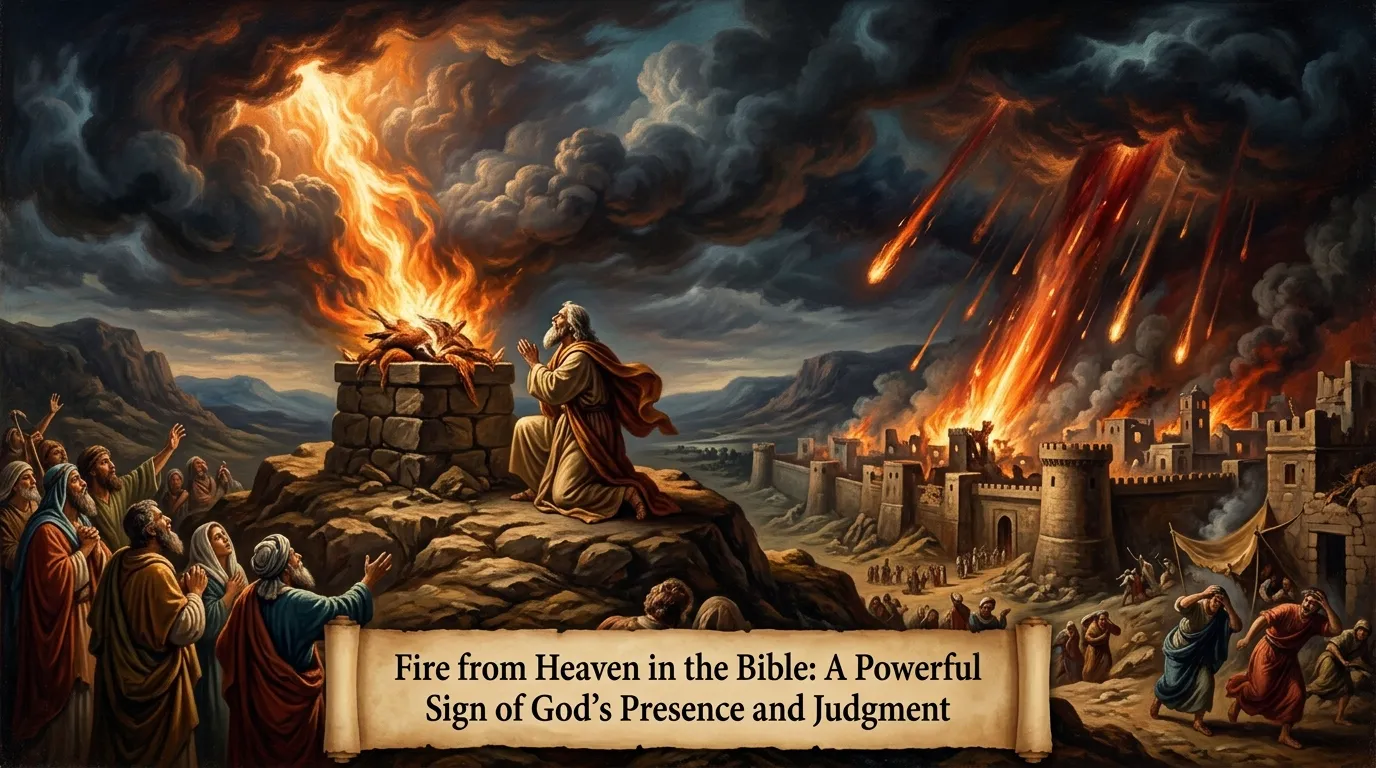
Elijah did everything he could to make the miracle harder. He rebuilt the altar with twelve stones, dug a trench around it, arranged the wood and the sacrifice — and then ordered water poured over everything. Once. Twice. Three times. “And the water ran around the altar and filled the trench also with water” (1 Kings 18:35). Only then did he pray — a prayer of sixty-three words — and “the fire of the LORD fell and consumed the burnt offering and the wood and the stones and the dust, and licked up the water that was in the trench” (18:38). Fire that burns stones. Fire that drinks water. The people fell on their faces: “The LORD, he is God!”
That is the Bible’s most dramatic “fire from heaven” — but it is only one appearance of a theme that runs from the burning bush to the lake of fire. Follow the flame through Scripture, and it tells a single story in four movements: the fire that leads, the fire that falls, the fire that rests, and the fire that will judge. Same element. Same God. Four revelations of who He is.
The Fire That Led
Israel’s first experience of divine fire was not destructive but directional. Coming out of Egypt, “the LORD went before them by day in a pillar of cloud… and by night in a pillar of fire, to give them light” (Exodus 13:21). For forty years, the camp moved when the fire moved and stayed when it stayed. God’s presence was not a doctrine to the wilderness generation; it was a light in the sky — visible, constant, leading.
Earlier still, Moses met the same fire in a bush that “was burning, yet it was not consumed” (Exodus 3:2). Fire that destroys is common; fire that illuminates without consuming is a miracle — and a portrait. This is what God’s presence does to those who draw near rightly: it enlightens without annihilating. Moses took off his sandals; the ground was holy; the man survived the flame. The fire that led Israel was the fire of a God who could be near without being lethal — the first hint of grace inside the glory.
The Fire That Fell
But the same fire that leads also answers — and sometimes judges. The two are closer together than comfortable religion admits.
At Carmel, fire was God’s signature. Elijah’s soaked sacrifice was a deliberate impossibility — no human trick could ignite it. When the fire fell, it proved three things at once: Baal was nothing, Elijah was God’s prophet, and the LORD, he is God. The fire was divine authentication — heaven’s “amen” to a prayed prayer. The same signature appeared when Solomon dedicated the temple: “fire came down from heaven and consumed the burnt offering and the sacrifices, and the glory of the LORD filled the temple” (2 Chronicles 7:1). God signed His acceptance in flame.
At Sodom, fire was God’s verdict. “Then the LORD rained on Sodom and Gomorrah sulfur and fire from the LORD out of heaven” (Genesis 19:24). On the captains of Ahaziah, fire was God’s defense — twice, fifty men consumed for threatening Elijah (2 Kings 1:10-12). On Nadab and Abihu, fire was God’s holiness: they offered “unauthorized fire” and “fire came out from before the LORD and consumed them” (Leviticus 10:1-2) — on the very day the priesthood began, lest anyone mistake God’s nearness for casualness.
The lesson is not that God is moody but that He is holy — the same holiness that warms the obedient consumes the defiant. Fire does not change; we do, by our posture toward it. Draw near in reverence like Moses, and it lights your path. Draw near in presumption like Nadab, and it judges. The flame is constant; the difference is the heart.
The Prayer About Fire Jesus Refused
The disciples once tried to weaponize heaven’s fire. When a Samaritan village rejected Jesus, James and John asked: “Lord, do you want us to tell fire to come down from heaven and consume them?” (Luke 9:54). They even had precedent — Elijah did exactly that to Ahaziah’s captains. Surely the Son of God could do no less?
Jesus “turned and rebuked them” (9:55). The reason, in the fuller text: “You do not know what manner of spirit you are of. For the Son of Man did not come to destroy men’s lives but to save them.” This is one of the most important fire-passages in the Bible, because it draws the line between the old covenant’s judgments and the new covenant’s mission. Elijah’s fire defended a prophet; Jesus’ mission would die for the very people the disciples wanted burned. The same God who sent fire on Carmel sent His Son to absorb fire on Calvary.
For believers, the application is searching: the desire to call down fire on opponents is the surest sign you have misunderstood your calling. The church’s weapon is not heaven’s flame but heaven’s love — the love that sent the Son not to condemn the world but to save it (John 3:17). Leave the judging fire to the Judge; our assignment is the seeking love of the Savior.
The Fire That Rested
At Pentecost, the fire came down again — but changed. “There appeared to them tongues as of fire, distributed and resting on each one of them. And they were all filled with the Holy Spirit” (Acts 2:3-4). Not consuming. Not judging. Resting. The fire that once fell on altars now settled on people — on fishermen and tax collectors, on each one, individually.
John the Baptist had promised this: “He will baptize you with the Holy Spirit and fire” (Matthew 3:11). Malachi had pictured the Lord “like a refiner’s fire” (Malachi 3:2) — and refining is what the Pentecost fire does: it does not destroy the gold; it burns away the dross. The Spirit’s fire purifies motives, ignites witness, and empowers holiness. The disciples who had wanted to burn Samaritans were, within weeks, preaching to them (Acts 8) — the fire had moved from their ambitions to their hearts, and transformed both.
This is the fire believers should pray for: not the fire that falls on enemies but the fire that rests on the willing — cleansing, empowering, refining. “Our God is a consuming fire” (Hebrews 12:29), yes — and the consuming begins in us, with the chaff of our own hearts.
The Fire That Never Went Out
There is one more fire in the story — the quietest, and perhaps the most personal. When God instituted the sacrificial system, He commanded: “The fire shall be kept burning on the altar continually; it shall not go out” (Leviticus 6:13). Day and night, Sabbath and festival, through every generation: the altar fire never went out. Priests tended it in shifts. It burned while Israel slept.
Why does this matter? Because the perpetual fire was Israel’s standing reminder of everything the dramatic fires declared. The pillar of fire said God is with you; the altar fire said it every morning. Carmel’s fire said God answers; the altar fire said He is always approachable. The consuming fire said God is holy; the continual fire said His holiness is constant — not a special effect for special occasions but the steady burn at the center of national life.
The New Testament relocates this fire — into the believer. “Do not be slothful in zeal, be fervent in spirit, serve the Lord” (Romans 12:11) — fervent literally means boiling, burning. “Do not quench the Spirit” (1 Thessalonians 5:19) — do not douse the altar fire. The Christian life is meant to burn continually: not only in the Carmel moments of dramatic answered prayer, not only in the Pentecost moments of powerful infilling, but in the Leviticus 6:13 ordinary — the daily tending, the morning offering, the quiet faithfulness that keeps the flame alive when no one is watching. God sends the fire; we tend it. That is the partnership: heaven provides the flame, and the believer — priest of the new covenant (1 Peter 2:9) — keeps it burning.
The Fire That Will Judge
Scripture ends where it must: the fire has a final appointment. “The heavens and earth that now exist are stored up for fire, being kept until the day of judgment” (2 Peter 3:7). “Fire came down from heaven and consumed them” — the last rebellion (Revelation 20:9). “Death and Hades were thrown into the lake of fire” (20:14).
This is not sensationalism; it is seriousness. A God who never judged would not be good — He would be indifferent, and indifference to evil is itself evil. The final fire is the guarantee that wrong will not win, cruelty will not stand, and every tear will be answered. Peter draws the only sane conclusion: “since all these things are thus to be dissolved, what sort of people ought you to be in lives of holiness and godliness” (2 Peter 3:11). The coming fire is not meant to terrify believers into panic but to steady them into holiness — to live now in the light of the ending that is sure.
From the bush to the altar, from Carmel to Pentecost, from the upper room to the last day: the fire tells one story. God is present, God is holy, God refines His own, and God will judge. Draw near to the flame — in reverence, in repentance, in the Spirit’s power — and it will light your way home. For the broader theology of divine fire across religious traditions, Wikipedia’s article on theophany surveys how the sacred has been experienced as fire, light, and glory through the ages.










