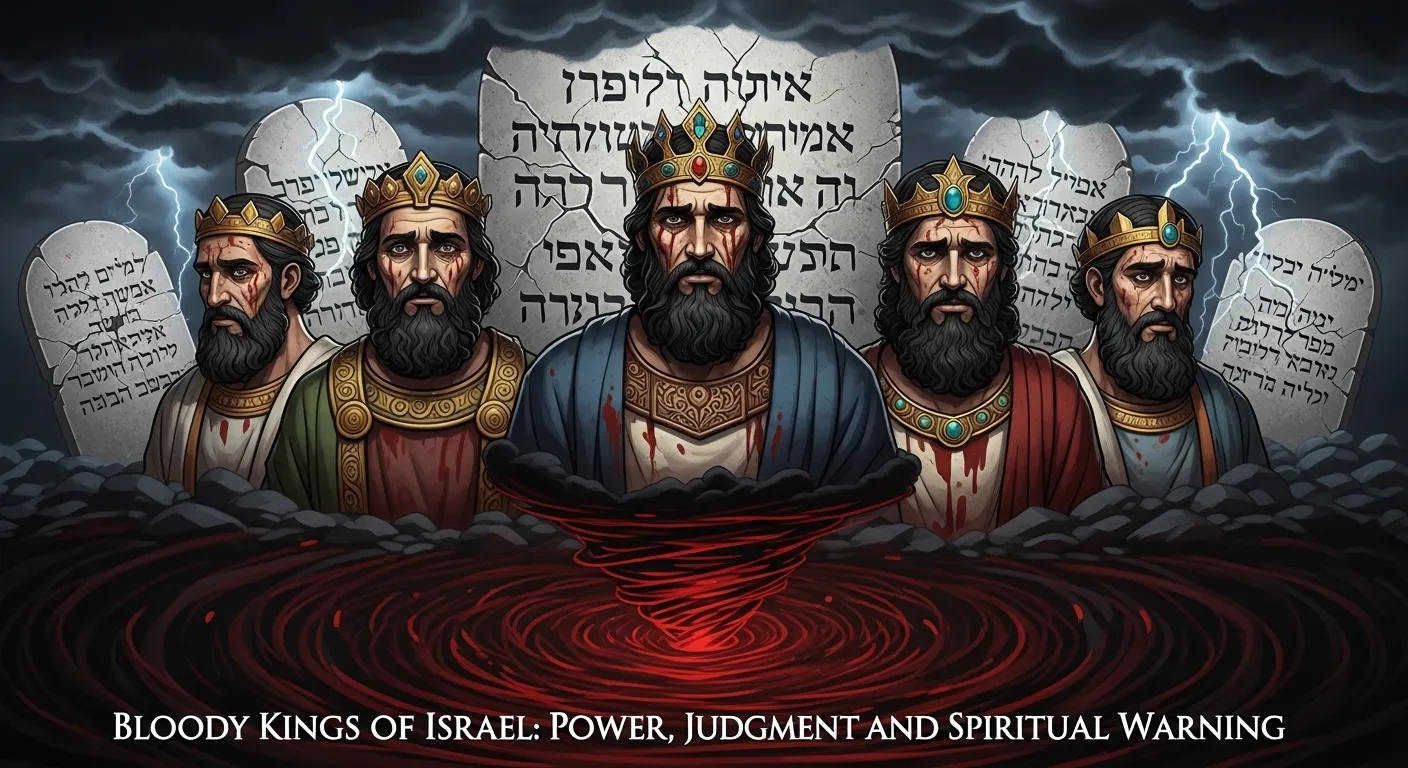
Open 1 and 2 Kings and you will find something no other ancient royal chronicle dares to do: a history of kings written by people who refused to flatter them. Egypt’s pharaohs carved their victories in stone and buried their failures in silence. Israel’s historians did the opposite. When a king of God’s people shed innocent blood, seized a vineyard, or led a nation into idolatry, the record names him, describes the crime, and pronounces the verdict. The bloody kings of Israel are not there to entertain us with violence. They are there to teach what power does to a human heart when God is pushed out of it.
The phrase covers the kings of both kingdoms — Israel in the north after the split, Judah in the south — across roughly four centuries. Some ruled with genuine faith and still stumbled into bloodshed. Others made violence their governing philosophy. Walking through their stories one by one reveals something the Bible wants every generation of leaders, parents, and ordinary believers to understand: Proverbs 29:2 is not a proverb, it is a prophecy — “When the righteous are in authority, the people rejoice: but when the wicked beareth rule, the people mourn.” The mourning in these stories is real, and it always outlasts the reign.
Jeroboam: The King Who Made Sin Official
The first bloody king never lifted a sword himself — which is exactly the point. Jeroboam, the first king of the northern kingdom, inherited ten tribes and one fear: that his people would keep traveling to Jerusalem to worship and their loyalty would drift back to the house of David (1 Kings 12:26–27). His solution was political genius and spiritual catastrophe. He built two golden calves, placed one at Bethel and one at Dan, and announced, “Here are your gods, Israel, who brought you up out of Egypt” (1 Kings 12:28).
Jeroboam’s bloodshed was slow. He did not execute anyone; he executed the nation’s conscience. He invented a religion, appointed his own priests, and created his own festivals — and the Bible’s verdict on him became the standard curse applied to nearly every northern king after him: he “made Israel sin” (1 Kings 14:16). A prophet pronounced judgment on his altar, his hand withered and was restored, and still “Jeroboam did not change his evil ways” (1 Kings 13:33). His story is the Bible’s warning about the bloodless kind of wickedness: the leader who never kills anyone but kills a nation’s faith, and whose damage outlives him by two centuries.
Ahab and Jezebel: Power Married to Cruelty
If Jeroboam corrupted worship, Ahab and Jezebel weaponized the throne. Ahab “did more evil in the eyes of the Lord than any of those before him” (1 Kings 16:30) — and he married Jezebel, a Phoenician princess who brought Baal worship as her dowry and persecution as her policy. Together they hunted the Lord’s prophets (1 Kings 18:4), and the single most revealing episode of their reign is also the most intimate: the theft of Naboth’s vineyard.
Naboth would not sell his ancestral land — the law forbade it (Leviticus 25:23). Ahab sulked like a child. Jezebel forged letters in his name, hired scoundrels to accuse Naboth of blasphemy, and had him stoned so Ahab could take the vineyard (1 Kings 21). It is the Bible’s perfect miniature of corrupt power: the law twisted into a weapon, religion used as camouflage, and an innocent man’s blood paying for a king’s landscaping. Elijah’s confrontation is one of Scripture’s thunderclaps: “Have you not murdered a man and seized his property?” (1 Kings 21:19). The judgment that followed — dogs licking Ahab’s blood, Jezebel thrown from a window — was not vengeance for its own sake. It was the moral order of the universe asserting itself: the blood you shed will find you.
Yet even here Scripture refuses simplicity. When Ahab humbled himself, God delayed the disaster (1 Kings 21:29). Mercy reached even into that house. The Bible’s bloody kings are warnings, not caricatures — and the mercy extended to them is part of the warning, because it proves no one had to end the way they ended.
Jehu: The Avenger Who Became What He Destroyed
Jehu is the most unsettling figure in the gallery because he started as God’s instrument. Anointed by Elisha’s servant, commissioned to wipe out the house of Ahab, he drove his chariot furiously to Jezreel and executed judgment with terrifying efficiency — Joram, Ahaziah, Jezebel, the seventy sons of Ahab, the prophets of Baal (2 Kings 9–10). God even commended him: “Because you have done well in accomplishing what is right in my eyes… your descendants will sit on the throne of Israel to the fourth generation” (2 Kings 10:30).
And then the turn, delivered in one devastating sentence: “Yet Jehu was not careful to keep the law of the Lord… he did not turn away from the sins of Jeroboam” (2 Kings 10:31). He destroyed Baal worship and kept the golden calves. He purged the land of Ahab’s idolatry and preserved Jeroboam’s. Jehu’s story is the Bible’s warning about righteous violence curdling into mere violence — the reformer who uses God’s cause to feed his own ambition, the man who is zealous against everyone else’s sin and blind to his own. His dynasty lasted exactly the four generations God promised, and no more. Zeal without obedience, Scripture says, is just another form of bloodshed.
Manasseh: The Worst King Who Repented
Manasseh, king of Judah, reigned fifty-five years — the longest reign in the Bible — and used them to undo everything his father Hezekiah had built. He rebuilt the high places, erected altars to Baal, practiced sorcery and divination, and “shed so much innocent blood that he filled Jerusalem from end to end” (2 Kings 21:16). Tradition holds that he had the prophet Isaiah sawn in two. If any king deserved to be written off, it was Manasseh.
Then the Assyrians dragged him to Babylon in chains, and in his distress “he sought the favor of the Lord his God and humbled himself greatly” (2 Chronicles 33:12). And God — astonishingly — listened. Manasseh came home, removed the idols, repaired the altar, and commanded Judah to serve the Lord. The chronicler, writing to a post-exilic community that felt beyond saving, included this story on purpose: if Manasseh could be forgiven, no one is beyond reach. The bloodiest king in Judah’s history became the Bible’s proof that repentance works even at the bottom.
Herod the Great: The Last of the Line
Centuries later, the pattern repeated in a new form. Herod the Great built the magnificent temple, then ordered the slaughter of the infants of Bethlehem when the Magi’s news threatened his throne (Matthew 2:16). His son Herod Antipas beheaded John the Baptist to save face at a birthday party (Mark 6:14–29). His grandson Herod Agrippa I executed James and imprisoned Peter, then accepted a crowd’s cry of “the voice of a god” — and was struck down, “eaten by worms” (Acts 12:23). The dynasty that tried to kill the Messiah ended as a footnote of worms. Luke’s dry record is the New Testament’s verdict on every bloody king: power that sets itself against God has an expiration date.
What the Blood Teaches
Why preserve all this? Because the Bible is not primarily interested in ancient politics; it is interested in the human heart, and these kings are its case studies. Three lessons run through the gallery.
First, power reveals; it does not create. Ahab was covetous before he was king; the throne just gave his covetousness an army. The kings’ sins — greed, pride, fear, the hunger for control — are ordinary sins with extraordinary resources. That is why their stories convict ordinary readers: the reader will never command a chariot, but the reader knows the feeling of wanting what Naboth has.
Second, a nation’s spiritual health follows its leaders, for good or ill. The northern kingdom never recovered from Jeroboam. Judah’s revivals — under Asa, Jehoshaphat, Hezekiah, Josiah — always began at the top. Leadership is a stewardship, and the Bible measures every one of these kings with the same sentence, repeated like a drumbeat: he “did evil in the eyes of the Lord” or he “did what was right in the eyes of the Lord.” The standard never moved, no matter how the kings did.
Third, the gallery exists because a greater King was coming. Every failed king in these books sharpens the longing for the one the prophets promised — the King whose reign would bring justice without bloodshed, “a righteous Branch” who would “reign wisely and do what is just and right in the land” (Jeremiah 23:5). The bloody kings are the dark background against which the light of Christ shines brightest. Their failures are why the crowds shouted “Hosanna” and why the church still prays “your kingdom come.”
Read these stories, then, not as ancient true crime but as a mirror and a mercy. A mirror, because the sins that destroyed thrones begin as whispers in ordinary hearts. A mercy, because even Manasseh found forgiveness, and because the King who finally came did not shed others’ blood to keep His throne — He shed His own to open it to us. Readers who want the historical background on the most infamous of these rulers can consult the Wikipedia entry on Ahab, which traces his reign, his marriage alliance, and the archaeological evidence surrounding Israel’s most notorious royal house.










