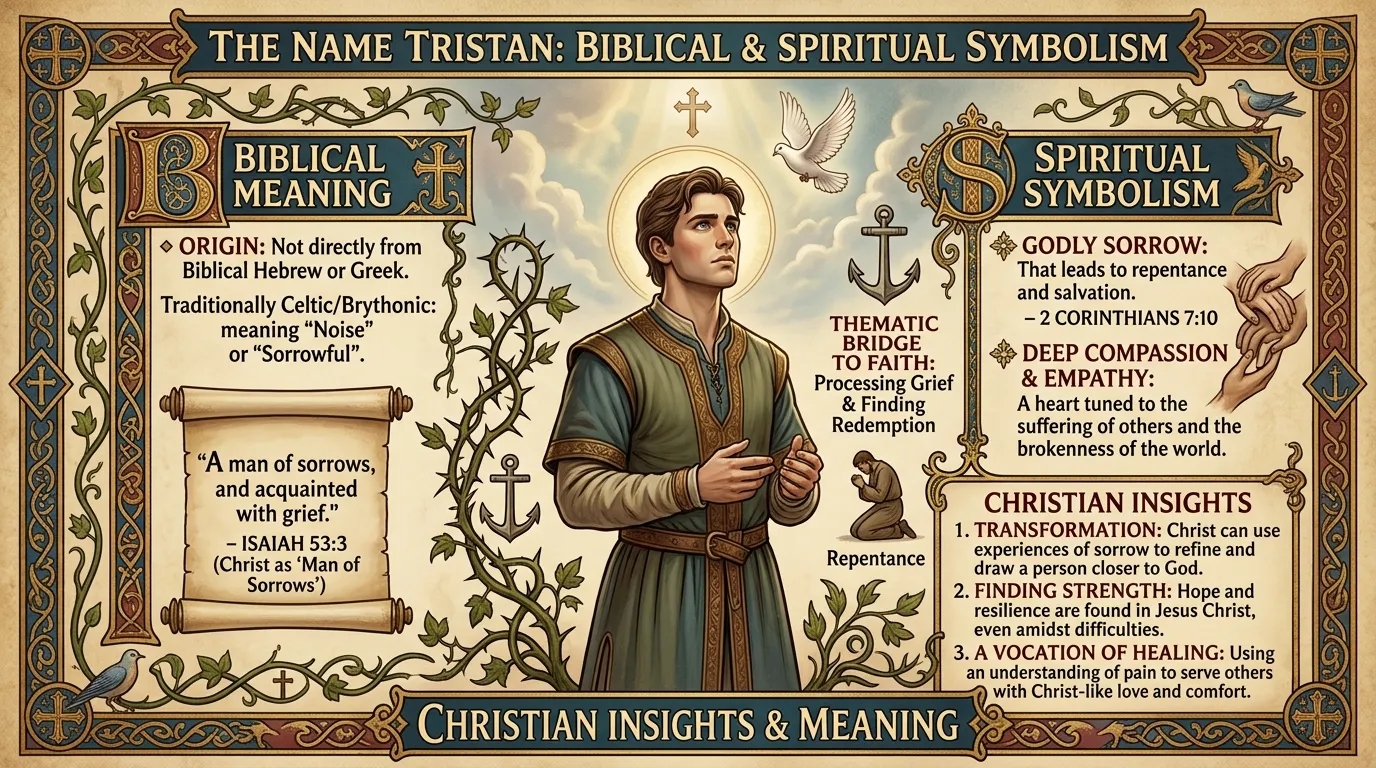
Let us begin with plain honesty, because you deserve it: the name Tristan never appears in the Bible. Not in the genealogies, not among the disciples, not in a single verse of either testament. If you arrived here hoping for a hidden Hebrew meaning or a forgotten Bible hero named Tristan, the straightforward answer is that there isn’t one. But that is not the end of the story — it is the beginning of a better one. Because the question underneath your search is really this: can a name that isn’t biblical still be carried with faith? Scripture’s answer is a resounding yes.
Where the Name Really Comes From
Tristan belongs to legend, not to Scripture — specifically to the medieval romance of Tristan and Isolde, one of the great love stories of Western literature, woven into the Arthurian cycle of tales. The name likely descends from the old Celtic Drustan or Drystan, and medieval writers happily connected it to the French word triste, meaning “sorrowful” or “sad” — fitting for a hero whose story is famously tragic. In the legend, Tristan is a Cornish knight of extraordinary courage and loyalty, torn between duty and love, whose tale ends in heartbreak.
None of that is biblical. But it is worth saying plainly: a name’s origin in legend does not make it a bad name, any more than a name’s appearance in Scripture automatically makes it a good one. (The Bible contains men named Judas and Jezebel, after all.) What matters is not where a name was born but what a life fills it with.
What the Bible Actually Says About Names
Scripture takes names seriously — but not in the way name-meaning websites sometimes suggest. In the Bible, names are given by parents, changed by God at turning points, and treated as descriptions of character or destiny. A few patterns worth noticing:
- God renames people at new beginnings. Abram becomes Abraham, “father of a multitude” (Genesis 17:5). Jacob the heel-grabber becomes Israel, “he strives with God” (Genesis 32:28). Simon becomes Peter, “rock” (John 1:42). In each case the new name is a promise, not a report — God names people for what he will make them, not merely for what they are.
- Parents name children out of their own stories. Leah names her sons out of her longing to be loved (Genesis 29:32–35). Hannah names Samuel — “heard by God” — out of answered prayer (1 Samuel 1:20). Jabez’s mother names him out of her pain, and Jabez spends his life praying his way out from under it (1 Chronicles 4:9–10). Biblical naming is deeply personal, and God honors that.
- Character outweighs etymology. “A good name is to be chosen rather than great riches” (Proverbs 22:1) — and in context, that “good name” is a reputation, not a vocabulary word. What people mean when they speak your name, after watching your life, matters infinitely more than what a dictionary says it meant centuries ago.
Carrying a Non-Biblical Name in Faith
Here is the liberating truth: most Christians in history have carried names that never appear in Scripture. The early church was full of converts who kept the names their pagan parents gave them — and God used those names gloriously. Your name does not need a verse attached to it to be pleasing to God. What it needs is a life attached to it that pleases him.
There is even a biblical precedent for finding redemptive meaning in an “outsider” name. The apostle Paul — originally Saul, named for Israel’s first king — carried a thoroughly Jewish name into a Gentile mission. Timothy’s name is Greek, not Hebrew, meaning “honoring God,” and Paul chose him as a partner (Acts 16:1–3). Luke, Silas, Titus, Priscilla — the New Testament is crowded with non-Hebrew names worn by heroes of the faith. God never asked a single one of them to rebrand.
If you bear the name Tristan — or are considering it for a child — consider what the legend’s hero was actually known for: courage, loyalty, and fierce devotion. Those are virtues Scripture celebrates everywhere. “Greater love has no one than this, that someone lay down his life for his friends” (John 15:13). Fill the name with that kind of love, and its origin in medieval romance becomes a footnote to a life of faith.
A Word About the “Sorrowful” Meaning
Some parents hesitate when they learn Tristan is linked to triste, “sorrowful.” Should that matter? Consider that some of the Bible’s greatest figures carried sorrow-shaped names. Jabez means “pain.” Mara — the name Naomi chose for herself — means “bitter” (Ruth 1:20). Jesus himself is called “a man of sorrows and acquainted with grief” (Isaiah 53:3). Scripture never treats sorrow as a curse on a name; often it is the doorway to depth, compassion, and a hard-won joy. A name touched by sorrow can belong to a person of uncommon tenderness.
What to Do With a Name’s Meaning, Practically
So the name isn’t biblical, its roots are legendary, and its folk meaning leans sorrowful. What now? Scripture suggests a thoroughly practical approach — redeem the name by filling it deliberately.
First, pray a blessing over it. In biblical culture, spoken blessing carried weight. Isaac blessed Jacob with words that shaped a nation (Genesis 27:27–29). You can do the same over a child, a grandchild, or yourself: speak aloud what you ask God to make the name mean. “Lord, make Tristan a name known for courage under pressure and loyalty that never wavers.” Words like that, prayed consistently, become a kind of renaming — not of syllables but of trajectory.
Second, attach a verse to it. Plenty of Christian families choose a “life verse” for each child — a passage that becomes that person’s banner. For a name linked with sorrow, Isaiah 61:3 is a natural fit: God gives “the oil of gladness instead of mourning.” For courage and loyalty, Joshua 1:9 or Proverbs 17:17 (“a friend loves at all times”). The verse becomes the name’s commentary, and over the years the person grows into both.
Third, tell the true story. When your child asks what his name means, tell him all of it — the knight, the legend, the sorrow, and then the better story: that God writes new meanings over old ones, that he renamed Jacob the deceiver into Israel the prince, and that a name is a vessel waiting to be filled. Children who hear that grow up understanding that identity is received from God, not inherited from etymology.
There is a final, quiet encouragement in Revelation: to the one who overcomes, Jesus promises “a new name written on the stone” (Revelation 2:17) — a name known only to the receiver and the Giver. Whatever name you carry now, God has another one prepared, perfectly fitted, fully known. Every earthly name is temporary. The eternal one is personal.
Questions Parents Ask
Is it wrong to give a child a name that isn’t in the Bible?
No. Scripture commands parents to raise children “in the discipline and instruction of the Lord” (Ephesians 6:4) — it never commands a biblical vocabulary list for naming. Choose a name with love, give it meaning through prayer, and raise the child to honor it.
Does a name shape a child’s destiny?
Only in the sense that character shapes destiny, and parents shape character. Jabez prayed specifically that the pain in his name would not define him — “that I may not cause pain” — and “God granted what he asked” (1 Chronicles 4:10). Pray over your child’s name, whatever it is.
Can I dedicate a non-biblical name to God?
Absolutely. Hannah dedicated Samuel — a name she chose out of her own story — to the Lord’s service (1 Samuel 1:28). Dedication is about surrender, not syllables. Present your child to God, speak blessing over the name, and let God write the meaning with the child’s life.
A Final Encouragement for Tristans
There is a quiet promise tucked into the story of every renamed person in Scripture: God is not limited by the raw material. He took Jacob the deceiver and made Israel the prince; he took Simon the reed and made Peter the rock; he took Saul the persecutor and made Paul the apostle. The pattern never changes — God receives what is, and shapes what will be. Bring him the name Tristan, with its legends and its sorrow and its courage, and let him do what he has always done: fill it with a story better than the one it started with. “Behold, I am making all things new” (Revelation 21:5) — including, gloriously, the meaning of your name.
For the full literary background — the Cornish knight, the tragic romance, and how the legend traveled through centuries of retelling — the encyclopedia’s account of Tristan and Isolde is the standard reference, and it makes a fine companion to the biblical principles above: a name’s story begins in history, but its meaning is finished in a life.
Whatever story your name came from, the Author of the better story is still writing. And that is true whether your name is Tristan, Timothy, or anything else: what Scripture promises is not a perfect etymology but a perfect ending — “I know the plans I have for you, declares the Lord, plans for welfare and not for evil, to give you a future and a hope” (Jeremiah 29:11). A name surrendered to God becomes, in the end, exactly what he intended it to be.










