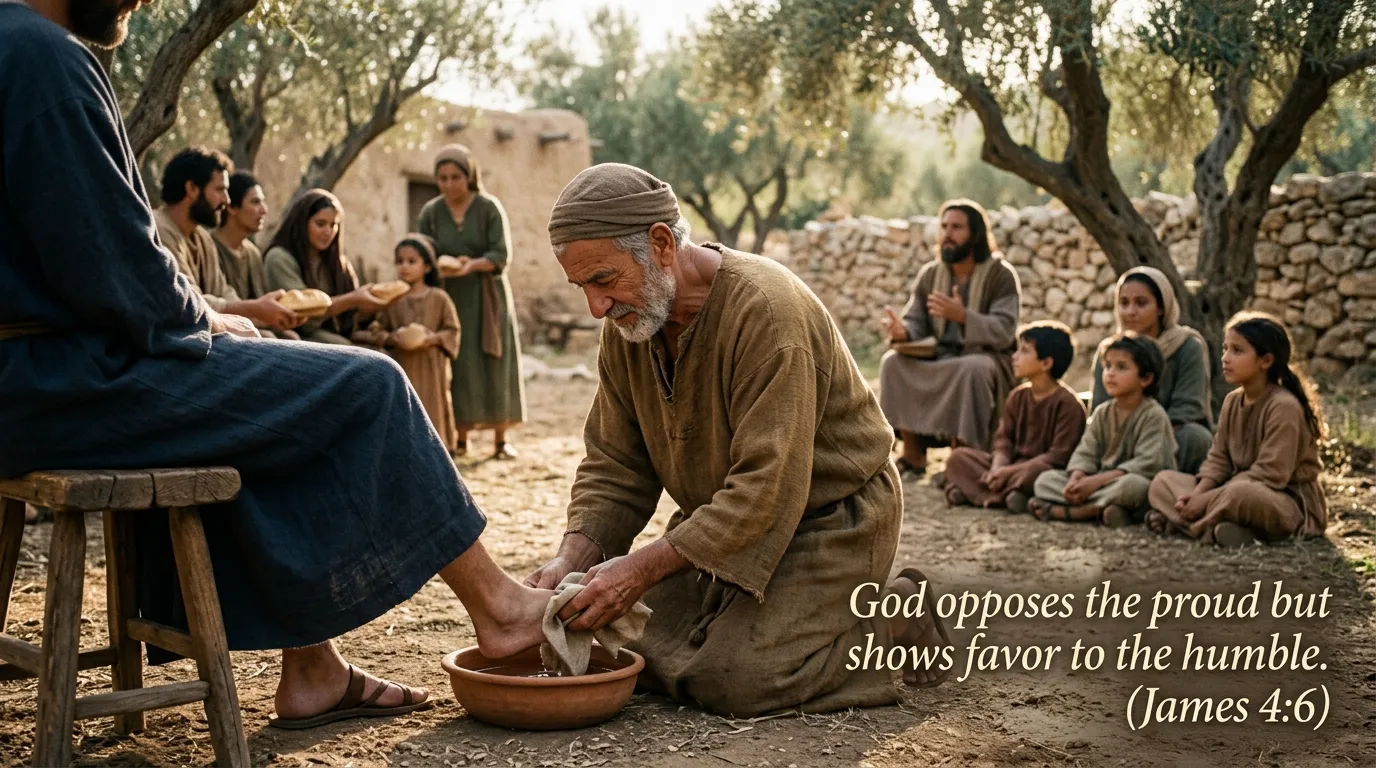
The night before the cross, Jesus did something no rabbi would do. He stood up from the Passover table, wrapped a towel around his waist like a household slave, poured water into a basin, and began washing his disciples’ dusty feet. Peter protested — this was upside down, inside out. And Jesus answered with a sentence that still rearranges every pecking order we build: “If I then, your Lord and Teacher, have washed your feet, you also ought to wash one another’s feet” (John 13:14). If you want to know what humility means in the Bible, start there — not with a definition, but with a towel.
An Unforgettable Picture: The Towel and the Basin
Foot washing belonged to the lowest servant in a first-century household. Roads were filthy, sandals were open, and the job was humiliating. That is precisely why Jesus chose it. He was not performing a random act of kindness; he was staging a living parable about what greatness looks like in the kingdom of God. The disciples had spent the evening arguing about which of them was the greatest (Luke 22:24). Jesus did not settle the argument with a lecture. He settled it with a basin.
Notice the order of John’s telling: “Jesus, knowing that the Father had given all things into his hands, and that he had come from God and was going back to God, rose from supper” (John 13:3–4). His humility did not come from insecurity or low self-esteem. It came from absolute security. He knew exactly who he was — and that is what freed him to kneel. Biblical humility is never self-hatred. It is self-forgetfulness, and self-forgetfulness is only possible when your identity is anchored somewhere unshakeable.
What the Word Actually Carries
The New Testament’s main word for humility, tapeinoō, literally means “to make low.” In the Greco-Roman world it was almost an insult — lowliness was for slaves, not for free men worth admiring. Christianity took this despised word and filled it with glory, because the gospel itself is the story of God making himself low. Paul says Christ “emptied himself, by taking the form of a servant” (Philippians 2:7). The word the world used for losers became the church’s word for the Lord.
The Old Testament carries the same thread with the Hebrew anavah, often paired with gentleness and a teachable spirit. It describes Moses, of whom Scripture says, “the man Moses was very meek, more than all people who were on the face of the earth” (Numbers 12:3) — written, remarkably, in the book Moses himself is traditionally credited with writing. True humility can even describe itself honestly without breaking itself.
Moses, David, and the Pattern of the Lowly
Scripture keeps handing its greatest assignments to people who insist they are unqualified. Moses argues at the burning bush that he cannot speak and should not go (Exodus 4:10–13). Gideon calls himself the least in the weakest clan (Judges 6:15). David, anointed king, asks, “Who am I, O Lord God, and what is my house, that you have brought me thus far?” (2 Samuel 7:18). This is not false modesty — it is accurate vision. Each of them saw the size of God clearly, and next to that size, their own smallness was simply a fact.
God’s response to such people is consistent across both testaments: “God opposes the proud but gives grace to the humble” (James 4:6; 1 Peter 5:5). That promise, quoted from Proverbs 3:34, is one of the most repeated sentences in the Bible. Grace flows downhill. It pools in low places. The humble do not earn God’s favor by groveling; they simply position themselves where favor already falls.
The Great Reversal: Christ’s Descent in Philippians 2
Paul’s famous hymn in Philippians 2:5–11 traces a downward staircase with an upward ending. Christ, being in the form of God, did not clutch equality with God; he emptied himself, took the form of a servant, became obedient to death — even death on a cross. Then the reversal: “Therefore God has highly exalted him.” Humiliation first, exaltation after. That is the unchanging grammar of the gospel.
Jesus taught the same grammar in plain language: “Whoever exalts himself will be humbled, and whoever humbles himself will be exalted” (Matthew 23:12). He said it about Pharisees who loved titles and front seats, but the principle outruns its original audience. Every attempt to lift ourselves triggers the counterweight; every willing descent is met, in God’s time, by God’s own lifting hand. “Humble yourselves before the Lord, and he will exalt you” (James 4:10).
Pride’s Warning Labels
Proverbs reads like a field guide to the opposite of humility, and its warnings are blunt: “Pride goes before destruction, and a haughty spirit before a fall” (Proverbs 16:18). “When pride comes, then comes disgrace, but with the humble is wisdom” (Proverbs 11:2). The book ties pride to strife (13:10), to self-deception (26:12), and to a particular spiritual blindness — the proud person stops listening, and the moment you stop listening, you stop learning.
Daniel’s account of Nebuchadnezzar is Proverbs acted out in history. The king surveys Babylon and says, “Is not this great Babylon, which I have built?” (Daniel 4:30) — and within the hour he is eating grass like an ox. Seven years later, restored, his conclusion is the whole Bible’s conclusion about pride: God “is able to humble those who walk in pride” (Daniel 4:37).
Humility Toward God, Gentleness Toward People
Scripture draws a useful distinction even if it never labels it: humility is our posture toward God, and it shows up toward people as gentleness. You cannot fake the second without the first. Moses could lead two million complaining people for forty years because his confidence was not in himself; when his siblings challenged him, “the Lord heard it” (Numbers 12:2) and defended him. The humble do not need to win every argument because they are not auditioning for worth — they already have it, given by God.
This is why Paul can command, “Walk in a manner worthy of the calling to which you have been called, with all humility and gentleness, with patience, bearing with one another in love” (Ephesians 4:1–2). Humility heads the list of the worthy walk. It is not the optional advanced course of the Christian life; it is the doorway. And it is learnable: Jesus’ invitation is explicit — “Take my yoke upon you, and learn from me, for I am gentle and lowly in heart” (Matthew 11:29). Of all the things Jesus could have said about his own heart — powerful, holy, just — he chose gentle and lowly. That is the curriculum.
What Humility Is Not
Because the word gets misused, a few clarifications from Scripture matter. Humility is not self-deprecation as performance — fishing for reassurance by advertising your flaws is pride wearing a costume. It is not refusing your gifts — Moses’ staff, David’s sling, and Paul’s intellect were all used at full strength; humility stewards gifts instead of worshipping them. It is not passivity — Jesus, the humblest person who ever lived, also flipped tables and confronted hypocrites to their faces. And it is not thinking God needs your groveling — “a broken and contrite heart, O God, you will not despise” (Psalm 51:17) describes honesty, not self-destruction.
The clearest test is how you handle being overlooked. The proud person keeps score: who got credit, who got thanked, who got the seat of honor. The humble person, secure in God’s verdict, can be forgotten by people without being shaken — because “the Lord sees not as man sees” (1 Samuel 16:7), and his seeing is the only seeing that finally counts.
That security is the whole secret. Biblical humility never asks you to become small; it asks you to become truthful — truthful about your limits and truthful about your worth, both measured against a God who is infinitely greater than your failures and infinitely kinder than your fears. The towel and the basin were not Jesus pretending to be less than he was. They were Jesus showing us, once and for all, what greatness actually is.
Practicing Lowliness This Week
Humility in Scripture is not a mood; it is a set of moves. A few the Bible commends:
- Serve beneath your rank. Do the task nobody thanks you for — the basin work (John 13:14–15).
- Receive correction without defending yourself. “Whoever heeds reproof is honored” (Proverbs 13:18).
- Speak of others’ strengths first. “In humility count others more significant than yourselves” (Philippians 2:3).
- Confess quickly. The humble own fault fast; the proud manage impressions (1 John 1:9).
- Pray like you need help. Because you do — “apart from me you can do nothing” (John 15:5).
None of this requires thinking less of yourself in the sense of self-contempt. C. S. Lewis’s old line still captures the biblical idea: humility is not thinking less of yourself, it is thinking of yourself less. The towel, the basin, the kneeling Lord — that is the picture. Everything else is commentary.
If you’d like a fuller account of how philosophers and theologians across the centuries have described this virtue, the encyclopedia entry on humility traces the concept from ancient ethics to modern psychology — a helpful backdrop to the Bible’s far older and far deeper vision.