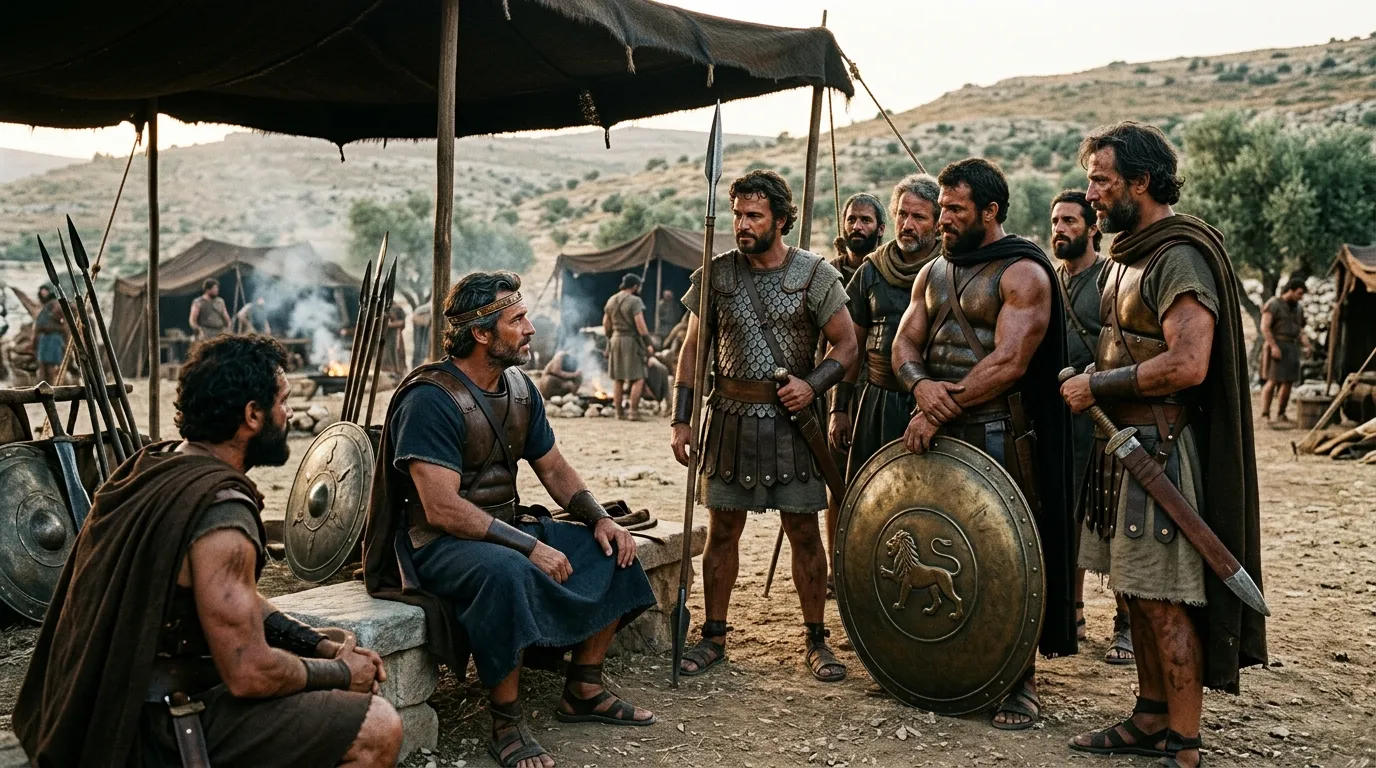
Near the end of 2 Samuel, tucked between David’s last words and the census that brought judgment, sits one of the Bible’s most stirring passages: a roll call. Thirty-seven names, with exploits attached — men who faced armies alone, held fields against impossible odds, and broke through enemy lines for a cup of water. “These are the names of the mighty men whom David had” (2 Samuel 23:8). It reads like a regimental honor roll carved in stone. And like every honor roll, it is really about something deeper than the names: what makes ordinary people mighty, and whom the mighty truly serve.
Where the Mighty Came From
The mighty men did not start mighty. When David was hiding in the cave of Adullam, the men who gathered to him were, frankly, the dregs: “everyone who was in distress, and everyone who was in debt, and everyone who was bitter in soul” (1 Samuel 22:2). The distressed. The indebted. The discontented. About four hundred of them. This was not a recruiting class; it was a support group for the broken.
And yet — “he became commander over them.” Under David’s leadership, and by God’s transforming power, the bitter became brave, the indebted became invaluable, the distressed became the mighty men of Israel. This is the first and greatest lesson of the list: God does not recruit the qualified; He qualifies the willing. If you feel like raw material rather than finished product — distressed, indebted, bitter in soul — you are exactly the kind of person this story is for. The mighty men are proof that nobody is beyond God’s re-making.
The Three Who Broke Through for a Cup of Water
The most revealing exploit on the list involves no killing at all. During a Philistine occupation, David — hiding in the stronghold, homesick — sighed aloud: “Oh, that someone would give me water to drink from the well of Bethlehem that is by the gate!” (2 Samuel 23:15). It was a wish, not an order. But three of his mighty men heard it, “broke through the camp of the Philistines and drew water out of the well of Bethlehem… and brought it to David.”
And David — this is the astonishing part — “would not drink of it. He poured it out to the LORD and said, ‘Far be it from me, O LORD, that I should do this. Shall I drink the blood of the men who went at the risk of their lives?'” (23:16-17). He treated the water as too sacred to drink — a drink offering, because it had cost blood to obtain. Here is loyalty in both directions: men who would risk death for their king’s passing wish, and a king who would not cheapen their sacrifice by treating it casually.
The spiritual point is sharp: true devotion counts no cost too great, and true leadership counts no sacrifice too small to honor. David’s men loved him; David honored that love by offering it to God. Every act of costly devotion to Christ follows the same path — poured out, finally, to the LORD.
The Ones Who Stood When Everyone Else Ran
The list’s battle accounts share a theme: standing alone. Josheb-basshebeth — also called Adino — “wielded his spear against eight hundred whom he killed at one time” (2 Samuel 23:8). Eleazar son of Dodo fought the Philistines so long and hard that “his hand clung to the sword” — the muscles locked, the grip frozen — and “the LORD brought about a great victory that day” (23:9-10). Note the order: Eleazar fought; the LORD brought the victory. Human courage, divine outcome.
Then Shammah son of Agee, and the lentil field. The troops had fled — the whole army, gone. The Philistines were coming for a plot of lentils, of all things. And Shammah “took his stand in the midst of the plot and defended it and struck down the Philistines, and the LORD worked a great victory” (23:11-12). A field of lentils. Not a city, not a king — lentils. The lesson is delicious: faithfulness is not measured by the grandeur of the ground but by the steadfastness of the stand. God does not ask whether your post is impressive; He asks whether you hold it. The man who will defend a lentil field for the Lord will defend anything.
Benaiah: A Lion in a Pit on a Snowy Day
No honor roll is complete without Benaiah son of Jehoiada, whose exploits read like legend because they were: “He struck down two ariels of Moab. He also went down and struck down a lion in a pit on a day when snow had fallen. And he struck down an Egyptian, a handsome man… he went down to him with a staff and snatched the spear out of the Egyptian’s hand and killed him with his own spear” (2 Samuel 23:20-21).
Pause on the lion. A pit. Snow falling. Most men would avoid a lion on a clear day on open ground; Benaiah went down into a pit after one in the snow. This is courage that borders on recklessness — except that it was courage in God’s service, and God honored it: Benaiah became commander of David’s bodyguard and, eventually, commander of Solomon’s entire army (1 Kings 2:35). God promotes the brave. Not the reckless, not the violent — the brave: those who will go down into the pit when duty calls, trusting that the God who gave the assignment will govern the outcome.
The Last Name on the List
The roll call ends with a name that stops the reader cold: “Uriah the Hittite — thirty-seven in all” (2 Samuel 23:39). Uriah. The loyal soldier David betrayed — sent to the front with his own death warrant in his hand (2 Samuel 11:14-15), murdered to cover the king’s adultery with Bathsheba.
Why is his name here, on the honor roll? Because Uriah was one of the mighty men — faithful to David even when David was faithless to him. He refused to go home to his wife while the army camped in the field (11:11); he carried his own death orders without opening them. His presence on the list is Scripture’s quiet, devastating verdict: the mighty man stayed mighty; it was the king who fell. The list honors Uriah and indicts David in the same breath — a reminder that no position, no anointing, no past faithfulness exempts anyone from the corrupting power of unrepented sin.
And yet — David repented (Psalm 51), and God restored him. The list that ends with Uriah’s name also belongs to the reign of the forgiven king. Grace does not erase the honor roll’s warning, but the warning does not cancel grace either. Both are true. That is the Bible.
The Ones Who Came Over While David Was Still an Outlaw
The Chronicler preserves a chapter 2 Samuel omits — the defectors. While David was still a fugitive, hiding at Ziklag, warriors started crossing over to him at the risk of their lives. The Gadites came: “mighty and experienced warriors… whose faces were like the faces of lions and who were swift as gazelles upon the mountains” (1 Chronicles 12:8). Men of Benjamin — Saul’s own tribe — defected to David (12:1-2). And then the famous scene: Amasai, chief of the thirty, seized by the Spirit, crying out: “We are yours, O David, and with you, O son of Jesse! Peace, peace to you, and peace to your helpers! For your God helps you” (12:18).
David’s response is the measure of the man at his best: “he received them and made them officers of his troops” (12:18). No suspicion. No probation. The king who had been rejected knew how to receive the rejected. These defectors teach the other half of the mighty-men story: might is not only forged in the cave — it is also attracted by a worthy leader. People cross dangerous lines to follow someone worth following. David, for all his later failures, was that kind of leader in those years: the anointed king who shared his men’s hardships, wept with them at Ziklag (1 Samuel 30:4), and inquired of God before he moved. Loyalty like theirs is rarely commanded; it is inspired.
And the New Testament parallel is exact. Christ, the greater David, also gathers His mighty ones from the unlikely — fishermen, tax collectors, zealots — and His call is the same one David’s defectors heard: cross the line, at cost, to the true King. “Whoever is not with me is against me” (Matthew 12:30) is the dividing line; “We are yours” is the answer. The mighty men of David, finally, are a preview of the church: defectors from the kingdom of darkness, enlisted under a King worth dying for.
What Made Them Mighty
So what is the “meaning” of the mighty men of David? Not military history — discipleship. They were mighty because of whom they served, not merely how they fought. Their courage flowed from loyalty to God’s anointed king; their victories are repeatedly credited to the LORD, not to their swords. Take the King away and they are just skilled killers. Keep the King central and they become a picture of the church: broken people made brave, standing their ground, loyal at any cost, serving a greater David.
For the greater David has His own mighty men and women — not with spears but with the “sword of the Spirit, which is the word of God” (Ephesians 6:17), wearing “the full armor of God, that you may be able to stand” (6:11). The call is the same: “Be on your guard; stand firm in the faith; be courageous; be strong” (1 Corinthians 16:13). Hold your lentil field. Go down into the pit if He sends you. Pour out your costly devotion at His feet. The King is worth it — and one day, the roll will be called again. For the historical background on these warriors and their world, Wikipedia’s article on David’s Mighty Warriors provides helpful context on the names and the era they served in.










