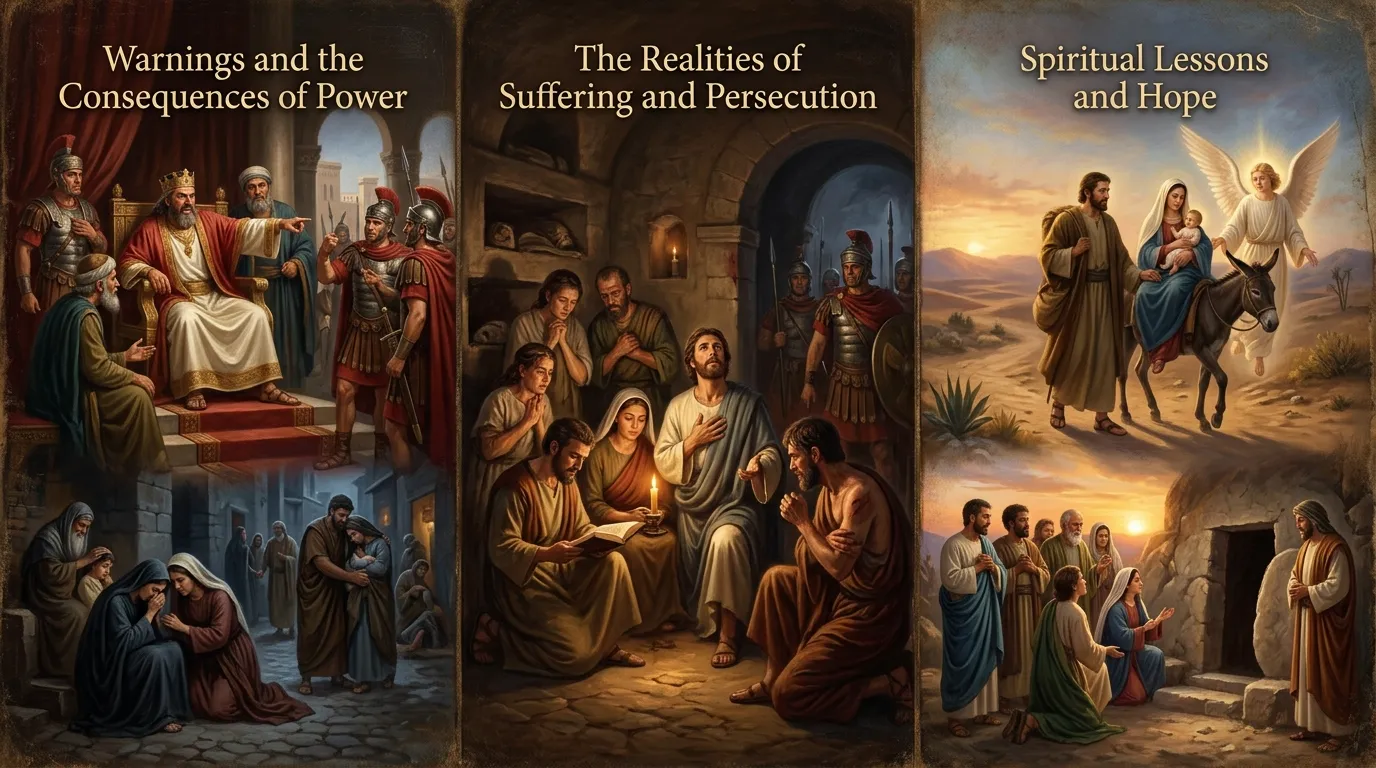
The Christmas story contains a sentence that should not be there. After the magi, the star, and the baby in the manger, Matthew writes: “Then Herod… sent and killed all the male children in Bethlehem and in all that region who were two years old or under” (Matthew 2:16). No softening. No explanation. Just the raw fact — and then the prophet’s cry: “A voice was heard in Ramah, weeping and loud lamentation, Rachel weeping for her children; she refused to be comforted, because they are no more” (2:18, quoting Jeremiah 31:15).
It is the darkest paragraph in the nativity, and it forces the question this article must answer honestly: why does the New Testament — the testament of grace, of “God so loved the world” — record such darkness? The answer matters, because how Scripture handles evil teaches us how to handle it too: with clear eyes, a grieving heart, and an unshaken hope.
Scripture Records Evil; It Never Applauds It
The first principle for reading every violent passage is also the most important: the Bible’s honesty about evil is not approval of evil. Matthew records Herod’s slaughter the way a war correspondent records a massacre — to expose it, not to celebrate it. The text weeps with Rachel. It does not shrug.
Consider why Herod killed. Matthew is precise: he was “troubled, and all Jerusalem with him” (2:3) at the news of a newborn king — troubled because his throne felt threatened. Fear curdled into fury, and fury into murder. The passage is a case study in how evil works: it begins in the heart long before it reaches the hands. Herod’s soldiers carried the swords, but Herod’s fear, pride, and love of power aimed them. Scripture shows us the machinery so we can recognize it in ourselves before it starts.
This is the Bible’s consistent method with human wickedness. It does not airbrush the patriarchs, the kings, or the apostles. It shows David’s adultery, Peter’s denial, and Herod’s massacre in the same unflinching light — because a book that hid human evil could not credibly announce divine grace. The darkness in the record is what makes the light in the gospel believable.
The Child Who Fled: God Enters the Suffering
But Matthew does something even more remarkable than recording the massacre: he shows us God entering the story as a victim of it. Warned in a dream, Joseph took the child and His mother by night and fled to Egypt (2:13-14). The Son of God spent His infancy as a refugee — displaced by political violence, sheltered in a foreign land, returning only when the tyrant was dead.
This changes everything about how Christians read suffering. God did not watch the slaughter of the innocents from a safe distance; His own Son was on the kill list. The flight to Egypt means that Jesus knows, from the inside, what it is to be hunted, homeless, and helpless. When the New Testament speaks of a High Priest who can “sympathize with our weaknesses” (Hebrews 4:15), the sympathy starts here — in a midnight escape with a baby who had done nothing wrong.
And Matthew adds the theological frame: “This was to fulfill what the Lord had spoken by the prophet, ‘Out of Egypt I called my son'” (2:15, quoting Hosea 11:1). Even Herod’s rage was woven into God’s pattern — not caused by God, but overruled by Him. Evil meant it for destruction; God meant the exile as a sign: this child is the true Israel, reliving the nation’s story — down into Egypt, and out again — to succeed where the nation failed.
Stephen and the Church’s First Blood
The New Testament’s other great confrontation with murderous evil comes in Acts 7. Stephen — “a man full of faith and of the Holy Spirit” (6:5), “full of grace and power” (6:8) — preached Christ to the council, and they “ground their teeth at him” (7:54). What happened next is recorded without flinching: “they cast him out of the city and stoned him” (7:58).
But look at what Stephen saw while the stones flew: “Behold, I see the heavens opened, and the Son of Man standing at the right hand of God” (7:56). Standing — the risen Christ, risen to receive His witness. And Stephen’s last words mirror his Lord’s: “Lord Jesus, receive my spirit… Lord, do not hold this sin against them” (7:59-60). Even in martyrdom, the New Testament’s emphasis is not on the murderers but on the martyr’s vision and the martyr’s forgiveness. The darkness is real; the light in it is more real.
And the story does not end at the stones. “Saul approved of his execution” (8:1) — the same Saul who would become Paul, the apostle to the nations. The church’s first great persecutor watched its first great martyr die. God wastes nothing: Stephen’s forgiving death planted a seed in Saul’s conscience that would bear fruit on the Damascus road. Every act of faithful suffering in the New Testament is a seed. The harvest is not always visible from the field.
Herod the Great Was Not the Last Herod
The New Testament’s confrontation with murderous power did not end in Bethlehem. A generation later, Herod Agrippa I — grandson of the Herod of the nativity — “laid violent hands on some who belonged to the church. He killed James the brother of John with the sword, and when he saw that it pleased the Jews, he proceeded to arrest Peter also” (Acts 12:1-3). Same family. Same tactic: eliminate the threat, please the crowd. James became the first apostolic martyr; Peter was chained between soldiers awaiting the same fate.
But Acts 12 is also the chapter where the pattern breaks. The church prayed — “earnest prayer for him was made to God by the church” (12:5) — and an angel walked Peter out of the maximum-security prison, past two guard posts and an iron gate that “opened for them of its own accord” (12:10). And Herod? Struck down for accepting divine honors, “eaten by worms” (12:23) — while “the word of God increased and multiplied” (12:24). The Herods keep killing; the church keeps growing; God keeps the books. That is the New Testament’s verdict on every power that murders to preserve itself: it is fighting the tide with a sword, and the tide is rising.
This is why the New Testament never counsels despair in the face of violent evil, and never counsels vengeance either. “Beloved, never avenge yourselves, but leave it to the wrath of God, for it is written, ‘Vengeance is mine, I will repay, says the Lord'” (Romans 12:19). The Christian’s confidence is not that evil will be outvoted but that it will be outlasted — by a kingdom that grows through prayer, not through swords, and whose King already walked out of His own tomb.
The Root in the Heart
The New Testament refuses to let us locate evil only “out there” — in Herods and mobs. It traces every Herod back to the heart. “Whoever hates his brother is a murderer” (1 John 3:15). Jesus said anger itself stands under judgment (Matthew 5:21-22). The distance between nursing a grudge and Herod’s massacre is a distance of degree, not of kind — the same root, given different soil.
This is why the New Testament’s answer to violence is never merely political but spiritual: “Blessed are the peacemakers, for they shall be called sons of God” (Matthew 5:9). “Do not be overcome by evil, but overcome evil with good” (Romans 12:21). The gospel does not just condemn Herod; it converts Sauls. It goes after the root — the fearful, proud, power-hungry heart — and replaces it with the heart of Christ.
For the believer, the practical counsel is direct: guard the heart’s early warnings. Herod was “troubled” before he was murderous. Bitterness, envy, the love of control — these are the seedlings. “Be angry and do not sin; do not let the sun go down on your anger” (Ephesians 4:26). Deal with the root while it is small, in prayer and confession, before it grows into something that harms others.
The Lamb’s Book: Where the Story Ends
The New Testament does not leave the victims of evil without a final word. In Revelation, John “saw under the altar the souls of those who had been slain for the word of God” (Revelation 6:9) — and they are not forgotten, not silent, not lost. They are before the altar, heard, robed in white, told to rest “a little longer” (6:11). God keeps His martyrs close.
And the end of the story is not vengeance but healing: “He will wipe away every tear from their eyes, and death shall be no more, neither shall there be mourning, nor crying, nor pain anymore, for the former things have passed away” (Revelation 21:4). Rachel weeping in Ramah will be comforted — not with explanations, but with restoration. The New Testament’s final answer to the darkest passages is not an argument; it is a promise: the light shines in the darkness, “and the darkness has not overcome it” (John 1:5).
So why does the New Testament record such darkness? To tell the truth about the world, to show us the heart’s capacity for evil, to prove that God entered our suffering rather than observing it — and to anchor our hope in the ending He has written. Read these passages with tears, as Matthew did. Then lift your eyes, as Stephen did, to the standing Son of Man. For the historical and artistic legacy of the Bethlehem narrative at the heart of this article, Wikipedia’s article on the Massacre of the Innocents traces how the church has remembered these children through the centuries.










