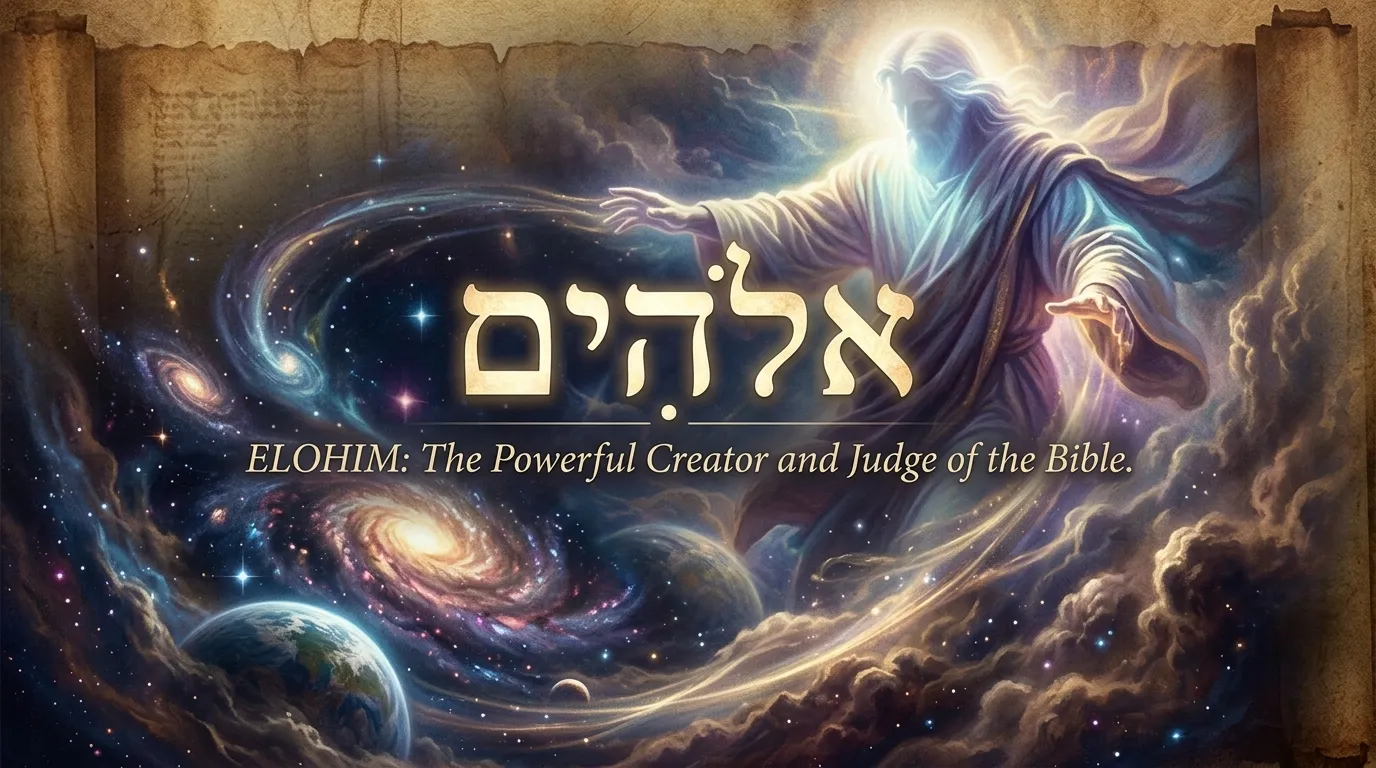
The Bible’s first sentence contains a grammatical puzzle that has fascinated readers for three thousand years. “In the beginning God created the heaven and the earth” (Genesis 1:1). The Hebrew word translated “God” is Elohim — and it is plural. The verb “created” (bara), however, is singular. A plural noun with a singular verb, in the first verse of the Bible.
It is not a mistake. It is not a leftover. It is the opening note of Scripture’s doctrine of God — and it only gets richer from there. Elohim appears over 2,500 times in the Old Testament, carrying meanings from the one true God to pagan idols to human judges. To understand it is to understand how the Bible talks about God Himself.
The Grammar That Preaches
Hebrew plurals usually mean “more than one.” But Elohim belongs to a category grammarians call the plural of majesty or plural of intensity — a plural form expressing greatness, fullness, or the totality of divine power, while the singular verb keeps the meaning firmly monotheistic. When the text says “Elohim created,” it is saying, in effect: the All-Powerful One — the fullness of divine might concentrated in a single Person — created.
The same pattern appears with other majestic plurals: adonim (“lords”) used of a single master, behemoth (plural of “beast”) for the single great creature of Job 40. The form magnifies; the verb specifies. One God, infinite in majesty.
Then comes Genesis 1:26, and the plot thickens: “And God said, Let us make man in our image.” Plural pronouns, from the singular-verb God. With whom is He speaking? The text does not pause to explain — it simply lets the plurality-within-unity stand, a door left open that the rest of Scripture will walk through.
How Wide the Word Reaches
Elohim is not exclusively the name of the true God. Its semantic range is wide, and each use illuminates the others:
- The true God. Overwhelmingly, Elohim denotes Yahweh — “In the beginning God created” (Genesis 1:1), “the LORD he is God” (Deuteronomy 4:35). This is the default, the anchor.
- False gods. “Thou shalt have no other gods [elohim] before me” (Exodus 20:3). The Philistines’ Dagon is elohim (1 Samuel 5:7); so is Chemosh of Moab (Judges 11:24). The word denotes deity as a category — the true God is the true Elohim among pretenders.
- Human judges and rulers. “Thou shalt not revile the gods [elohim], nor curse the ruler of thy people” (Exodus 22:28). Jesus quotes Psalm 82:6 — “I have said, Ye are gods [elohim]” — to defend His own claims (John 10:34-36). Those who wield God-derived authority bear the divine title by delegation.
- Angelic or spiritual beings. “Thou hast made him a little lower than the angels [elohim]” (Psalm 8:5). The word can denote mighty spiritual beings generally.
The breadth is the point: Elohim means mighty one(s) — power, transcendence, the divine realm. When applied to Yahweh with singular verbs and exclusive claims (“I am God, and there is none else,” Isaiah 45:22), it declares Him the supreme Mighty One, before whom every other elohim is either delegated, demonic, or imaginary.
El and Its Compounds: The Names Within the Name
Elohim is the plural of El (or Eloah), the ancient Semitic word for God — and El gathers compounds that unfold God’s character like facets:
El Elyon — “God Most High” (Genesis 14:18-20). Melchizedek’s title for the God above all gods, “possessor of heaven and earth.” When Abraham meets this God, the pagan kingdoms shrink to their true size.
El Shaddai — “God Almighty” (Genesis 17:1), the name God gives when calling Abraham to impossible fatherhood. Traditionally “the All-Sufficient One” — the God who is enough, whose might makes the barren fruitful.
El Olam — “the Everlasting God” (Genesis 21:33). Abraham plants a tamarisk tree and calls on the God who outlasts every tree, every empire, every age.
El Roi — “the God who sees me” (Genesis 16:13), Hagar’s name for God in the wilderness — the only person in Scripture who names God, and she is an Egyptian slave girl. Elohim sees the unseen.
Each compound is a sermon: the God of Genesis 1:1 is not an abstract Power but the Most High, the Almighty, the Everlasting, the God-Who-Sees.
The Trinity Question: What Elohim Does and Does Not Prove
Honesty requires care here. Some Christians have claimed the plural Elohim proves the Trinity. It does not — not by itself. The plural of majesty is a recognized Hebrew idiom, and Jewish readers have always understood it monotheistically. To build the Trinity on grammar alone overpressures the text.
What Elohim does is permit — even anticipate — the fuller revelation. The plural form with singular meaning, the “let us” of Genesis 1:26, the Angel of the LORD who speaks as God, the Spirit of God hovering in Genesis 1:2 — the Old Testament’s God is one, but a oneness with internal depth, a unity with room for relationship. When the New Testament reveals Father, Son, and Spirit as one God (Matthew 28:19; 2 Corinthians 13:14), it does not contradict the Old Testament’s Elohim; it unfolds Him.
The doctrine rests on the whole canon, not on one word — but the first word of the Bible turns out to be exactly the kind of word a Trinitarian God would inspire: one and plural, single and full, unity and majesty in four Hebrew letters.
Why It Matters for Worship
God is not a bigger version of us. The plural of majesty guards transcendence: He is Elohim, the Mighty Ones-concentrated-in-One, not merely a stronger man. Worship begins where our categories end.
Power and personhood coincide. The God of infinite might is the God who sees (El Roi), who covenants, who speaks. Elohim the Creator is Yahweh the covenant-keeper — the same God, power and love in one name.
Authority is delegated, never owned. That judges can be called elohim is both an honor and a warning: all human authority is borrowed from the true Elohim, and “God standeth in the congregation of the mighty; he judgeth among the gods” (Psalm 82:1). Every ruler answers to the Mighty One.
Praying to Elohim: The Name in Worship
Elohim is not only a word to study; it is a name to pray. The Psalms address Him constantly, and the prayers reveal what the theology means on your knees:
“My God, my God” — Eli, Eli (Psalm 22:1), the cry Jesus makes His own on the cross (Matthew 27:46). The Mighty One is my Mighty One — transcendence you can possess, majesty you can claim in the dark.
“God is our refuge and strength” — Elohim is “our refuge” (Psalm 46:1). The plural-of-majesty God is a hiding place: infinite power, personally available. The fortress has a name, and the name is His.
“Great is the LORD” — gadol YHWH, but the psalm continues “and greatly to be praised… in the city of our God [Elohim]” (Psalm 48:1). Worship’s scale matches God’s scale: the great Elohim deserves great praise. Small worship is a theological error — it mismeasures the Majesty.
The practical upshot: pray big. The God of Genesis 1:1 — the plural-majesty Creator — is not embarrassed by large requests. “Call unto me, and I will answer thee, and shew thee great and mighty things, which thou knowest not” (Jeremiah 33:3). Elohim can handle it. In fact, small prayers may be the clearest sign we have forgotten who He is.
One caution belongs here: the plural Elohim has sometimes been pressed into service for ideas Scripture never teaches — from ancient polytheism to modern speculation. The text’s own guardrails (singular verbs, exclusive claims) keep the meaning anchored: one God, infinite majesty. Let the grammar preach, but let it preach what the whole canon confirms.
Questions About Elohim
Does the plural “Elohim” mean there are multiple gods?
No. The singular verbs and exclusive claims (“there is none else,” Isaiah 45:22) make strict monotheism unmistakable. The plural is a Hebrew idiom of majesty and fullness, not a headcount.
Why is “Elohim” used for idols and judges too?
Because the word denotes the category of divine/mighty beings. Context determines the referent: with singular verbs and covenant claims, it is Yahweh; applied to Dagon or human judges, it marks them as (real or claimed) powers — always subordinate to, or in rebellion against, the true Elohim.
What is the difference between Elohim and Yahweh?
Elohim is the generic word for God (power, deity); Yahweh (LORD) is God’s personal covenant name, revealed to Moses (Exodus 3:14-15). Genesis 1 uses Elohim (God as Creator); Genesis 2 begins using Yahweh Elohim (the LORD God as covenant partner). Together they declare: the all-powerful Creator is the personally-known Redeemer.
Four letters, twenty-five hundred occurrences, one inexhaustible God. The Bible’s first word about God is already telling you He is greater than grammar — and closer than breath. For the linguistic and historical study of the term across Semitic languages, the Wikipedia article on Elohim is a solid reference; for the God Himself, Genesis 1:1 remains the best introduction ever written.










