In the folklore of half the world, the owl is the wise old bird — the spectacled professor of the forest, perched on a stack of books. It is a charming image, and it is almost entirely modern. Open the Bible, and you will find a very different bird. The owl of Scripture does not sit on books. It sits on ruins. It haunts the rubble of judged cities, nests in the wastelands, and appears on the list of unclean birds. To understand the owl meaning in the Bible, you have to set aside the greeting cards and hear the prophets.
This is not because the Bible hates owls. It is because the Bible uses the owl the way a painter uses shadow: to show what the world looks like when God’s presence withdraws. The owl is Scripture’s portrait of desolation — and, paradoxically, of the watchfulness that desolation can teach.
The Night Bird in the Prophets’ Warnings
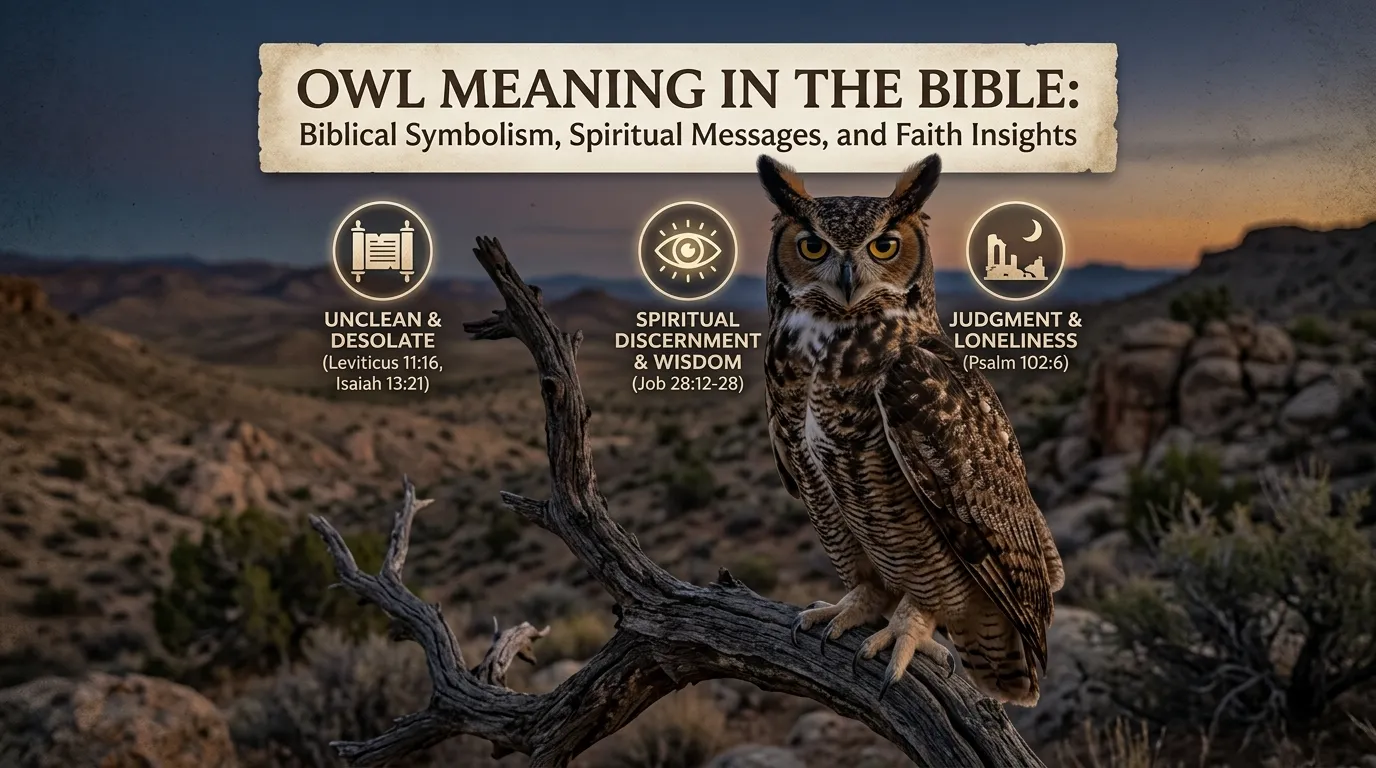
The owl’s most prominent biblical role is as a resident of ruins. When Isaiah pronounces judgment on Babylon, he describes what the great city will become: “hyenas will inhabit her… owls will dwell there” (Isaiah 13:21-22). When he prophesies against Edom, the picture is even starker: “The desert owl and screech owl will possess it… thorns will overrun her citadels” (Isaiah 34:11-13). Zephaniah says the same of Nineveh: the owl will “hoot in the window” of its shattered palaces (Zephaniah 2:14).
Read these passages and feel their weight. The prophets are not writing nature documentaries; they are writing obituaries for civilizations. The owl appears because the owl is what moves in when humanity moves out. Palaces become perches. Marketplaces become nesting grounds. The bird that loves the dark inherits the cities that loved their darkness.
The theological point is devastating and clear: this is what becomes of every human project built without God. Babylon was the glory of kingdoms (Isaiah 13:19); it became an owlery. Every empire, every ideology, every personal kingdom constructed in defiance of heaven has the same appointment with the night birds. The owl is not the cause of the ruin. It is the evidence of it — nature’s way of posting the “condemned” notice.
Unclean: The Owl in the Law
The owl also appears in Leviticus 11 and Deuteronomy 14, in the lists of unclean birds the Israelites were forbidden to eat. Several owl species are named — the great owl, the little owl, the screech owl, the white owl (the exact identifications are debated, but the family is unmistakable).
Why unclean? The Bible does not always explain its dietary categories, but the patterns are suggestive. Many unclean birds are birds of prey or carrion-eaters — creatures associated with death. The owl hunts in darkness and is linked, in the prophetic imagination, with desolate places. For Israel, what you ate taught what you were: a holy people, set apart for the living God, did not feed on creatures of darkness and death. The dietary law was a daily, edible sermon about separation.
There is pastoral wisdom here for the modern reader. The question is not really about owls or menus; it is about appetites. What do you feed on? The media you consume, the conversations you savor, the resentments you nurse — do they belong to the light or to the ruins? “Blessed is the one… whose delight is in the law of the Lord” (Psalm 1:1-2). Holiness has a diet, and the owl reminds us to check ours.
The Owl’s Lament: Psalm 102
But the Bible’s most moving owl passage is not about judgment at all. It is about sorrow. Psalm 102 is the prayer of “one afflicted, when he is faint and pours out his complaint before the Lord” — and in the middle of it, the psalmist cries: “I am like a desert owl, like an owl among the ruins” (Psalm 102:6).
Sit with that image. The psalmist does not compare himself to a lion or an eagle. He chooses the loneliest bird in Scripture — the desert owl, crying in the night over collapsed walls — and says: that is me. Sleepless (“I lie awake,” v. 7), isolated (“like a lonely bird on a housetop”), wasting away. This is depression given feathers. This is grief with a voice that only comes out after dark.
And here is the miracle of the psalm: it is a prayer. The man who feels like a desert owl is talking to God about it. He does not wait until he feels like an eagle to pray. He brings the owl to the throne. “Hear my prayer, Lord; let my cry for help come to you” (Psalm 102:1). The psalm ends, astonishingly, in hope: “The children of your servants will live in your presence” (Psalm 102:28). The owl’s lament becomes, by the final verse, a song of the future. Desolation is not the psalm’s destination; it is its starting point.
If you are in an owl season — lonely, sleepless, surrounded by the ruins of plans — Psalm 102 gives you both permission and a path: permission to feel like the desert owl, and a path to bring that feeling to God instead of nursing it alone. He is not embarrassed by your lament. He put it in His hymnbook.
Night Vision: What the Owl Sees That We Don’t
Now turn the image over, because the owl has one more sermon, and it is about its eyes. Owls see in darkness. Their enormous eyes gather light where other birds are blind; they hunt, navigate, and thrive in conditions that disable everyone else. The Bible never explicitly makes this point about owls — but Scripture’s broader theology of darkness and sight invites the reflection.
Some things can only be seen in the dark. Stars are invisible at noon. It took the night of his wrestling for Jacob to see God face to face (Genesis 32:30). It took the darkness of the tomb for the disciples to see the resurrection. Paul learned that God’s “power is made perfect in weakness” (2 Corinthians 12:9) — a truth no one discovers in comfort. The owl’s gift is night vision, and suffering often confers the same: an ability to perceive God’s presence, God’s purposes, God’s tenderness, in places where the comfortable cannot see Him at all.
This does not romanticize pain. The ruins are still ruins; the prophets’ warnings still stand. But it means the dark seasons are not wasted on those who bring them to God. “Weeping may stay for the night, but rejoicing comes in the morning” (Psalm 30:5) — and sometimes, in the night itself, the weeping one learns to see.
The Desert Will Bloom: The Owl’s Ruins Reversed
Scripture does not leave the owl in the ruins forever. Isaiah, the same prophet who filled Babylon and Edom with night birds, also foresaw a day when the wastelands themselves would be healed: “The desert and the parched land will be glad; the wilderness will rejoice and blossom” (Isaiah 35:1). “Water will gush forth in the wilderness and streams in the desert. The burning sand will become a pool” (Isaiah 35:6-7).
Follow the logic: if the owl is the resident of desolation, then the healing of desolation means the owl’s tenancy ends. The ruins get rebuilt. The wasteland blooms. What judgment emptied, grace refills. This is the Bible’s final word over every ruin — personal as well as civilizational: desolation is never the last chapter where God is writing. “He has sent me… to bestow on them a crown of beauty instead of ashes” (Isaiah 61:1-3). The night birds will have to find somewhere else to roost, because the city of God is coming, and in it “there will be no more night” (Revelation 22:5).
From Omen to Watchman
A final word is needed, because owls carry heavy superstitious baggage. In many cultures, an owl’s call is considered an omen of death; some Christians, hearing one at night, feel a chill of spiritual dread. The Bible gives no warrant for treating owls as omens. They are creatures — made by God, named in His book, assigned their meaning by the prophets as images of desolation, not as fortune-telling devices. “Let no one be found among you… who interprets omens” (Deuteronomy 18:10) applies to owl calls as much as to anything else.
But there is a better use for the owl’s famous wakefulness. Scripture repeatedly calls God’s people to watch: “Watch and pray so that you will not fall into temptation” (Matthew 26:41). “Be alert and of sober mind. Your enemy the devil prowls around like a roaring lion looking for someone to devour” (1 Peter 5:8). The owl stays awake while others sleep. The Christian is called to the same vigilance — not the anxious scanning of the fearful, but the steady watchfulness of one who knows the night is real and the dawn is coming.
So the owl of the Bible is, finally, a teacher with two lessons. From the ruins, it preaches: build on God, or build for the birds. From the darkness, it whispers: bring your night to Him — He sees in the dark, and He can teach you to see too. For the natural history behind the symbol — how these remarkable hunters actually see, hear, and live — the Wikipedia article on owls is genuinely fascinating; but the meaning that matters is the one the prophets gave it, and it still preaches wherever ruins stand and wherever the lonely cry in the night.