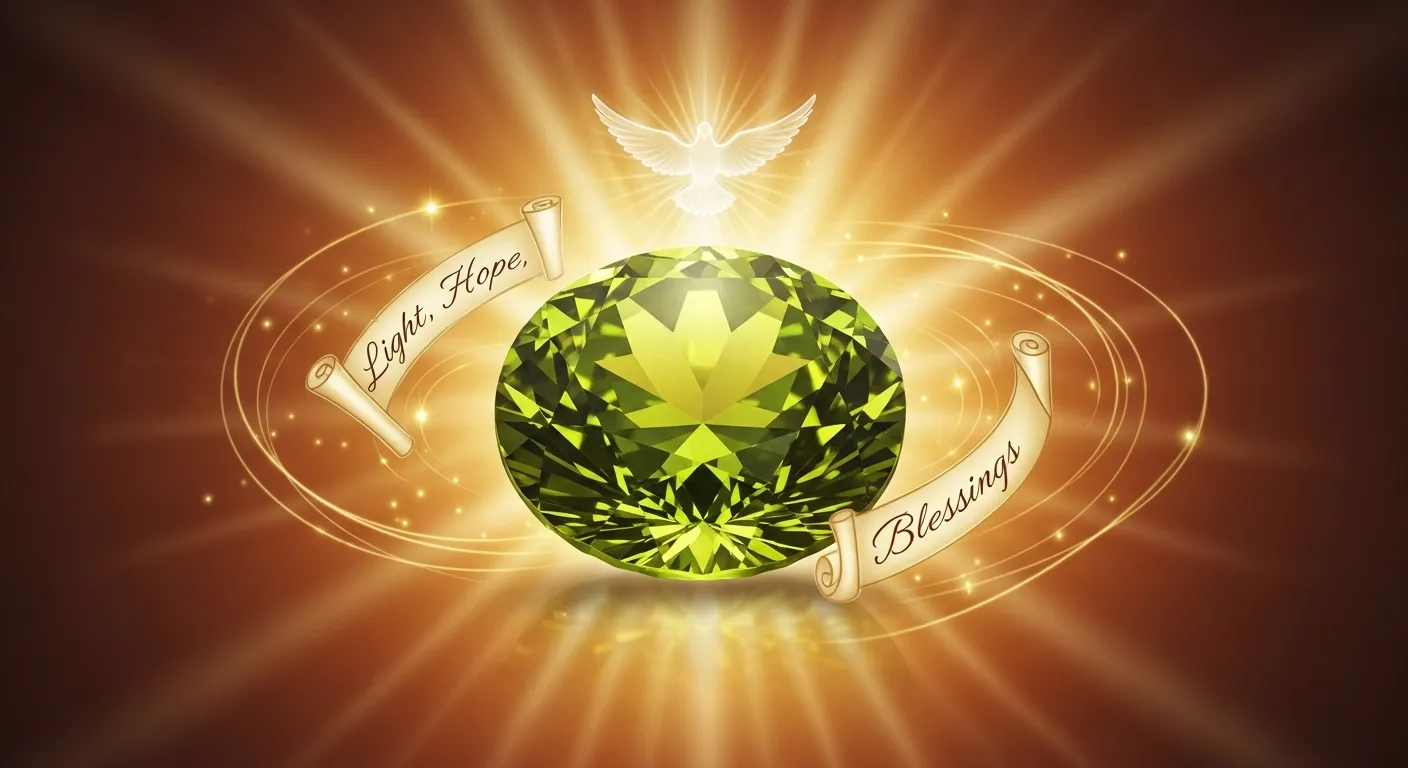
Green is the Bible’s color for “alive.” The first green thing in Scripture is vegetation sprouting on the third day of creation (Genesis 1:11). The last green things are the leaves of the tree of life, “for the healing of the nations” (Revelation 22:2). Between those two bookends, green keeps showing up wherever Scripture wants to say: this is living, this is growing, this is not dead yet.
Peridot — the lime-green gemstone that glows even in dim light — sits inside that color story. A note on names first: you will not find the English word “peridot” in most Bible translations. Older English Bibles use “chrysolite” (from the Greek chrysolithos, “golden stone”) for the Hebrew pitdah or tarshish in several passages, and many scholars identify that stone with what mineralogists now call peridot. The identification is probable, not certain — ancient gem names rarely map one-to-one onto modern ones. What is certain is the set of passages tradition connects with this green-gold stone, and the spiritual themes Scripture attaches to them.
The Green Stone on the Priest’s Chest
In Exodus 28:18, God prescribes the second row of the high priest’s breastplate. The King James Version renders it: “the second row shall be an emerald, a sapphire, and a diamond.” Other translations read “turquoise, lapis lazuli, and emerald.” The variation itself is instructive — translators working from the same Hebrew word (nophek) have proposed emerald, turquoise, and carbuncle across the centuries.
What does not vary is the stone’s function. Whatever its precise mineral identity, this green stone sat over Aaron’s heart, engraved with a tribe’s name, carried into God’s presence as part of the “breastplate of judgment” (Exodus 28:15, 29). Green, the color of living things, rested against the priest’s beating heart as he interceded for living people. If the breastplate’s message is “you are remembered before God,” the green stone’s shade adds: “you are alive to Him.”
Jewels in Eden
Ezekiel 28:13 describes the covering of the anointed cherub — traditionally understood as a portrait of Eden before the fall, or of the king of Tyre as a type of Satan: “every precious stone was your covering: sardius, topaz, and diamond, beryl, onyx, and jasper, sapphire, emerald, and carbuncle.” The list reads like the inventory of a treasury, and the green-gold stone appears in some renderings of this passage.
Eden’s jewels belong to the original goodness — beauty before the fall, splendor as God intended it. The stones adorned a being of great glory, and their presence in the passage underscores a theological point: beauty and preciousness are not human inventions or post-fall corruptions. They are woven into the fabric of creation as God made it. The green among them — life’s color — belonged at the beginning, before anything died.
The Slow Green of Growing Faith
Nothing green hurries. A seed does not become a tree by effort but by time, water, and light — which is why Scripture keeps using growth as its master image for sanctification. “Grow in the grace and knowledge of our Lord and Savior Jesus Christ” (2 Peter 3:18) is a command, but it is a command to undergo a process, not to achieve a result by willpower.
Consider how green things grow in the Bible. The mustard seed becomes the largest garden plant (Matthew 13:32). The blade, then the ear, then the full grain in the ear (Mark 4:28) — Jesus’ own description of the kingdom’s growth is a time-lapse of green. The righteous flourish like the palm tree and grow like a cedar (Psalm 92:12). None of this is instant. Green is the color of patience made visible.
This is where peridot’s particular shade becomes a sermon. Peridot glows in low light — it is one of the few gemstones that keeps its color in dim conditions, even at night. Faith, too, is meant to glow in the dark. The green of growing things persists through winter, through drought, through the long nights when nothing seems to be happening. Peridot’s glow is a picture of the quiet, persistent life of God in the believer — not spectacular, not showy, but alive and growing even when no one is watching.
Light in the Dark, and an Honest Warning
The honest warning runs the other direction, and Scripture supplies it: “Man looks at the outward appearance, but the Lord looks at the heart” (1 Samuel 16:7). A green stone can remind you that God values life and growth — or it can become one more outward thing collected, displayed, and trusted. The difference is not in the stone. It is in the heart looking at it. Any symbol, however biblical its roots, becomes an idol the moment it replaces the reality it was meant to recall.
This is the consistent biblical posture toward beautiful things: enjoy them, learn from them, let them point you to God — and never let them become the thing you trust. Peridot glows in the dark, but it is not the light. Christ is the light (John 8:12). The stone can illustrate the sermon; it cannot preach it. Keep the symbol a symbol, and the green stays glorious. Make it a savior, and it becomes just another stone.
The Green Thread: Life’s Color From Genesis to Revelation
Peridot’s green belongs to a thread that runs the whole length of Scripture. Follow it. The first green in the Bible is vegetation on day three — “Let the land produce vegetation: seed-bearing plants and trees” (Genesis 1:11) — life’s color appearing before life’s creatures, as if God were painting the nursery before the children arrived.
The Psalms pick it up as the image of the blessed life: the righteous are “like a tree planted by streams of water, which yields its fruit in season and whose leaf does not wither” (Psalm 1:3). Jeremiah sharpens it into a promise for drought seasons: the one who trusts in the Lord “will be like a tree planted by the water… its leaves are always green. It has no worries in a year of drought” (Jeremiah 17:8). Green becomes the Bible’s shorthand for spiritual drought-resistance — not the absence of dry years but the presence of deep roots.
Even the Gospels keep the thread. When Jesus feeds the five thousand, Mark notes the crowd sat down on “the green grass” (Mark 6:39) — a detail that reads like stage direction until you remember Psalm 23: “he makes me lie down in green pastures.” The Good Shepherd was reenacting the psalm, feeding His flock on green ground. And Revelation closes the thread where Genesis opened it: the tree of life, “bearing twelve crops of fruit,” with “leaves for the healing of the nations” (Revelation 22:2). Green leaves, healing the world. From the third day to the last chapter, green means God giving life — and the green stone on the priest’s chest said the same about God’s people: alive, growing, remembered in the color of life itself.
So the peridot passages leave us with a balanced word. Green means alive — the priest’s breastplate says God sees His people as living and precious; Eden’s jewels say beauty is original to God’s world; the slow growth of 2 Peter says faith matures the way green things mature, gradually and from within. But the stone is a signpost, not a destination. The life it pictures must be received from the Light of the world, not from the mineral. Green is promise-colored: wherever it appears in Scripture, God is saying that what looked dead is not finished. Mineralogists classify peridot as gem-quality olivine, formed deep in the earth’s mantle and carried up by volcanic activity — some of it has even been found in meteorites, which is a pleasing detail for a stone the color of life. Wikipedia’s peridot entry has the geology for anyone curious. Scripture’s contribution is different: green is alive, God clothes His priests and His garden in it, and the slow, glowing growth it pictures is exactly how He grows His people — from the inside out, in every kind of light.










