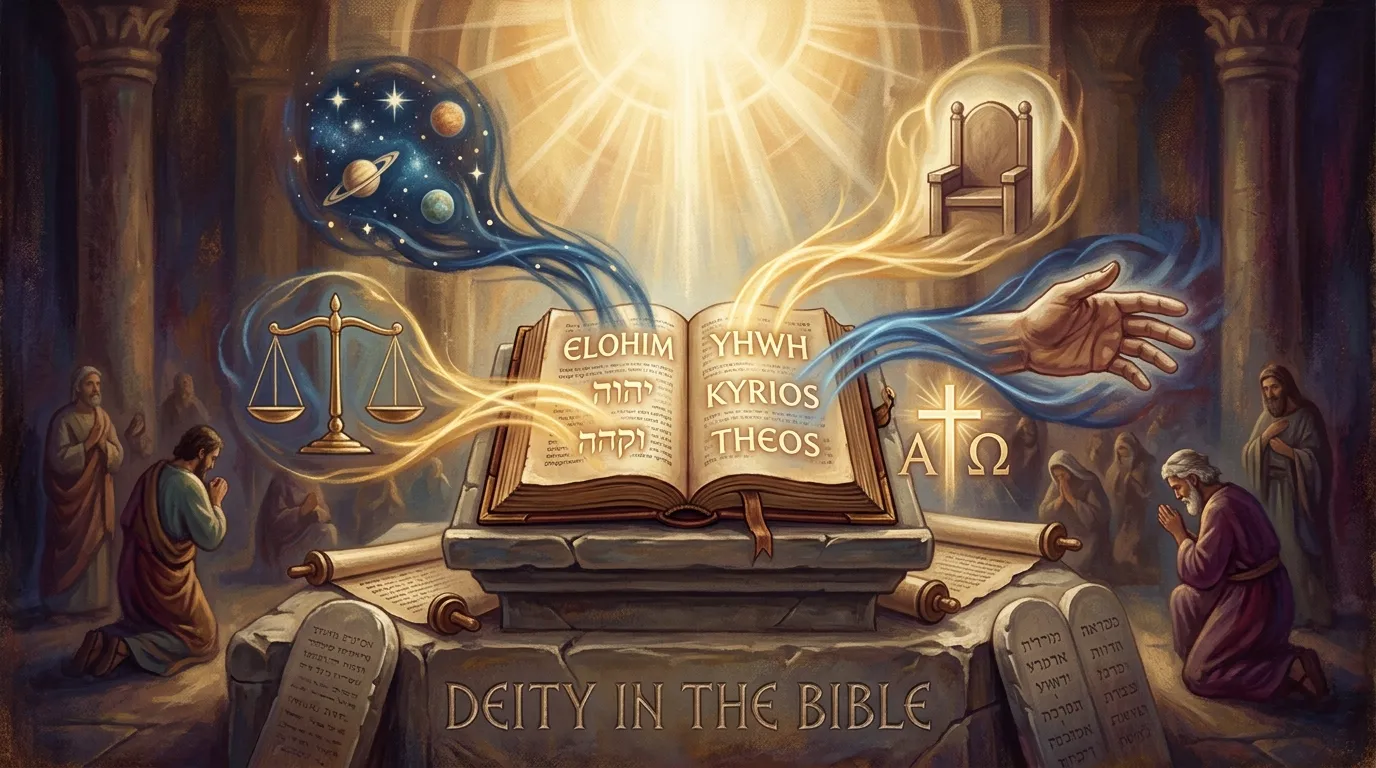
The word “deity” is a claim disguised as a noun. To call something a deity is not merely to describe it; it is to place it in a category — the category of ultimate things, of beings worthy of worship, of realities that answer to no higher court. Philosophers have spilled oceans of ink over what belongs in that category and what the word even means. The Bible enters that conversation not as one more philosophy but as a revelation: it does not argue that a deity might exist; it announces that the Deity has acted, spoken, and — most scandalously of all — become flesh.
Understanding the deity meaning in the Bible, then, requires two moves: first, grasping what the word claims in human thought, and second, seeing how Scripture fills, corrects, and finally explodes that word with the reality of the God of Abraham, Isaac, and Jacob.
What the Word “Deity” Is Claiming
In philosophy, “deity” (from the Latin deus, god) denotes a divine being — but the term smuggles in a set of assumptions worth examining. To speak of “deity” in the abstract is to treat godhood as a property that something might possess, like redness or weight. It invites the question: what qualifies? Power? Eternity? Worship-worthiness? The history of thought offers competing answers — Aristotle’s Unmoved Mover, perfect and self-contemplating but utterly uninvolved; the Stoics’ divine Reason pervading nature; the deists’ distant Clockmaker who winds the universe and withdraws.
Notice what all these have in common: they keep deity at arm’s length. The philosopher’s god is typically an explanation, not a person — the answer to a cosmological puzzle, the ground of being, the necessary first cause. Such a deity may be logically required, but it cannot be loved, cannot be prayed to, cannot forgive. It is a conclusion, not a companion.
The Bible’s response is not to deny the philosophers’ questions but to answer them with a Person. Yes, God is the Creator (Genesis 1:1), the eternal one (Psalm 90:2), the all-powerful (Jeremiah 32:17). Every true thing philosophy intuits about deity — transcendence, necessity, perfection — Scripture affirms. But then Scripture adds what philosophy could never deduce: this Deity speaks, chooses, loves, grieves, covenants, and bleeds. The God of the Bible is not less than the philosophers’ Absolute; He is infinitely more, because He is someone, not merely something.
Mars Hill: Paul Debates the Philosophers
The New Testament’s great collision between biblical deity and philosophical deity happens in Acts 17, when Paul stands before the Areopagus in Athens — the intellectual capital of the ancient world, crawling with Epicurean and Stoic philosophers. His sermon is a masterclass in engaging philosophy without surrendering revelation.
Paul begins where they are: “I see that in every way you are very religious. For as I walked around and looked carefully at your objects of worship, I even found an altar with this inscription: to an unknown god” (Acts 17:22-23). He does not mock their altar; he uses it. Their philosophy had reasoned its way to a divine reality beyond their idols — and Paul announces that this unknown God is known, and has a name, and has acted in history.
Then come the corrections, each one dismantling a philosophical assumption: “The God who made the world and everything in it is the Lord of heaven and earth and does not live in temples built by human hands” (Acts 17:24) — deity is not contained by our architecture. “He is not served by human hands, as if he needed anything” (Acts 17:25) — deity is not sustained by our sacrifices; we are sustained by Him, for “he himself gives everyone life and breath and everything else.” And the climax: “In him we live and move and have our being” (Acts 17:28) — quoting their own poets back to them, then driving to the scandal: God “has set a day when he will judge the world with justice by the man he has appointed. He has given proof of this to everyone by raising him from the dead” (Acts 17:31).
A philosophical deity does not appoint days. It does not raise men from the dead. It does not judge. Paul’s God does all three — and at the resurrection, some sneered, some wanted to hear more, and some believed (Acts 17:32-34). The abstract deity of the philosophers could never produce that reaction, because abstractions do not rise from tombs.
The God Who Is One — and the Scandal of the Trinity
The Bible’s doctrine of deity holds together two truths that philosophy finds nearly impossible to combine: absolute oneness and personal relationality. “Hear, O Israel: The Lord our God, the Lord is one” (Deuteronomy 6:4). No pantheon, no committee, no divine family feud like the gods of Olympus. One God, one will, one sovereign purpose.
And yet this one God is Father, Son, and Holy Spirit — distinct persons, one essence. Jesus prays to the Father (John 17), sends the Spirit (John 14:16-17), and receives worship as God (John 20:28; Hebrews 1:6). The Spirit searches the deep things of God (1 Corinthians 2:10) and can be grieved (Ephesians 4:30) — personal acts of a personal agent. The New Testament never resolves this into a formula; it simply reports it, the way one reports that water is both one substance and three states.
Why does this matter philosophically? Because it solves the ancient dilemma of the One and the Many. A solitary, undifferentiated deity — the pure Absolute of some philosophies — cannot love from eternity, because love requires an other. But the triune God is, from all eternity, a communion of love: “God is love” (1 John 4:8) is not a statement about God’s mood but about His nature. Love is not something God does; it is something God is — because deity, in the Bible, is eternally relational. No philosophy reached that conclusion. Only revelation could announce it.
“Divine Nature”: What Romans 1 Says Is Obvious
Paul makes a striking claim about what human beings can know of deity without Scripture: “For since the creation of the world God’s invisible qualities — his eternal power and divine nature — have been clearly seen, being understood from what has been made, so that people are without excuse” (Romans 1:20). The phrase “divine nature” (theiotes) is as close as the New Testament comes to the philosophical term “deity.”
Paul’s argument is that creation is a readable revelation of deity: its vastness speaks of power, its order of wisdom, its beauty of glory. Every human being, philosopher or farmer, has access to this testimony. The problem is not lack of evidence but suppression of it: “they… suppressed the truth by their wickedness” (Romans 1:18). Humanity’s perennial project is not discovering deity but redesigning it — “they exchanged the glory of the immortal God for images” (Romans 1:23), trading the true Deity for manageable substitutes.
This is why the Bible’s doctrine of deity always comes with a moral edge. Knowing God is not like knowing geometry; it is like meeting a King. The right response to deity is not analysis but worship — “Come, let us bow down in worship, let us kneel before the Lord our Maker” (Psalm 95:6). Philosophy that refuses to kneel has missed the point of its own subject.
The Deity Who Draws Near
Here, finally, is where the biblical meaning of deity leaves every philosophy behind. The philosophers’ gods — even the best of them — remain at a distance: contemplated, not encountered. But the God of the Bible comes. He walks in the garden (Genesis 3:8). He dwells in the tabernacle (Exodus 40:34-35). He is born in a stable (Luke 2:7). He weeps at a tomb (John 11:35). He bleeds on a cross (John 19:34).
“The Word became flesh and made his dwelling among us. We have seen his glory, the glory of the one and only Son, who came from the Father, full of grace and truth” (John 1:14). Made his dwelling — the Greek is eskenosen, literally “tabernacled.” The deity who once dwelt behind the veil has pitched His tent in the neighborhood. No philosophical system contains a category for this, because no philosopher would have dared to invent it.
So what does “deity” mean in the Bible? It means the one true God — eternal, all-powerful, perfectly holy, undivided in essence and eternally relational in person — who refused to remain an abstraction and instead entered His own creation to rescue it. The word “deity” claims ultimacy; the Bible answers that the Ultimate has a face, and His name is Jesus. If you want to see how humanity’s conceptions of deity have varied across religions and centuries, the Wikipedia article on deity maps the territory well; but the territory is not the destination. The destination is a Person — and He is not unknown, not distant, and not waiting for philosophy’s permission. He is waiting for your worship.










