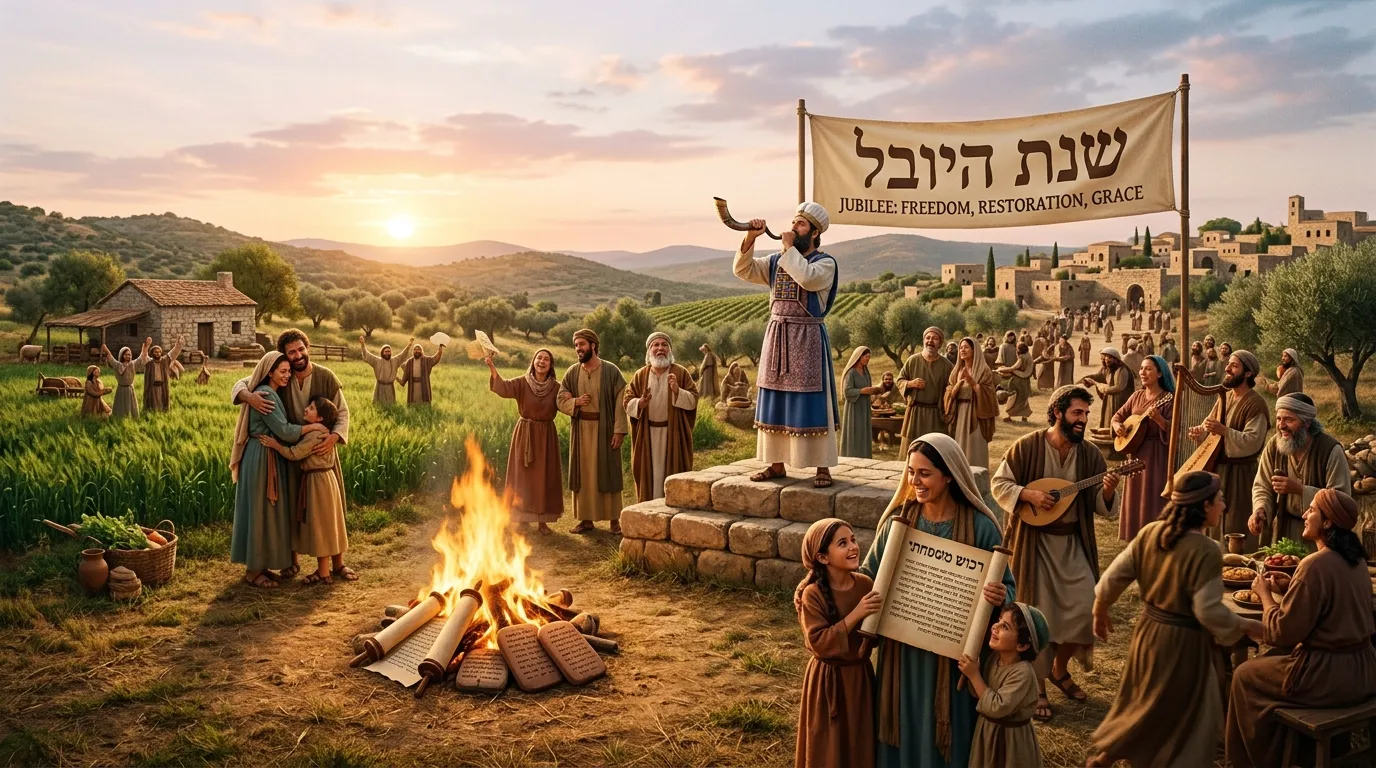
Listen. A ram’s horn sounds across the hills of ancient Israel, but this is not an ordinary trumpet call. This blast announces something Israel had waited fifty years to hear: every debt canceled, every slave freed, every family farm returned to its original owners. Imagine being the farmer who lost his land in a bad year, watching strangers harvest fields your grandfather planted. Imagine being the debtor working off a debt you could never repay. Then the trumpet sounds, and in a single day, everything resets. This was the Year of Jubilee, and it was one of the most radical institutions God ever gave His people.
“And you shall consecrate the fiftieth year, and proclaim liberty throughout the land to all its inhabitants. It shall be a jubilee for you, when each of you shall return to his property and each of you shall return to his clan” (Leviticus 25:10). Those words were inscribed on the Liberty Bell in Philadelphia centuries later, but they were first spoken to a nation of former slaves learning what freedom meant. Jubilee was God’s built-in safeguard against permanent inequality, permanent debt, and permanent despair.
How the Jubilee Worked
The mechanics are laid out in Leviticus 25. Israel counted seven cycles of seven years, forty-nine years, and the fiftieth year was the Jubilee. It began on the Day of Atonement with the trumpet blast, a detail rich with meaning: the year of release started on the day of forgiveness. Three great resets occurred.
First, land returned to its original family. In Israel, land was not truly bought and sold the way we think of real estate. What was sold was the number of harvests until the Jubilee. “The land shall not be sold in perpetuity, for the land is mine” (Leviticus 25:23). God retained ultimate ownership. Every family had an ancestral inheritance that could be temporarily lost but never permanently. No matter how badly a generation failed, their grandchildren would get the farm back.
Second, debts were effectively canceled and Hebrew slaves freed. An Israelite who fell into poverty could sell himself into service, but the Jubilee, like the seventh-year release in Deuteronomy 15, set a hard limit on bondage. No one could be trapped forever. The law even commanded generosity at release: the freed servant was not to be sent away empty-handed but supplied from the flock, the threshing floor, and the winepress (Deuteronomy 15:13-14). Freedom came with a stake, not just a door.
Third, the land itself rested. Like the weekly Sabbath and the seventh-year Sabbath, the Jubilee year meant no sowing or reaping, only eating what grew on its own. God promised to provide enough in the sixth year to carry His people through (Leviticus 25:20-22). Jubilee was a giant exercise in trust: stop striving, and watch God provide.
Why God Commanded It: Theology in Economics
Jubilee was never just economic policy. It was theology enacted in the marketplace. Every fifty years, Israel physically rehearsed three truths about God.
God owns everything. The land is Mine, God said. Human ownership is always stewardship, always temporary. Jubilee prevented the illusion of absolute ownership from hardening into idolatry. Every half century, the wealthiest landowners watched their accumulated holdings revert, a vivid reminder that they were tenants, not lords.
God hates permanent oppression. In the ancient world, debt slavery was a one-way door. Jubilee smashed it open. God had brought Israel out of Egypt “with a mighty hand” (Deuteronomy 5:15), and He would not tolerate His free people rebuilding Egypt’s economics among themselves. A society that never resets its debts eventually recreates slavery. God legislated against that outcome.
God loves fresh starts. Perhaps the deepest truth: no failure is final with God. The family that lost everything gets it back. The slave walks free. The land rests and renews. Jubilee is grace with a calendar date, the gospel preached through property law. It told every struggling Israelite that their story was not over, because God had scheduled their restoration in advance.
Did Israel Actually Keep It?
Honesty requires admitting what Scripture suggests: there is no clear record of Israel ever celebrating a Jubilee. The prophets never describe one. The historians never mention one. Some scholars believe it was observed in the early years and abandoned; others think it remained an unrealized ideal, a standing rebuke to a nation that preferred its inequalities.
If that is true, it makes the prophets’ message sharper. Isaiah condemned those who “join house to house, who add field to field, until there is no more room” (Isaiah 5:8), the exact opposite of Jubilee economics. Nehemiah confronted nobles who were enslaving their fellow Jews through debt, demanding they restore what they had taken (Nehemiah 5:1-13). The Jubilee law stood as God’s unmet expectation, proof that knowing God’s will and doing it are different things. An ignored Jubilee is its own kind of judgment.
Jesus Announces the Ultimate Jubilee
Centuries later, in a synagogue in Nazareth, Jesus stood up, opened the scroll of Isaiah, and read: “The Spirit of the Lord is upon me, because he has anointed me to proclaim good news to the poor… to proclaim liberty to the captives… to proclaim the year of the Lord’s favor” (Luke 4:18-19). Then He sat down and said, “Today this Scripture has been fulfilled in your hearing” (Luke 4:21).
The phrase “the year of the Lord’s favor” is Jubilee language, drawn from Isaiah 61, which itself echoes Leviticus 25. Jesus was announcing that the ultimate Jubilee had arrived, not a year but an era, not the release of land but the release of souls. The debts He canceled were not financial but moral, the record of sin nailed to the cross (Colossians 2:14). The captives He freed were not debt-slaves but those bound by sin and death (John 8:34-36). The inheritance He restored was not farmland but sonship itself: “you have received the Spirit of adoption as sons” (Romans 8:15).
This is why the early church instinctively practiced Jubilee economics. Believers sold possessions and distributed to those in need, so that “there was not a needy person among them” (Acts 4:34). They did not legislate a fiftieth year. They lived the Jubilee spirit every day, because the trumpet had sounded in Christ and the release was permanent.
Living the Jubilee Today
Christians are not under the Levitical calendar, but the Jubilee’s principles still shape faithful living. Forgive debts of the heart. If God canceled your unpayable moral debt, the grudges you hold against others are small change. Release them. Practice generosity that restores. Jubilee generosity did not just relieve; it reestablished, giving freed servants a stake for a new start. Give in ways that restore dignity, not just relieve symptoms. Rest deliberately. The Sabbath principle inside Jubilee calls believers to stop striving periodically and trust God’s provision, a countercultural act in an age of endless hustle.
And proclaim liberty. The church’s mission is Jubilee proclamation: telling captives they can go free, telling the crushed they can start over, telling the weary that rest is real. Every baptism is a small Jubilee. Every confession is a trumpet blast. Every act of forgiveness is a fiftieth year.
Jubilee Echoes in the Prophets
Though Israel may never have celebrated a Jubilee, the prophets kept its music alive. Isaiah 61 is the great Jubilee passage, and it reads like Leviticus 25 set to poetry: “The Spirit of the Lord God is upon me, because the Lord has anointed me to bring good news to the poor; he has sent me to bind up the brokenhearted, to proclaim liberty to the captives, and the opening of the prison to those who are bound; to proclaim the year of the Lord’s favor” (Isaiah 61:1-2). Good news to the poor: debts canceled. Liberty to captives: slaves freed. The year of the Lord’s favor: Jubilee itself, now envisioned as an era rather than a year.
Ezekiel added a striking detail: in the restored land, the prince’s gifts of land would revert in the year of liberty, “the year of jubilee” explicitly named (Ezekiel 46:17). Even in visions of the future, God’s reset button remained part of the design. The prophets would not let Israel forget what they had neglected. The Jubilee stood as both rebuke and promise: you did not keep it, but God will keep it for you, in a greater form than you imagined.
This prophetic thread is exactly what Jesus picked up in Nazareth. When He read Isaiah 61 and declared it fulfilled, He was claiming to be the Jubilee in person. The trumpet had become a man. The fiftieth year had become a lifetime. And the release He announced would outlast every calendar, because the debt He canceled was the one no Jubilee of land could touch.
The ram’s horn has sounded, and it is still sounding. Debts canceled, slaves freed, land restored, and behind it all, a God who schedules restoration the way other kings schedule taxes. For more on the historical and cultural background of this remarkable institution, the Wikipedia article on the biblical Jubilee offers a solid overview, but the living reality is better: in Christ, every day can be the year of the Lord’s favor.