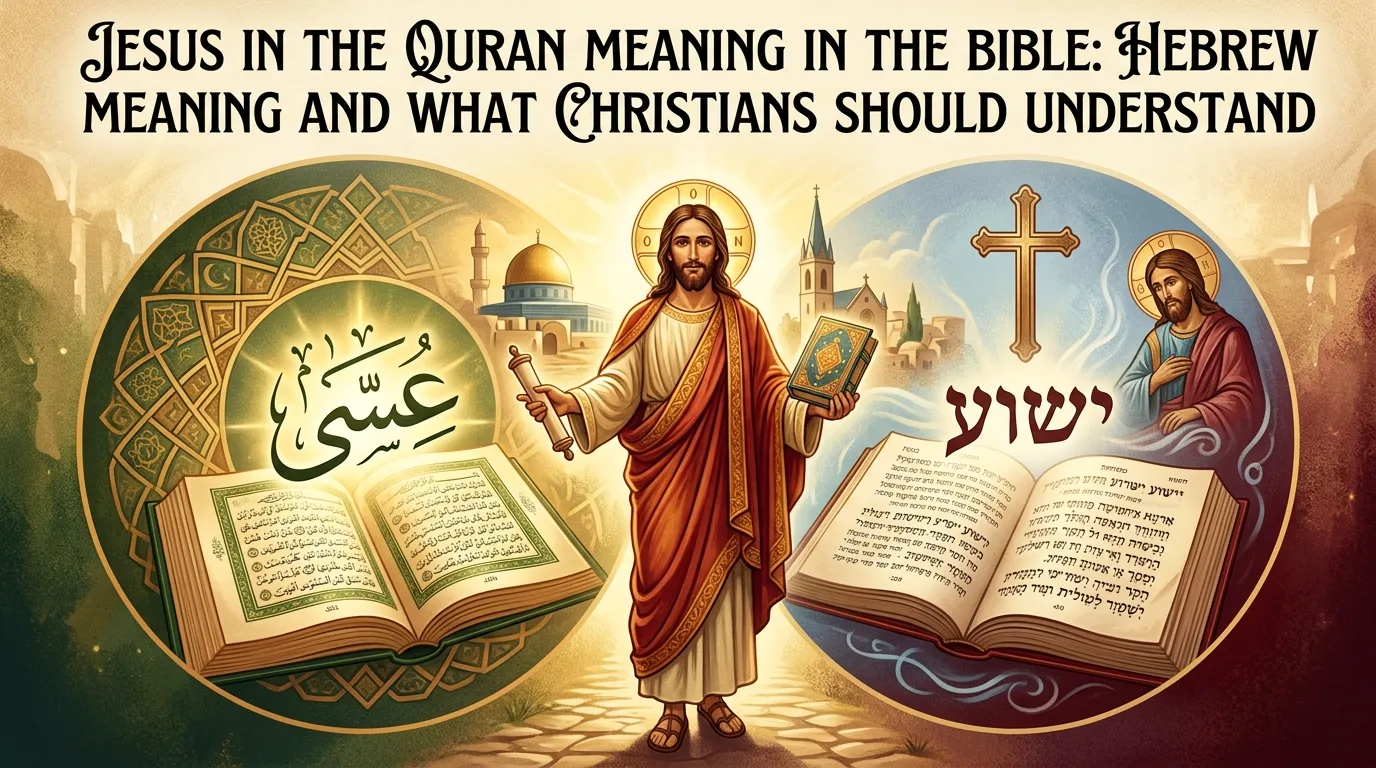
Jesus appears in the Quran more than any other person except Abraham — by name, with honor, and with titles that Christians will recognize. He is called Isa, son of Mary. He is called the Messiah. He is said to have been born of a virgin, to have performed miracles, and to have been taken up to God. And yet the Quran’s portrait of Jesus differs from the New Testament’s at the very points Christians consider most essential: His divinity, His death on the cross, and His resurrection.
Understanding both portraits — what they share and where they diverge — is essential for any Christian who wants to talk with Muslim neighbors with knowledge and respect. The goal is not to win an argument. It is to understand what each Scripture actually teaches, so that the conversation can be honest rather than confused.
What the Quran Says About Jesus
The Quran speaks of Jesus, called Isa ibn Maryam (Jesus, son of Mary), in several passages, most notably in Surahs 3, 4, 5, and 19. The portrait is reverent. Jesus is a prophet and messenger of God. He is the Messiah (al-Masih). He was born to the virgin Mary by God’s command — the Quran affirms the virgin birth explicitly. He performed miracles: healing the blind and the leper, and raising the dead, “by God’s permission.” He was given the Gospel (Injil) as revelation. He was taken up to God, and Muslims believe He will return before the end of time.
At the same time, the Quran denies three teachings that are central to the New Testament. It denies that Jesus is the Son of God in a divine sense, affirming instead that God “does not beget, nor is He begotten.” It denies that Jesus died on the cross, stating that “they did not kill him, nor did they crucify him, but it was made to appear so to them” (Surah 4:157). And it denies the Trinity, warning against saying “three.” From the Quran’s perspective, Jesus is a great prophet, but He is not divine, and He was not crucified.
These are not minor differences of emphasis. They are fundamental disagreements about who Jesus is and what He did. A Christian and a Muslim can both honor Jesus, but they honor Him in different ways, for different reasons, with different consequences.
What the Bible Says About Jesus
The New Testament presents Jesus as far more than a prophet. John’s Gospel opens with the claim that “the Word was God” and “the Word became flesh and dwelt among us” (John 1:1, 14). Jesus calls God His Father in a unique sense, forgives sins, receives worship, claims to have existed before Abraham, and declares, “I and the Father are one” (John 10:30). At His baptism, a voice from heaven says, “This is my beloved Son” (Matthew 3:17). The angel tells Joseph to name the child Jesus, “for he will save his people from their sins” (Matthew 1:21).
The New Testament also insists on the crucifixion and resurrection as the center of the gospel. Paul summarizes it: “Christ died for our sins in accordance with the Scriptures, that he was buried, that he was raised on the third day in accordance with the Scriptures” (1 Corinthians 15:3–4). The death is not an accident or an appearance. It is the atonement — the Son of God bearing the judgment for human sin. The resurrection is not a metaphor. It is the historical event on which the entire Christian faith stands: “If Christ has not been raised, then our preaching is in vain and your faith is in vain” (1 Corinthians 15:14).
These claims are why Christians cannot simply merge the two portraits. The Bible’s Jesus is the Son of God, the Savior, the Lamb of God, the risen Lord, and the only way to the Father (John 14:6). To accept the Quran’s portrait as complete would require setting aside the New Testament’s central claims. To accept the New Testament’s portrait as complete requires respectfully disagreeing with the Quran’s.
Where the Two Portraits Agree — and Why It Matters
The areas of agreement are real and worth naming. Both Scriptures affirm the virgin birth. Both affirm that Jesus performed miracles by God’s power. Both call Him the Messiah. Both affirm that He was taken up to God and will return. Both honor Mary. These shared affirmations are a genuine basis for respectful conversation. A Christian talking with a Muslim does not need to start from zero. He can start from the shared ground: we both believe Jesus was born of a virgin, did miracles, and is the Messiah.
But shared ground is not the same as shared faith. The agreements are about the edges of the portrait; the disagreements are about the center. The question is not whether Jesus was a prophet — Christians agree He was a prophet. The question is whether He was only a prophet. The New Testament’s answer is no. And that answer is the reason Christians worship Jesus rather than merely admiring Him.
How Christians Should Respond
First, with accuracy. A Christian should know what the Quran actually says about Jesus, not a caricature of it. Misrepresenting another faith’s teaching is neither honest nor persuasive. Read the passages. Understand the Muslim position. Then present the biblical position clearly and without hostility.
Second, with respect. Muslims revere Jesus, and a Christian should never mock that reverence. The tone of the conversation should reflect the reality that both sides are talking about a figure they hold sacred. Peter’s instruction applies: defend the faith “with gentleness and respect” (1 Peter 3:15). A Christian who wins an argument by insulting the other person’s prophet has lost something more important than the argument.
Third, with confidence in Scripture. The Christian’s authority is the Bible. The New Testament was written by eyewitnesses or their close associates, within a generation of the events, and it has been transmitted with remarkable fidelity. The Christian can invite a Muslim friend to read the Gospels for himself — to meet Jesus in the text, to hear His claims, to weigh His death and resurrection. The most persuasive argument for the biblical Jesus is the biblical Jesus, encountered in the Gospels.
Fourth, with prayer and patience. Religious identity runs deep. A person does not change it because of one conversation. The Christian’s job is to witness faithfully, answer honestly, and leave the outcome to God. The same Spirit who drew the first disciples draws people today, from every background, to the Son of God.
The Question That Remains
Reading the Gospels for Yourself
The most productive step in any conversation about Jesus is to go to the sources. For the Christian, that means the four Gospels — Matthew, Mark, Luke, and John — written by eyewitnesses or their close associates within a generation of the events. For the Muslim, it means the Quran’s passages on Isa, read in context. A Christian who has never read the Quran’s Jesus passages will struggle to understand his Muslim friend’s perspective. A Muslim who has never read the Gospels will struggle to understand the Christian’s. Honest conversation requires both sides to have read the other’s book.
The Gospels invite investigation. Luke opens by saying he wrote “an orderly account” based on eyewitness testimony, so that his reader “may have certainty” (Luke 1:3–4). John closes by saying his Gospel was written “so that you may believe that Jesus is the Christ, the Son of God, and that by believing you may have life in his name” (John 20:31). The invitation is open: read, weigh, and decide. The Christian’s confidence is that the Gospels, read honestly, present a Jesus who cannot be reduced to a mere prophet — a Jesus whose claims, miracles, death, and resurrection demand a verdict. The verdict is the most important decision any person will ever make.
One more point of honesty serves both sides. Christians and Muslims disagree about Jesus, and no amount of goodwill can erase the disagreement. But disagreement does not require hostility. The New Testament commands Christians to love their neighbors, to pray for those who disagree with them, and to speak the truth in love. The history of Christian-Muslim relations includes dark chapters of crusade, conquest, and contempt — chapters Christians should name and repent of, not defend. The way forward is not to pretend the differences are small. It is to acknowledge them honestly, to defend the faith graciously, and to love the neighbor fully. The Jesus Christians worship taught them to love their enemies. Surely they can love their neighbors who honor Him as a prophet, even while praying that they will come to know Him as Savior and Lord.
In the end, the question the Quran and the Bible both force is the same question Jesus asked His own disciples: “Who do you say that I am?” (Matthew 16:15). Peter’s answer — “You are the Christ, the Son of the living God” — is the Christian confession, and it is the claim on which everything stands. The Quran offers a different answer. The Bible offers this one. Christians believe the Bible’s answer is true, not because it is comfortable, but because it is the testimony of the apostles, confirmed by the resurrection, and sealed by the Spirit. That is the Jesus the Bible presents: not merely a prophet, but the Savior of the world. For a detailed comparison of the two traditions’ teachings, see the article on Jesus in Islam and its relationship to the Christian portrait.










