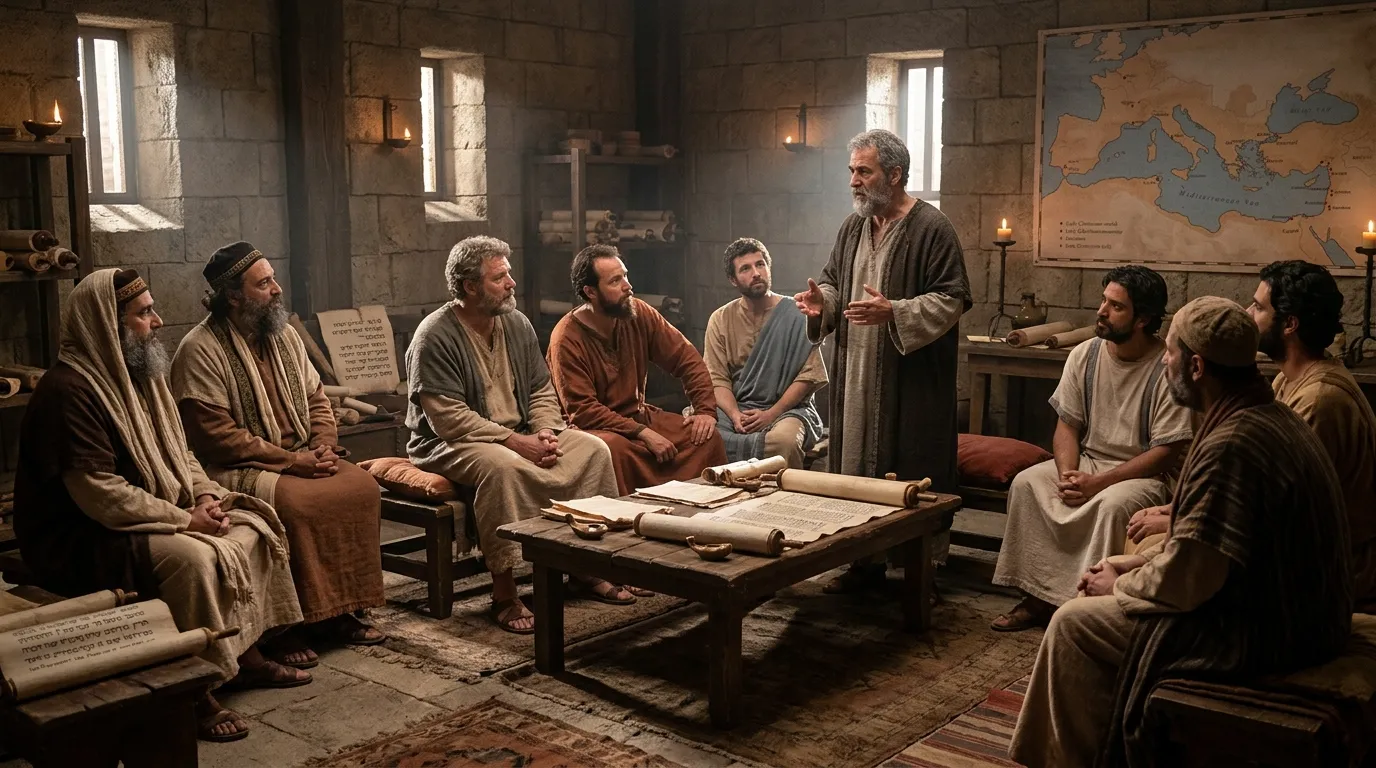
The meeting began with a fight, and it ended with a letter. In between, the early church answered the most important question it would ever face: do people have to become Jews to become Christians? The gathering in Jerusalem, recorded in Acts 15, is often called the Jerusalem Council or Conference. It was the church’s first great crisis, its first great debate, and its first great decision — and the way it was handled set the pattern for every church dispute since.
The stakes could not have been higher. If the church had decided wrongly, Christianity would have become a sect of Judaism, the gospel would have been buried under the law, and the mission to the nations would have died in its cradle. The decision the leaders reached — that salvation is by grace through faith, without the requirement of circumcision — is the reason the church exists in every nation today.
The Dispute: A Question That Could Not Be Ignored
The trouble started in Antioch, the church that had become the base for Paul and Barnabas’s mission to the Gentiles. “Some men came down from Judea and were teaching the brothers, ‘Unless you are circumcised according to the custom of Moses, you cannot be saved'” (Acts 15:1). The claim was not about a minor ritual. It was about the gospel itself. If circumcision was required for salvation, then Christ’s work was not sufficient. Grace would become grace-plus-law. And the Gentiles who had believed would be told that their faith was not enough.
Paul and Barnabas “had no small dissension and debate with them.” The Greek suggests a fierce, prolonged argument. The church did not suppress the disagreement. It did not split over it. It did not let the loudest voices win. It sent the question to Jerusalem, to the apostles and elders, for a decision. That instinct — to take a hard question to the gathered leaders, in the light of Scripture and testimony — is the first lesson of the council.
Notice what the church did not do. It did not decide by popular vote. It did not decide by seniority. It did not decide by whoever argued longest. It decided by listening to evidence: the testimony of what God had done, and the teaching of what God had said. Truth was not determined by politics. It was discerned by the community under Scripture.
The Testimonies: Three Witnesses
When the council met, three testimonies shaped the outcome. The first was Peter’s. He reminded the assembly of Cornelius, the Gentile centurion to whom God had given the Holy Spirit without circumcision. “God, who knows the heart, bore witness to them, by giving them the Holy Spirit just as he did to us, and he made no distinction between us and them, having cleansed their hearts by faith” (Acts 15:8–9). Peter’s argument was devastating: if God had accepted the Gentiles without circumcision, who were they to demand it?
Peter added the theological heart of the matter: “We believe that we will be saved through the grace of the Lord Jesus, just as they will” (Acts 15:11). Jews and Gentiles are saved the same way — by grace, through faith. The law does not save anyone. It never did. It was a tutor, a guardian, a pointer to Christ. To require it for salvation is to misunderstand both the law and the gospel.
The second testimony was Paul and Barnabas’s. They described “the signs and wonders God had done through them among the Gentiles” (Acts 15:12). The mission itself was evidence. God had been at work among the uncircumcised, healing, converting, and building churches. To demand circumcision after the fact would be to deny what God had already done.
The third testimony was James’s, and it was the scriptural anchor. James quoted the prophet Amos: “After this I will return, and I will rebuild the tent of David that has fallen” — and connected it to the inclusion of the Gentiles, “that the remnant of mankind may seek the Lord” (Acts 15:16–17). The inclusion of the nations was not a new idea. It was the fulfillment of prophecy. The Old Testament had always anticipated it.
The Letter: Freedom With Responsibility
The council’s decision was unanimous, and it was communicated in a letter carried by Paul, Barnabas, Judas, and Silas to Antioch. The letter is a model of pastoral wisdom. It affirms the gospel — no circumcision required, salvation by grace — and then it asks the Gentile believers to abstain from four things: food sacrificed to idols, blood, meat from strangled animals, and sexual immorality (Acts 15:29).
Why those four? They were the practices most likely to destroy fellowship between Jewish and Gentile believers — the table practices and moral standards that would make shared meals and shared worship impossible. The council was not adding requirements for salvation. It was asking the Gentiles to exercise love: to give up certain freedoms for the sake of unity with their Jewish brothers and sisters. Freedom in Christ is real, but it is not the freedom to trample on your brother’s conscience.
The letter’s tone is as instructive as its content. It begins, “It has seemed good to the Holy Spirit and to us” (Acts 15:28). The leaders claimed the Spirit’s guidance without claiming infallibility — and they wrote with gentleness, not triumphalism. The losing side was not humiliated. The decision was framed as a shared discernment, not a power play. When the letter arrived in Antioch, “they rejoiced because of its encouragement” (Acts 15:31). A good decision, communicated well, produces joy. A good decision, communicated arrogantly, produces resentment.
The Precedent: How the Church Handles Disagreement
The Jerusalem Conference set a pattern that has guided the church ever since. First, take disputes seriously. The church did not wave the question away. It gathered, debated, and decided. Second, let Scripture have the final word. Testimony and experience mattered, but the decision was anchored in the prophets. Third, protect the gospel. The council refused to add anything to grace. Fourth, protect unity. The council asked both sides to give something: the Judaizers gave up their requirement, and the Gentiles gave up certain freedoms. Fifth, communicate clearly and kindly. The letter was the decision; the delivery was the pastoral care.
The council also shows that disagreement among believers is not a sign of failure. The apostles disagreed. Paul and Barnabas argued with the Judaizers. Peter and Paul would later clash over table fellowship (Galatians 2). The church has never been a community without conflict. It is a community that handles conflict by returning to the gospel, listening to Scripture, and choosing unity over victory.
That pattern is still needed. Churches today face questions the apostles never imagined, and the temptation is to settle them by culture-war tactics: by shouting, by splitting, by labeling, by leaving. The Jerusalem way is slower and harder: gather, listen, weigh Scripture, decide, and write the letter with grace. The church that learns that way will survive its disputes. The church that does not will split over every question, and each split will be smaller and angrier than the last.
The Ripple: What the Decision Unleashed
The Jerusalem decision did not merely settle a dispute. It unleashed the mission. With the question of circumcision answered, Paul’s missionary journeys could proceed without the constant threat of Judaizing teachers undoing his work. The gospel spread to Cyprus, Galatia, Macedonia, Achaia, and Rome — and eventually to every nation on earth. The letter from Jerusalem traveled with Paul, and wherever it was read, Gentile believers rejoiced. The decision made in one room in Jerusalem became the charter of the global church.
The decision also shaped Christian theology for all time. Paul’s letters — especially Romans and Galatians — are extended defenses of the Jerusalem principle: salvation by grace through faith, apart from works of the law. The doctrine of justification, the relationship between law and gospel, the inclusion of the Gentiles — all of it flows from Acts 15. The council was not a footnote. It was the hinge on which the history of the church turned. And its lesson endures: whenever the church is tempted to add requirements to grace, it must return to Jerusalem and remember the decision.
There is a quiet footnote to the council that deserves remembering: the men who disagreed most fiercely stayed in the same church. Paul and the Judaizers did not become best friends. Peter and Paul would clash again. James and Paul saw the law differently. But they remained brothers, bound by a gospel bigger than their disagreements. The Jerusalem Conference did not produce unanimity of opinion on every question. It produced unity around the gospel and charity in everything else. That is the church’s calling in every age: to hold the center fiercely, to love across differences generously, and to remember that the grace that saved us is the grace that must govern us.
The conference ended with a letter, a journey, and a rejoicing church. The gospel went forward, unburdened by the law, and the nations streamed in. The decision made in that room in Jerusalem is the reason the church is not a Jewish sect but a global family — and the reason every believer, in every nation, can say: I am saved by grace, through faith, in Christ alone. For the history and significance of this gathering, see the article on the Council of Jerusalem and its place in early Christianity.










