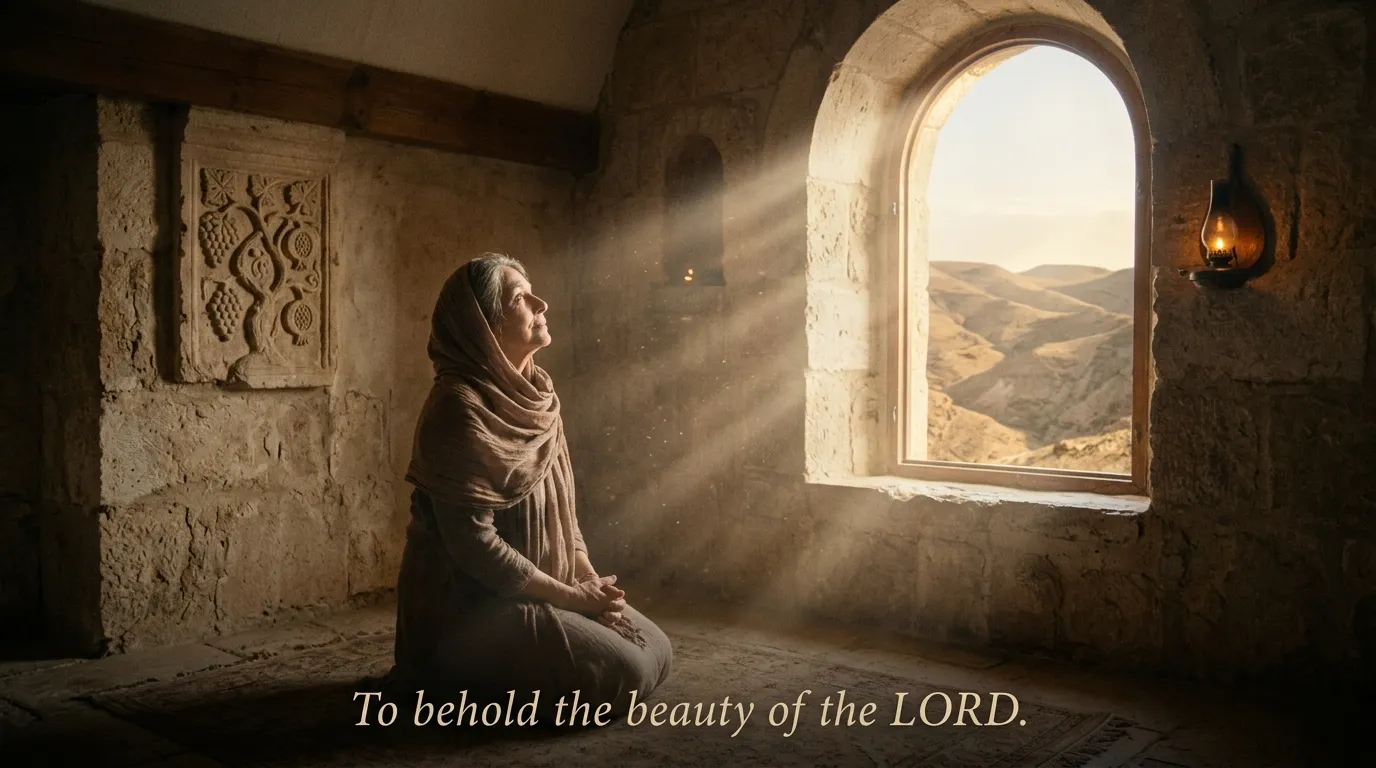
David had been a shepherd, a fugitive, a warrior, and a king. He had asked God for many things across a dramatic life — deliverance from Saul, victory over Philistines, forgiveness after Bathsheba. But when he distilled his heart’s deepest desire into a single sentence, it was not for safety, success, or even pardon. It was this: “One thing have I asked of the LORD, that will I seek after: that I may dwell in the house of the LORD all the days of my life, to gaze upon the beauty of the LORD and to inquire in his temple” (Psalm 27:4).
The beauty of the LORD. The phrase stops us, because we are not used to thinking of God as beautiful. Powerful, yes. Holy, yes. Loving, yes. But beautiful — the word we use for sunsets and symphonies — applied to God Himself? Yet Scripture does it repeatedly, and the more closely you look, the more you realize that God’s beauty is not one attribute among many but the radiance of all of them together — the glory of His character made, in some sense, visible to the worshiping heart. To seek the beauty of the LORD is to seek God not for His gifts but for Himself, not for what He gives but for what He is. It is the purest form of worship there is.
What David Meant: Beauty as the Whole of God
The Hebrew word David uses is no’am — pleasantness, delightfulness, loveliness. It is the word for something that draws the heart the way beauty draws the eye. When David asks to gaze on the LORD’s no’am, he is not asking to see a physical form — God is spirit (John 4:24), and no one has seen Him (John 1:18). He is asking for the perception of God’s perfections: to have his spiritual sight so opened that the holiness, mercy, faithfulness, and love of God strike him the way a masterpiece strikes the viewer — with delight, wonder, and longing.
This helps us understand what “the beauty of the LORD” actually is. It is not God’s appearance but God’s attractiveness — the sum of His perfections experienced as desirable. Jonathan Edwards, the theologian who thought most deeply about this, described divine beauty as the harmony of God’s attributes: His justice is beautiful, His mercy is beautiful, and the combination — justice and mercy embracing in the cross — is the most beautiful thing in existence. To gaze on the beauty of the LORD is to contemplate God until the heart says, of Him, what the bride says in the Song: “he is altogether desirable” (Song of Solomon 5:16).
Notice David’s two verbs: to gaze and to inquire — beholding and learning, wonder and study, the heart and the mind together. Gazing without inquiring becomes sentimentality; inquiring without gazing becomes mere theology. David wants both: to see the beauty and to understand it, to be ravished and to be instructed. That double posture is the Bible’s picture of mature worship.
Worship in the Splendor of Holiness
The Psalms repeatedly connect God’s beauty with the act of worship: “Worship the LORD in the splendor of holiness” (Psalm 96:9; 1 Chronicles 16:29). The phrase is usually translated “the beauty of holiness” — and it is worth pausing on, because it locates God’s beauty precisely: in His holiness. We tend to think of holiness as God’s separateness, His moral distance from sin. But Scripture presents holiness as radiant — the seraphim do not merely declare God holy, they cry it in a way that shakes the temple’s foundations (Isaiah 6:3-4). Holiness, beheld, is beautiful. It is the beauty of absolute purity, of love without shadow, of power without cruelty.
This is why beauty-belongs at the center of worship, not at its edges. Worship is not God’s people telling God how great He is as a duty; it is God’s people seeing how beautiful He is and responding. The most dramatic demonstration comes from Jehoshaphat: facing an invading coalition he could not defeat, he sent singers ahead of the army — “Give thanks to the LORD, for his steadfast love endures forever” — and the enemy armies destroyed each other (2 Chronicles 20:21-22). Worshiping God’s beauty was not the celebration after the victory; it was the weapon of the victory. When God’s people gaze on who He is, the battle shifts.
The temple itself was designed as a school for this gaze. Its gold, its carved cherubim, its woven colors — all of it was beauty in service of Beauty, the loveliness of the house training the heart to perceive the loveliness of the Householder. That is why David longed to dwell in the house of the LORD: not for the architecture, but for what the architecture taught — sustained, unhurried beholding of the Beautiful One.
Moses Asked, and God Passed By
The boldest request for God’s beauty in Scripture comes from Moses: “Please show me your glory” (Exodus 33:18). Glory (kabod) and beauty (no’am) are close kin — both speak of God’s weighty, radiant presence. And God’s answer is one of the most tender passages in the Bible. He cannot show Moses His face — “man shall not see me and live” (Exodus 33:20) — but He will make all His goodness pass before him and proclaim His name: “The LORD, the LORD, a God merciful and gracious, slow to anger, and abounding in steadfast love and faithfulness” (Exodus 34:6-7).
Consider what this means: when Moses asked to see God’s glory, God showed him God’s character. The beauty of the LORD is not a light show; it is who God is — merciful, gracious, faithful, just. The proclamation that follows includes both mercy (“forgiving iniquity and transgression and sin”) and justice (“who will by no means clear the guilty”). God’s beauty holds together what we keep pulling apart: the tenderness that forgives and the holiness that judges, the love that welcomes and the purity that cannot tolerate evil. Beholding that combination is what made Moses’ own face shine afterward (Exodus 34:29-35) — he had gazed on Beauty, and it left its mark on him.
Isaiah caught the same vision from a different angle: “Your eyes will behold the king in his beauty” (Isaiah 33:17) — a promise to the faithful remnant that the true King, in all His loveliness, would one day be seen. The verse looks forward, past every earthly monarch, to the one King whose beauty needs no crown to be evident.
The King in His Beauty: Christ
All of this converges on Jesus. If the beauty of the LORD is the radiance of God’s perfections, then the incarnation is that radiance made visible — “the Word became flesh… and we have seen his glory, glory as of the only Son from the Father, full of grace and truth” (John 1:14). On the Mount of Transfiguration, three disciples got a glimpse: “his face shone like the sun, and his clothes became white as light” (Matthew 17:2). In Revelation, the risen Christ appears with “eyes like a flame of fire” and a face “like the sun shining in full strength” (Revelation 1:14, 16) — and John’s response is to fall as though dead, then to worship.
But here is the paradox the Gospels will not let us miss: the most beautiful Person who ever lived was, by Isaiah’s account, not physically impressive — “he had no form or majesty that we should look at him, and no beauty that we should desire him” (Isaiah 53:2). The beauty of the LORD, even incarnate, is not skin-deep. It shone in His compassion for lepers, His welcome of children, His tears at Lazarus’s tomb, His forgiveness from the cross. The crowds who called Him beautiful were not admiring His features; they were seeing Him — perceiving the no’am of God in a Galilean carpenter. And that is exactly David’s prayer, answered: to gaze on the beauty of the LORD, now with a human face.
Beholding Changes the Beholder
Scripture’s final word on God’s beauty is that gazing transforms. “We all, with unveiled face, beholding the glory of the Lord, are being transformed into the same image from one degree of glory to another” (2 Corinthians 3:18). The mechanism is beholding: we become like what we worship. The psalmist knew it — “Those who look to him are radiant, and their faces shall never be ashamed” (Psalm 34:5). Moses’ shining face was the prototype. John’s vision is the promise: “we shall see him as he is” — and “everyone who thus hopes in him purifies himself as he is pure” (1 John 3:2-3).
This is why David’s “one thing” is the wisest prayer in the Psalter. Everything else we seek from God — help, guidance, provision, protection — is a means; gazing on His beauty is the end. And the end has a way of supplying the means: the heart ravished by God’s beauty finds it easier to trust His wisdom, obey His commands, and rest in His love. Worship is not the warm-up for the Christian life. It is the Christian life, seen from the inside.
So make David’s prayer your own, in your own words: one thing I ask — to see You as You are. Open the Gospels slowly. Linger in the Psalms. Come to worship expecting a vision, not just a service. The beauty of the LORD is not hiding; He has been revealing it since Moses asked, since David sang, since the Word became flesh. “Blessed are the pure in heart, for they shall see God” (Matthew 5:8) — and seeing Him, they will never want to look away.
David’s prayer itself — the twenty-seventh psalm, with its famous longing to gaze on divine beauty — is examined verse by verse on Wikipedia’s page on Psalm 27, a good companion for readers who want to linger in the text.










